Wednesday, May 9, 2012

Audio Shiur: Parshat Behar - How Much is Enough?

Audio Shiur:
Parshat Behar - How Much is Enough?

The challenge for many of us today isn't a lack of means; rather, we have too much - or at least we think that we need more than we do. By studying the mitzvah of Shemittah (and the Ramban and Kli Yakkar), we can raise our sense of awareness about the mitzvah, and its spiritual ramifications, even to those of us who don't own land in Israel.

Click here to download the shiur, or here to navigate to the shiur on YUTorah.org.


Now you can subscribe to this shiur as a podcast, directly from iTunes! To subscribe, click here.

Are we One Movement Anymore? The Problem and Challenge of Religious Zionism

by Rabbi Reuven Spolter, Director of Student Recruitment

Following the (recently cancelled) announcement of early elections here in Israel, the Religious Zionist movement found itself in a familiar position: unprepared. After years of leadership in the Knesset, the religious Zionist movement splintered over ideological grounds into two generally distinct groups which then aligned themselves into distinct political parties. Habayit Hayehudi places its emphasis on religious Zionist activity throughout Israel while stressing the importance of involvement within greater Israeli society. On the other hand, the Ichud Haleumi (sadly, they haven't really updated their website in three years! If you'd really like to see just how sad the split it, see here.) finds itself more attuned to rabbinic instruction and direction, and places a far greater emphasis on settlement of the Land of Israel over other values.
While the split reflects genuine differences in a very diverse community, it also has significantly weakened the Religious Zionist community's influence and political clout. Instead of one political party with eight Knesset seats (and the power, influence and financial wherewithal that brings), the greater movement founds itself with two parties of four seats each, one of which found itself a member of the majority in the soon-defunct government (with the "important" portfolio of Science and Technology – and yes, I am being sarcastic when I say “important”) while the other remained in the opposition, left with little to no political power at all. The split truly cost us all. The question we must contemplate is: Can we find a way to reunite? Can we restore the power that we should have (and badly need), or, due to our unwillingness to find common ground, will we continue to diminish our influence and thereby fail to properly influence broader Israeli society?
Orot's Amadot Conference Schedule
At Orot’s recent Amadot Conference, Rabbi Yuval Sherlo, Rosh Yeshiva of the Yeshivat Hesder Petach Tikvah participated in a panel that addressed this vexing question: Are we one movement? And, more importantly, can we remain a united force, or have we become so divided that we can no longer operate as a single unit.
Rav Sherlo made a number of fascinating points that I’d like to share.
Legitimacy: One of the critical measures of whether groups have split irreversibly is how they relate to each other. Put another way, do they relate to one another as legitimate? That is the difference between machloket – dispute – and division. As long as both groups legitimize each other, they can remain united. Yet, if one group refuses to acknowledge that the position of the other might be wrong – but still remains legitimate, and instead insists that the position of the other is not legitimate, then they have lost any sense of common ground, and rupture is inevitable.
Marriage: Do groups within the framework marry each other? Rav Sherlo pointed out that the Mishnah (Yevamot 1:4) emphasizes that despite all of the great disputes between Beit Shammai and Beit Hillel, לא נמנעו מלישא זה עם זה – “they did not refrain from marrying with each other.” Can we same the same about different Religious Zionist groups today? He explained that he teaches at Migdal Oz (a rather left-wing women’s seminary), and he has yet to witness a wedding between a Migdal Oz girl and a yeshiva student from Har Hamor (a very right-wing yeshiva). This is a matter for concern. To what degree have we split ideologically so far, that little, if any interaction remains between the two groups that fall under the broad umbrella of Religious Zionism?
Language: The language of ideology doesn’t lend itself to compromise. Ideology articulates a specific vision, a worldview which represents idealism in its purest sense. It speaks to the world which we would create – if only we had the power to actualize our dreams. Platforms of ideology don’t often include words like love, compromise, mutual respect and the like. Imagine a marriage based solely on ideology, where words like those didn’t exist. How long would such a marriage last? Not long.
Rav Sherlo noted that we also suffer from two mutually exclusive beliefs. We believe that the world not only wants what we have to offer, but is waiting for us to save it. We have the truth – the combination of Torah and real life; of Religiosity and Zionism, of spirituality and worldliness – that provides the proper path for the Jewish Nation. Yet, at the very same time we also believe that the same world hates us: the secular press can’t stand us; the European Union is trying to topple us; the Israeli Supreme Court can’t stand us; the Chareidim attack us at every turn.
So which do we really believe? Does the world look to us to save it, or is it trying to bring us down? 
Rav Sherlo suggested that the solution to all of these challenges lies in a single word: Relax. We need to find the proper balance that pulls on Religious Zionism at all times. Our community defines itself in a kind of musical tone: Religious-Zionism; Yeshivat-Hesder; Kibbutz-Hadati. (He compared it to a metronome, which sways from side to side in rhythm.) Each side pulls on the other. Is it Religious? Or is it Zionism? Is it a Yeshiva? Or is it Hesder (part of the army)?
If we can learn to Relax, and see the value inherent in each of these seemingly contradictory terms, then the tension between them has the potential to draw us even closer together. In fact, the fact that the two parties formally agreed this week to run as a single party gives cause for hope. (Although the proof is in the pudding. With elections now pushed off for another year, a lot can happen between now and next October.)
On the other hand, if we cannot or will not learn to relax, and instead insist on remaining absolutists; if we continue to insist that we can only define ourselves in the most literal sense, then the forces pulling on the two sides of Religious Zionism have the chilling potential to irrevocably tear us apart.

Monday, May 7, 2012

Internet Filters: Why We Need Them, Even if They Don't Work

Gil Student just published an important piece on the various forms of internet filters available. I highly recommend it, and especially the advice for parents with children on the web that he shares at the end of the post (which I haven't fully implemented yet - but will). In Israel, the server-side filters are far more developed than they are in the United States (we use Internet Rimon, but there are other options available as well), and are even cheaper than many of the regular internet providers.
And yet, despite all of our efforts, we know that internet filters don't really work. For every effort that we make to make the internet safer in our homes, we know, deep down, that our children are often way, way ahead of us.
I was recently invited to speak to a group of seventh-grade boys, and I spoke with them about the challenge of making good choices. When I casually alluded to the choices that they make when they're sitting at the computer and noted that we have Internet Rimon in our home, their teacher chimed in.
"You know," he told me, "there's a program that you can download to get around Rimon's limits - and all of the kids know about the program?" I didn't know. "Even worse," he said, "is that you can download the program from the web, and Rimon doesn't block the site from which you can download the program!"
I can't say that I was that surprised. After all, children throughout time have exerted immeasurable efforts to circumvent the limits that their parents place upon them.
And yet, despite the fact that these filters are limited; despite the fact that they have holes - they're critical tools that every religious person needs to install in his or her home. Moreover, they're not just for our children. These filters are important - perhaps even most important - for ourselves.

Let us not mince words. The Internet doesn't only present a danger to our children. We fall prey to those very same dangers ourselves. We seek not only to protect the members of our families from their lapses; rather we must also protect them from our failures as well.
How then are we supposed to protect ourselves from ourselves? After all, if I'm the one that set up the web filter; if I have the passwords, and can circumvent the censor, of what value is the filter?
I believe that they offer great value, especially when we examine an important aspect of how the yetzer hara functions, and one of the principal ways that he (the side of us which draws us toward sinful activity) operates.
Essentially, our yetzer hara doesn't want us to think. He wants us to do anything but think. He wants us to yearn, to desire, to act impulsively. He realizes, perhaps better than we do, that when we pause to examine our actions, chances are that we'll make the right choice. When we stop to weigh whether we really want to sin, and consider not just the benefits, but also the consequences, there's a strong possibility that we won't sin after all. It's just not worth it.
Our yetzer hara knows all of this. So his best bet is to avoid the thought process entirely. So he tells us to, "Just Do It." Now. Don't Delay. Don't think. And that, to our great dismay, is precisely what we do.
The best illustration of this tactic that I've ever read can be found in the first letter of C.S. Lewis' "The Screwtape Letters." (While Lewis himself was speaking about Christianity - in fact, the entire book is a series of "letters" from a head tempter to one of his junior associates - the work is perhaps the most effective mussar work I have encountered, and I try to reread it before Rosh Hashanah each year.) In the first letter he writes,

My Dear Wormwood,
I note what you say about guiding your patient's reading and taking care that he sees a good deal of his materialist friend. But are you not being a trifle naif? It sounds as if you supposed that argument was the way to keep him out of the Enemy's clutches. That might have been so if he had lived a few centuries earlier. At that time the humans still knew pretty well when a thing was proved and when it was not; and if it was proved they really believed it. They still connected thinking with doing and were prepared to alter their way of life as the result of a chain of reasoning. But what with the weekly press and other such weapons, we have largely altered that. Your man has been accustomed, ever since he was a boy, to having a dozen incompatible philosophies dancing about together inside his head. He doesn't think of doctrines as primarily "true" or "false," but as "academic" or "practical," "outworn" or "contemporary," "conventional" or "ruthless." Jargon, not argument, is your best ally in keeping him from the Church. Don't waste time trying to make him think that materialism is true! Make him think it is strong or stark or courageous—that it is the philosophy of the future. That's the sort of thing he cares about.
The trouble about argument is that it moves the whole struggle onto the Enemy's own ground. He can argue too; whereas in really practical propaganda of the kind I am suggesting He has been shown for centuries to be greatly the inferior of Our Father Below. By the very act of arguing you awake the patient's reason; and once it is awake, who can foresee the result! Even if a particular train of thought can be twisted so as to end in our favour, you will find that you have been strengthening in your patient the fatal habit of attending to universal issues and withdrawing his attention from the stream of immediate sense experiences. Your business is to fix his attention on the stream. Teach him to call it "real life" and don't let him ask what he means by "real."
Remember, he is not, like you, a pure spirit. Never having been a human (oh, that abominable advantage of the Enemy's!) you don't realise how enslaved they are to the pressure of the ordinary. I once had a patient, a sound atheist, who used to read in the British Museum. One day, as he sat reading, I saw a train of thought in his mind beginning to go the wrong way. The Enemy, of course, was at his elbow in a moment. Before I knew where I was I saw my twenty years' work beginning to totter. If I had lost my head and begun to attempt a defence by argument, I should have been undone. But I was not such a fool. I struck instantly at the part of the man which I had best under my control, and suggested that it was just about time he had some lunch. The Enemy presumably made the counter-suggestion (you know how one can never quite overhear what He says to them?) that this was more important than lunch. At least I think that must have been His line, for when I said, "Quite. In fact much too important to tackle at the end of a morning," the patient brightened up considerably; and by the time I had added "Much better come back after lunch and go into it with a fresh mind," he was already halfway to the door. Once he was in the street the battle was won. I showed him a newsboy shouting the midday paper, and a No. 73 bus going past, and before he reached the bottom of the steps I had got into him an unalterable conviction that, whatever odd ideas might come into a man's head when he was shut up alone with his books, a healthy dose of "real life" (by which he meant the bus and the newsboy) was enough to show him that all "that sort of thing" just couldn't be true. He knew he'd had a narrow escape, and in later years was fond of talking about "that inarticulate sense for actuality which is our ultimate safe guard against the aberrations of mere logic." He is now safe in Our Father's house.
You begin to see the point? Thanks to processes which we set at work in them centuries ago, they find it all but impossible to believe in the unfamiliar while the familiar is before their eyes. Keep pressing home on him the ordinariness of things. Above all, do not attempt to use science (I mean, the real sciences) as a defence against Christianity. They will positively encourage him to think about realities he can't touch and see. There have been sad cases among the modern physicists. If he must dabble in science, keep him on economics and sociology; don't let him get away from that invaluable "real life." But the best of all is to let him read no science but to give him a grand general idea that he knows it all and that everything he happens to have picked up in casual talk and reading is "the results of modern investigation." Do remember you are there to fuddle him. From the way some of you young fiends talk, anyone would suppose it was our job to teach!
Your affectionate uncle,
SCREWTAPE
If what Lewis wrote held true in England of the 1930s, how much more true are his sentiments today! We live in an era of constant distraction, when we can't get anything done without being interrupted by texts, instant messages, emails, status updates, tweets, calls - the list is unending. It seems that if we're not doing three things at once, we're not really doing anything. And, with smartphones, we're distracted even while interacting with other people. Even when I'm giving a shiur, people constantly check their phones, text, send email. (As a teacher, that's really distracting.) It seems that what happens on Facebook today is, in fact, more real than the actual lives that we're leading. That's just how the yetzer hara likes things. Don't think. Click. What's next. Click on that link.
The greatest danger of the Internet isn't simply the content. Rather, it's the fact that the most dangerous, insidious, pernicious content is instantly accessible. Back when I was a kid (yes, I know, ages ago, when they still distributed movies on tapes), if you wanted to watch something remotely inappropriate, you had to have gumption to actually rent it from the video store. There was some sense of shame. But not today. With the web, you're there in literally an instant, without thinking. And, before you know it, you've enmeshed yourself in a website from which it's difficult to disengage.
This, to my mind, is one of the primary motivations for internet filters.
No, they're not perfect, and clever people can get around them, perhaps easily. But filters make us pause, if only for a moment. And a critical moment it is. If I've got to get around the filter that I myself put into place, I must take at least one additional step in order to access a site that the software thinks I should not.
That instant is crucial, because it's the moment that I must stop and ask myself, "Do I really want to access that site?"
More often than not, the answer is no. So I click elsewhere.

Lag B'omer Schedule 5772

Just to give you a sense of the craziness that is Lag B'omer in Israel, I'd like to share with you the suggested schedule emailed to the members of our yishuv, with suggeted "times" that the various bonfires should end this coming Wednesday night.

זו המלצה בלבד, אך כוחה של המלצה זו יפעל רק אם כולנו ההורים ניישמה, ובכך ניטיב עם ילדינו. עשרות הורים בכלל הקהילות כבר הודיעו על הצטרפותם למהלך. בהצלחה לכולנו.
המדריכים מתנועות הנוער נתבקשו להיות במדורות עד שעת הסיום המוצעת.
כיתות א-ב (אם יש כאלה שעושים ללא ההורים)
22:30
כיתות ג
23:30
כיתות ד
24:30
כיתות ה
01:30
כיתות ו- ח
בשעה  01:00-03:00 יוצאים למשחק המרוץ למיליון.


Translation:
This is just a recommendation, but its power is only effective if all of us parents follow through - for the benefit of our children. Tens of parents in the community have notified us that they will partipate in this initiative. Good luck to us all.
Madrichim of the youth groups are asked to remain present at the bonfires until the recommended end time.

Grade and Suggested End time:
Grades 1-2 (If there are those who make bonfired without parents: 10:30pm
Grade 3: 11:30pm
Grade 4: 12:30am
Grade 5: 1:30am
Grades 6-8: Between the hours of 1:00am and 3:00am the children will participate in the "Race for the Millions" games (a takeoff on a popular Israeli game show).

Reading the email, all I could think was, "Really? My fourth grader should be up until 12:30am at her bonfire? Kids in sixth grade have a program that begins at 1:00am? Why is this a good idea? And why in the world are there parents who let their kids stay out so late?

Sunday, May 6, 2012

The Jerusalem Post is Out of Control

Thank God that the Jerusalem Post finally concluded its long-awaited conference last week. (Truthfuly, the paper crossed the line between "news" and "self-promotion" ages ago, and self-congratulatory editorial doesn't help matter.) No, I didn't go, and truth be told, it doesn't really seem like anything especially interesting happened at the NY Marriott Marquis. Why then am I happy that the conference is over? Because the paper's site has been bombarding viewers with crazy ads for months, framing the entire page with distracting banners, popups, and animations making the site almost impossible to read. Just as an experiment, I took a snapshot of the JPost homepage this morning, and blocked out the ads. How much space is left for actual content? See for yourself:


Not so much. For comparison, I did the same for a new Israel news website called the Times of Israel, which thusfar seems to have some quite compelling content. This is what I found:


Just for comparisons, what about the Old Grey Lady, the NY Times herself? How many ads does she run? Here you go:


Not nearly as much as the Jerusalem Post - not by a longshot. (Makes you wonder why the Jewish sites don't go wider like the Times.)
Now, I certainly don't begrudge JPost the need for revenue. They're in business for a reason. Yet, one gets the sense that Jpost needs to squeeze as much revenue as possible to support a bloated and expensive print operation, which is undoubtedly dwindling due to the proliferation of digital media. Yet, legacy print publications are learning, perhaps the hard way, that there's a limit to the number of ads a reader will suffer through. Eventually, a leaners, more economically viable competitor will emerge (See Huffington Post, and now the Times of Israel) which probably pays writers very little (if anything at all), and organizes the information in a far more readible, accessible fashion.
Personally, I've got nothing against Jpost. I can't say that I buy their paper every Friday, but I have been a pretty loyal web surfer, until now. It's just getting too hard to find the news amid all the clutter.

Tuesday, May 1, 2012

What is Jewish Culture? Does it Even Exist? A Thought for Achrei Mot

On Shabbat, when we sing the zemirot around the table, I often wonder about the tunes to which we sing the beautiful words of the songs. To what degree are those tunes simply a reflection of the myriad of cultures from which the Jewish people have emerged?
Take Dror Yikra, for example. On the one hand, its a Sephardic ballad, drawing heavily on the mournful Arabic notes we all recognize. The next week, it's a gruff German tune, short, curt and severe. Then, the following week, it's a Beach Boys tune (who doesn't love Dror Yikra to Sloop John B? Check out this version - nicely done, but it really highlights the Beach Boy's theme.) You can even sing it to Scarborough Fair. Some claim that Paul Simon actually stole the tune from his grandfather, and that it was originally Dror Yikra. Actually, I think that you can sing it pretty much anything. While the words are undoubtedly Jewish, to what degree does the tune influence the song? Is Dror Yikra to the Beach Boys "Jewish"? Is that the way we're supposed to sing these songs? And if not, what tunes do we actually have that are in fact authentically Jewish? What "Jewish" culture exists that isn't borrowed from the surrounding culture in which we lived?

The section of the Torah that outlines the numerous forbidden sexual relationships is called the Arayot. One would think that it needs no introduction. And yet, the Torah introduces this section in a rather unusual manner.
וַיְדַבֵּר ה’, אֶל-מֹשֶׁה לֵּאמֹר.. דַּבֵּר אֶל-בְּנֵי יִשְׂרָאֵל, וְאָמַרְתָּ אֲלֵהֶם:  אֲנִי, ה’ אֱלֹקיכֶם. כְּמַעֲשֵׂה אֶרֶץ-מִצְרַיִם אֲשֶׁר יְשַׁבְתֶּם-בָּהּ, לֹא תַעֲשׂוּ; וּכְמַעֲשֵׂה אֶרֶץ-כְּנַעַן אֲשֶׁר אֲנִי מֵבִיא אֶתְכֶם שָׁמָּה, לֹא תַעֲשׂוּ, וּבְחֻקֹּתֵיהֶם, לֹא תֵלֵכוּ. אֶת-מִשְׁפָּטַי תַּעֲשׂוּ וְאֶת-חֻקֹּתַי תִּשְׁמְרוּ, לָלֶכֶת בָּהֶם:  אֲנִי, ה’ אֱלֹקיכֶם. וּשְׁמַרְתֶּם אֶת-חֻקֹּתַי וְאֶת-מִשְׁפָּטַי, אֲשֶׁר יַעֲשֶׂה אֹתָם הָאָדָם וָחַי בָּהֶם:  אֲנִי, ה’.
And the LORD spoke unto Moses, saying: Speak unto the children of Israel, and say unto them: I am the LORD your God. After the doings of the land of Egypt, wherein ye dwelt, shall ye not do; and after the doings of the land of Canaan, whither I bring you, shall ye not do; neither shall ye walk in their statutes. Mine ordinances shall ye do, and My statutes shall ye keep, to walk therein: I am the LORD your God. Ye shall therefore keep My statutes, and Mine ordinances, which if a man do, he shall live by them: I am the LORD. 
The entire short section requires analysis and explanation. Rarely, if ever in the Torah, do we find allusions to other cultures and civilizations. What behavior of the Canaanites and Egyptians does Judaism find so abhorrent that it must be mentioned specifically? What is the meaning of the final phrase, וחי בהם - "he shall live by them", and what is its relevance to the rest of the section? What is the meaning of the commandment, "you shall not walk in their statutes"? What do they do that we may not?
While the notion of  - חקות הגויים - "the laws (or practices) of the nations" - is a broad and fascinating subject that requires deeper analysis, I'd like to focus on Rashi's powerful comments. What do they do that we may not? Rashi writes,
מה הניח הכתוב שלא אמר, אלא אלו נמוסות שלהן, דברים החקוקין להם, כגון טרטיאות ואצטדיאות. 
What has the verse left out that has not yet been stated? This must refer to their customs - things which are statutes for them, such as their theaters and stadiums.
In other words, Jews are forbidden to follow secular, non-Jewish culture. According to Rashi we may not attend non-Jewish sporting events, nor may we sit in their theaters to watch their plays (or movies).
Rashi's comments raise a myriad of challenges for the modern Jew (and I imagine Jews in all times). Does he really mean that I can't attend a Tigers game (I'm not sure) or the latest Avengers flick? (pretty much sure that he meant that) To what degree have we become so embedded in the culture surrounding us that it is now our culture as well? More pointedly, if Judaism disdained foreign, non-Jewish culture, what is Jewish culture?
I thought of this question in light of a short news item about a future Ten Volume Look at Jewish Culture that recently appeared in the NY Times, which reported that,
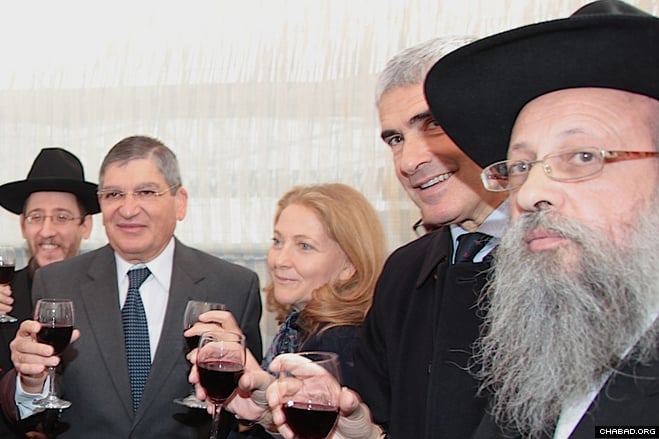
Yale University Press and the Posen Foundation are embarking on a 10-volume anthology that covers more than 3,000 years of Jewish cultural artifacts, texts and paintings. “This monumental project includes the best of Jewish culture in its historical and global entirety,” the editor in chief, James E. Young, a professor of English and Judaic Studies at the University of Massachusetts Amherst, said in a news release. “It will provide future generations with a working legacy by which to recover and comprehend Jewish culture and civilization.”
The series, called the Posen Library of Jewish Culture and Civilization, is starting at the end, with Volume 10, a collection of works that date from 1973 through 2005 and include cultural figures like the writers Saul Bellow and Judy Blume, the architect Frank Gehry, the sculptor Louise Nevelson, Supreme Court Justice Ruth Bader Ginsburg and the Harvard law professor Alan M Dershowitz. (Volume 1 will begin in the second millennium B.C.) More than 120 scholars are expected to work on the project, according to John Donatich, director of Yale University Press.
Reading the piece I wondered (and commented on the site - I'm "Shibaz"), "Why is the writing of Judy Bloom "Jewish culture"? (Sure, she wrote great books, but was there anything particularly "Jewish" about Superfudge?) Will this be an anthology of Jewish culture, or simply a collection of cultural items created by Jews? And perhaps most importantly, what's the difference between the two?"

So is singing Dror Yikra Jewish if I sing it to the Beach Boys? Is that not what Rashi meant when he wrote that we must not follow "their customs"? And if he did mean that, how should I sing Dror Yikra - or any other song? What is a Jewish melody? What is Jewish culture?

Monday, April 30, 2012

Yom Ha'atzmaut in Israel vs. in the Diaspora

Even though I'm no longer an actively practicing pulpit rabbi, I remain connected to many of my rabbinic friends, and somewhat active in the rabbinic community. To that end, I receive (and sometimes participate) in a rabbinic email list, which discusses fascinating topics, issues and challenges pertinent to rabbis of all stripes.
Each year, as Yom Ha'atzmaut approaches, the rabbis begin a series of discussions about the religious observances of the day, including whether and how to recite Hallel, tachanun, and the suspension of the mourning practices of Sefirat Ha'omer. I recently wrote a response not to any particular email, but to the entire genre, as it highlighted a substantial gulf between the observance of these holidays here, and the way that we observed them in the States. Then, my good friend Rabbi David Brofsky sent a moving response, which I am also sharing. (Note: While the email list is private, I have removed any reference to members of the group, and only share my own and Rabbi Brofsky's words with his permission.)

Inevitably, it seems, each year the same discussions arise in some form. Do we recite hallel, when, with a brachah or without? Did the Rav recite hallel? What's the position of the Chief Rabbinate? I know that the questions come from a desire to adhere precisely to the letter of the law, but feel that sometimes they overshadow the true nature of the day. Instead of focusing on the nisim and yad hashem, we occupy ourselves with whether to say hallel with our without a brachah, and which rabbanim advocate what (which is sometimes also code for "is or is not a big enough Zionist").

[A certain rabbi] asked about what actually takes place here. In my religious yishuv Yom Ha'atzmaut is treated as a fully religious holiday. People came to shul on YH eve dressed by and large in white shirts (which is pretty much like Shabbat), we recited a tefillah chagigit
(without hallel), and on YH morning the shul recited Hallel with a brachah. More to the point, the davening itself had a celebratory tone - in the way that people prayed. It wasn't a rushed, weekday morning davening, but more like the relaxed davening of a minor holiday. This might have much to do with the fact that no one had to get to work. To be honest, I find myself
in an unusual situation, in that personally I don't recite the brachah, following the practice that has become accepted in the United States (as communicated from Rav Soloveitchik). But I haven't communicated this to my children, and they recited a normal hallel with a brachah - which is the accepted, universal practice here in Israel in the community where I live.
I see no reason to confuse them.

Personally, I long for a time when these discussions take a backseat to the univserval acceptance on Yom Ha'atzmaut as a religious event; when our communities will see it as such, and spend more time thanking God for the State of Israel and the sovreignity of the Jewish people in our Homeland, than allowing the nuance of ritual, as important as it may be, to distract us.

 ***********************************************************************

Rabbi David Brofsky
I would like to add a few thoughts to R. Spolter's email, which focussed on the content and experience of Yom HaAtzmaur, from the perspective of one, like R. Spolter, who lives in Israel.
To be honest, when I lived in America, I found great difficulty connecting to the religious side of Yom HaAtzmaut. Yes, my "Zionism" was solid, as was my firm belief that the establishment of the state of Israel and its continual existence is a miraculous event- the largest event to affect the Jewish people in almost two thousand years, and obviously one must give thanks to HKB"H. However, the feeling was somewhat dry, and often, I felt that Yom HaAtzmaut events were "hijacked" by who I perceived as "nationalists"- who did not necessarily emphasize the religious aspect of the say (or at least I thought then).

After living in Israel for almost two decades, I must relate the following: 
1. Yom Ha-Zikaron: There is no day similar to Yom Ha-Zikaron in the secular or religious calendar. Chazal were aware that despite the intensity of the aveilus of Tisha BeAv, Aveilus Yeshana (old mourning) is important to commemorate, and we should all merit feeling it in the depths of our soul, but it is still Aveilus Yeshana. We all know, however, that the intensity of a shiva house in which a young woman and children have lost their husband/father is far more intense than Tisha BeAv. That is Aveilus Chadasha. (New mourning) Yom HaZikaron is Aveilus Chadasha. One listens to the radio, watches the television, attends ceremonies in military ceremonies- and simply spends the day crying. If one has not personally known a soldier that was killed, or a civilian killed in a terror attack, then one is certainly connected in another way; one remembers the incident, mourns those who have lost their lives, cries for the widows and children left behind. There is nothing like it. Halavay our feelings on Tisha BeAv should be so intense; halavay the nation should mourn on our religious days of mourning as they do on Yom HaZikaron.

2. Yom HaAtzmaut: R. Spolter noted the festive mood during davening. In many religious communities, tefillot yom haatzmaut, especially hallel, are the most heartfelt of the year. For me, this reminds me of R Hai Gaon's understanding of hallel on leil ha-seder: shira. It is praise which is not imposed, like the regalim, or even lke Chanukka, which the Chasam Sofer
suggests may even be mi-deoraisa! - but rather which comes from the feelings and experiences of the kehilla. Imagine if we really felt that we were saved by the hand of God on Chanukka, or that if the salvation of Purim was still felt! Imagine if we really felt as if we had just left Egypt and were marching towards the land of Israel! Here, the niflaot Hashem (wonders of God) are apparent to all. The feeling of what was, what could have been, what could be (which we all try to feel during the tzomos and chagim during the year- as that is partially their purpose!) is felt by all. (Incidentally, one who experiences Yom HaAtzmaut in such a manner cannot fathom how one can omit tachanun on Tu B'shvat or pesach sheini, but say it
on Yom Ha'atzmaut. Similarly, one cannot understand the objection to suspending nihugei aveilus for the day- just as shiva is set aside for a regel.)

It is possible that the commemoration of Yom HaAtzmaut in chutz la'aretz should be different- as the expectation that one so intensely feel gratitude to HKB"H may not be reasonable. In addition, culturally, the American equivalents, Memorial Day and July 4, are, to the best of my
memory, days of shopping family get-togethers (also noble activities...). But I feel that rabbinic leadership outside of Israel should at least understand what these days are to a religious-zionist Israeli, and hopefully, as R. Spolter suggested, the discussion of how to make Yom
HaAtzmaut a more intensely/religiously felt holiday should take a greater role in these yearly discussions.

Thursday, April 26, 2012

Audio Shiur: Parshat Achrei Mot - To Life!

Audio Shiur:
Parshat Parshat Achrei Mot - To Life!

As we gathered on Yom Hazikaron to study the introduction to the section of the Arayot at the beginning of Chapter 18, the words "vechai bahem" resonate strongly. What's are the "rules" that bring life? What kind of life do they bring? We touch upon aliyah, Brooklyn, sports, soccer and the sacrifice of those holy people who gave their lives to protect and defend the Jewish nation.

Click here to download the shiur, or here to navigate to the shiur on YUTorah.org.


Now you can subscribe to this shiur as a podcast, directly from iTunes! To subscribe, click here.

Wednesday, April 25, 2012

Unity

We've all seen the photos of stopped traffic as the sirens wail here in Israel. This morning I realized that the pictures don't really do it justice. Usually I'm alone at work at 11am. And last night, we were ready for the siren, waiting attentively at a Yom Hazikaron program in the yishuv.
But this morning, somehow, even though I knew the siren was coming, it caught me by surprise.
I was sitting at a second-floor balcony at the bank - which was quite busy this morning, when the siren sounded at precisely 11:00am. Everything just stopped. Everyone stood up, and we all bowed our heads, left to our thoughts, prayers and emotions. I actually found the shift from movement and activity to frozen silence jarring. Think about it: have you ever seen a group of people, simply standing silently at attention, not moving, not speaking? Everything just stopped, and I marveled at the quietness; the stillness of the busy bank as the siren blared outside.
As we all stood in silence. I looked down at the scene below. I saw a group of Ethiopians; two elderly chareidim, who had been meeting with a bank official at one of the desks: young Sabras and immigrants of all stripes and ages.
Over the week between Yom Hashoah and Yom Haatzmaut, for two minutes, the entire country really does stand still. Standing at the bank, I felt a sense of oneness with all of these people who I don't know; a sense of shared sacrifice and a feeling of the shared burden that we all appreciate. And I thought of the families of those who we remember on this day.
Why do we unite only for sadness? Why is it so difficult to stand together on other days of the year? Who knows.
But these silent moments give me strength. Because as much as we argue, they remind us all that if we ever need it, we will stand together as one.

Tuesday, April 24, 2012

The Halachic Significance of Yom Ha'atzmaut

I take it as a given that Israel's declaration of independance in 1948 represents a momentous day in Jewish history, with fundamental implications not just on the future of the Jewish people, but also on our very definition. Yet, is there also halachic meaning to the fact that we, as a nation, once again control our own destiny? I just heard a short talk from Rabbi Professor Neria Guttel (my boss), where he asserted that indeed there is halachic significance to Yom Ha'atzmaut. I'll share one example that he cited.
The Gemara in Megillah (14a) wonders why we don't recite Hallel on Purim, and offers several explanation. Among them we find:
1. Because we don't say Hallel for miracles that took place outside of the Land of Israel
2. The reading of the Megillah constitutes a form of praise, obviating the need to recite Hallel.
Rava adds a different perspective.
רבא אמר בשלמא התם הללו עבדי ה' ולא עבדי פרעה, אלא הכא הללו עבדי ה' ולא עבדי אחשורוש? אכתי עבדי אחשורוש אנן
Said Rava, Regarding [the Exodus from Egypt when the nation did recite Hallel], we can say that "these [the Jewish people] are the servants of God and not servants of Pharaoh. Yet here [in the Purim story], can we say that "these are the servants of God and not the servants of Achashverosh?" We are still the servants of Achashverosh.
According to Rava, the fact that God saved the entire Jewish nation from annihilation on Purim is not sufficient justification to recite Hallel, because they remained the subjects of the King Persia afterwards as well. As great as the salvation was, as long as the Jews remained subject to the whim of a foreign ruler, they should not recite Hallel.
We can derive, of course, the opposite rule as well. Living in an era that witnessed the rebirth of the Jewish nation, we can proudly proclaim that we no longer live as "subjects of Achashverosh." Whether we like the government's decision or dislike it - it remains a Jewish decision, made by the Jewish nation.
For that fact alone, we must declare thanks and praise to the Creator.