
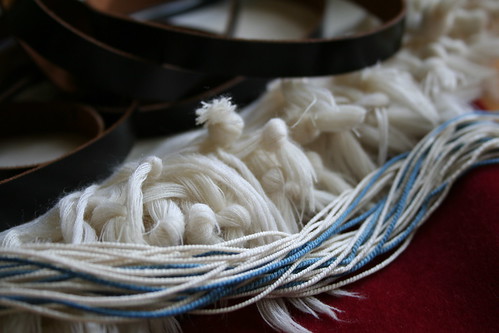
 While the custom to refrain from wearing a tallit after Bar Mitzvah is almost universally accepted in most Ashkenazic sources, the basis for the custom is harder to pinpoint. Moreover, rabbinic support for this custom is thin at best. Noting the practice, the Chafetz Chayim (Mishnah Berurah Orach Chayyim 17:10) writes,
Mishneh Berurah's comments require explanation: In Devarim 22, the Torah juxtaposes two seemingly unrelated topics.ומ"ש בדרשות מהרי"ל בהלכות נשואין שנוהגין שגם נערים גדולים אין מתעטפים בציצית עד שנושאין להם נשים וסמכו להן אקרא דכתיב גדילים תעשה לך וסמיך ליה כי יקח איש אשה הוא דבר תמוה דעד שלא ישא אשה יהיה יושב ובטל ממצות ציצית:And that which is written in the Drashot of Maharil in the Laws of Marriage, that they had a custom that older young men do not wrap themselves in tzitzit (tallit) until they are married to women, and they based themselves on the verse where it is written, "You shall make twisted cords for yourself" and immediately following we read, "If any man takes a wife," (Devarim 22:12-13) - this is a suspicious matter, for until he marries a woman he should sit idle from performing the commandment of tzitzit?
The very next verse shifts suddenly to the topic of marriage.גְּדִלִים, תַּעֲשֶׂה-לָּךְ, עַל-אַרְבַּע כַּנְפוֹת כְּסוּתְךָ, אֲשֶׁר תְּכַסֶּה-בָּהּ.Thou shalt make thee twisted cords upon the four corners of thy covering, wherewith thou coverest thyself. (Devarim 22:12)
What possible connection can there be between these two verses? According to Mishnah Berurah's expanation, Maharil explained that the proximity of the two topics indicated that until a man married he should not wrap himself in a tallit Gadol. Indeed, this quote of a 14th century Tosafits seems to be the oldest, most authoritative and generally accepted primary source for the custom not to wear a tallit until marriage.כִּי-יִקַּח אִישׁ, אִשָּׁה; וּבָא אֵלֶיהָ, וּשְׂנֵאָהּ.If any man take a wife, and go in unto her, and hate her (Devarim 22:13)
Yet, when we examine the source text itself, the matter becomes far more murky.
While Maharil's work on Minhagei Ashkenaz is a critical source of Ashkenazic custom, it's important to understand that Maharil did not himself write the book. Rather, Wikipedia writes (I'm pretty sure correctly) that,
[Mihagei Maharil] was compiled by Moelin's student, Zalman of St. Goar, and was first published - with various additions - at Sabbioneta, in 1556 and frequently thereafter. It had a great influence on the Jews of Central Europe and was largely responsible for the importance attached to minhag in these communities.This minor detail carries great weight when we examine the text of Minhagei Maharil on the issue of wearing a tallit before marriage.
Examining the text, it's clear that the topic of whether a young man should or should not wear a tallit before he marries is not the subject discussed here. Rather, it's clear that in some communities young men did wear a tallit immediately following Bar Mitzvah, as was Rav Zalman's personal minhag in his home community, while in other areas, such as the Maharil's community young men waited until marriage.י] בדידי הוה עובדא שבחור הייתי ונשאתי גרושה, ותקנתי טלית חדש לנישואין ונתעטפתי בו מקודם הנישואין בשבועות לכבוד הרגל, כי אמרתי מאחר שהורגלתי במדינות אחרים ללבוש ציצית מיום שנעשיתי בר מצוה ולא נהגתי בארץ מולדתי בריינוס שנוהגין שגם נערים גדולים אין מתעטפין בציצית עד נושאין אשה וסמכוה להא דכתיב גדילים תעשה לך וסמיך ליה כי יקח איש אשה, ואני שניתי כשאר ארצות ואמרתי כבוד רגל עדיף. ואחר הרגל אמר אלי אמ"ץ מהר"י סג"ל דשלא כדין עשיתי דיום חתונה עדיף לגבי בחור מכל רגל וכל כלי חדשים יחזיק לנישואיןIt happened to me that I was an unmarried young man, and I married a widow, and I purchased a new tallit for my wedding, in which I wrapped myself [for the first time] before the wedding on Shavuot in honor of the holiday. [I did this] because I said, since I had grown accustomed in other states to wear tzitzit [on a tallit] from the day that I became a Bar Mitzvah, and in the land of my birth in Reine, where they have the custom that even older young men do not wrap themselves in the tzitzit until they marry a woman, and they base their custom on the fact that it is written, "Thou shalt make thee twisted cords" and this is adjacent to the verse, "If a man shall take a woman." And I had the custom of the other lands, and I said that the honor of the holiday takes precedence. And after the holiday my master and teacher Mahari Segel said to me that I did not act in accordance with the law, for the day of the wedding takes precedence with regard to an unmarried young man over any holiday, and he should hold onto any new item of clothing to use at the wedding.
Rather, the text deals with a different question entirely: if one has a new item of clothing to wear, is it better to wear that garment for the first time in honor of a chag, as Rav Zalman chose to do, or should he wait to wear the garment on the occasion of his wedding. Maharil told R. Zalman that in choosing to wear the new tallit on Shavuot he chose poorly, and should have waited until his wedding, which deserved the great honor of wearing the new garment.
Critically (for our discussion), there is no indication that the justification that R. Zalman gives for the custom not to wear a tallit after Bar Mitzvah (the connection between the verses in Devarim) came from Maharil himself, or that Maharil subscribed to or supported the custom.
What emerges then, from the text, is a source for a custom attributed to the Maharil that Maharil himself may never have taught or accepted. Thus, when Mishnah Berurah rejects the explanation of Maharil for the custom to refrain from wearing a tallit until marriage, it could very well be that Maharil himself never actually gave the explanation, never accepted it, and might also have rejected the custom personally even if he did not publicly repudiate it.
In essence, we have no evidence that the custom attributed to the Maharil came from Maharil at all.
If this is true, then we have to wonder: where did the custom originate? How did it become so prevalent in Ashkenazic custom? And most importantly, should we still follow the custom today?
To be continued...


