Showing posts with label Beha'alosecha. Show all posts

Wednesday, June 7, 2017

Audio Shiur: Parshat Behaalotecha - Moshe's Pain

Audio Shiur:
Parshat Behaalotecha - Moshe's Pain

When Miriam and Aharon speak negatively about Moshe, what was his reaction? Did he react at all? Was he above it all?

Click here to navigate to the shiur on YUTorah.org.

Click on the player below to play the Shiur or right click here to download)


Did you know that this shiur is available as a free podcast on iTunes? Click here to subscribe - and leave a comment and rating so more people will find the shiur! Thanks!

Monday, June 20, 2016

Parshat Beha'alotecha - Loving the Stranger

Audio Shiur:
Parshat Beha'alotecha - Loving the Stranger

What's the real reason why Yitro didn't want to stay - if he was in fact Yitro? Would we have remained with Moshe, given the same circumstances?

Click here to navigate to the shiur on YUTorah.org.

Click on the player below to play the Shiur or right click here to download)


Did you know that this shiur is available as a free podcast on iTunes? Click here to subscribe - and leave a comment and rating so more people will find the shiur! Thanks!

Thursday, June 4, 2015

Rabbinic Life in the Fish Bowl

When we made aliyah seven years ago and I left the pulpit rabbinate, I knew that leaving rabbinic life would prove traumatic. I loved many things about the job and the life: the relationships with congregants; helping people in times of need; the opportunity to teach Torah regularly and speak to the community about important issues on a regular basis. Yet, to me the most challenging, demoralizing and distressing aspects of the rabbinate was the "fishbowl." People were watching us (and yes, I mean "us" - not just me, but my wife and children as well). 
I remember the day that I really understood just how profound the fishbowl effect really is: the day that I went to see Spiderman. 
It was a Sunday night, many weeks after the movie had come out, and my wife agreed to humor me and accompany me to a movie she had no interest in seeing. After dinner, we ended up at a theater nowhere near our home. Yet, as we walked into the theater, I heard someone call out, "Hey - we didn't know that rabbis liked Spiderman!" They didn't mean anything by it. Maybe my presence in the theater made them uncomfortable. Maybe the people just wanted to say hello or be noticed by the rabbi. Truth be told, they weren't even members of my shul. But, then and there I remember realizing that I could never, ever do anything in public (and perhaps even in my own home) and expect it to remain private. I knew then that I could expect that my entire congregation, and probably every member of the Jewish community would know if I did something wrong, questionable, or even notable.
I'm certain that those people in that theater didn't mean any harm. But that comment, and the reality it brought was very painful to me, as it robbed me once and for all, of any sense of personal privacy for as long as I remained a pulpit rabbi.

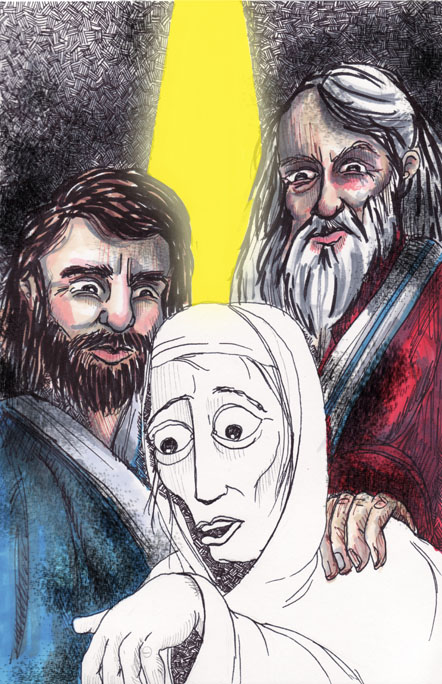
It should come as no surprise that Moshe Rabbeinu - the greatest pulpit rav ever - faced the same fishbowl life, a challenge highlighted by events recounted at the end of Parshat Beha'alotecha. In truth, so many of the events of the parshah deal with issues of rabbinic leadership; the loneliness, frustration and difficulty inherent in a life of spiritual leadership. Yet, all of these challenges seem to come together in the final episode of the parshah, when Miriam and Aharon discuss Moshe's personal life and his decision to separate from his wife. But that's not the end of the story. When Aharon appeals to Moshe to pray for Miriam's recovery, Moshe accedes, but in an unusual way, crafting perhaps the shortest prayer in history: אל נא רפא נא לה - "God please heal her please." 
One could say, "Nice. Short and sweet. To the point." Yet, it seems a bit strange. It's his sister after all. Couldn't he at least say a Misheberach? Add a bit of flourish. A kapitel tehillim
Rashi asks the same question, and offers a startling answer:
מפני מה לא האריך משה בתפילה? שלא יהיו ישראל אומרים אחותו עומדת בצורה והוא עומד ומרבה בתפילה
Why didn't Moshe pray more extensively? So that [the Children of] Israel would not say, "His sister is in pain, so he stands and prays at length."
Why didn't he daven a little longer for Miriam? He was afraid of what people would say. For his sister! He couldn't pray a few extra moments for his sick sister, because he was afraid of "what people would say." It makes me so sad for him, and angry, and upset. Could they not just give him a moment of peace; a modicum of privacy? Perhaps they could, but they would not.

Over the last week, the Orthodox community once again found itself mired in a scandal surrounding the life of a rabbi, and the questionable choices that he has made. The Internet is literally made for this type of episode, with the ability to share stories in a viral manner around the world. What was once a communal badly kept secret is now international news.
Without commenting on the specifics of the episode itself, this much I will say: what was once a communal fishbowl is now a global fishbowl. Blogs and websites now regularly publicize the actions of rabbis and spiritual leaders (for better or for worse), branding them eternally (via Google) leaving them no ability to defend or protect themselves. What rabbi would want to live under permanent threat of global shaming? Who could defend themselves against a vindictive congregant in a social media environment that shares and condemns first, and asks questions later - if ever? Rabbis are burning out faster than ever. If you've never lived in the fishbowl, you cannot appreciate the toll that it takes emotionally and psychologically. 
Today I watch these episodes play out over the internet and thank God that I no longer live in that fishbowl. It's just too much. And I wonder: how many rabbis leave the pulpit - or never enter it, due to the fishbowl effect? How many sane, talented young people legitimately never enter the pulpit because of episodes like these? The rabbi did sign up for a public life, but he didn't sign up to live in a never-ending reality show for his entire community.

What can you do? I guess the best thing you can do is give your rabbi some space. 
Let him work out at the gym in peace. 
You don't need to make a comment about what groceries are in his cart (really) or what his children are wearing. 
Give him and his family a bit of space. 
Protect his privacy when others talk about him and his family. 
Let him pray for his sister for as long as he needs.
Give him the privacy you yourself would want.
 
The rabbi really does live in a fishbowl. But it doesn't mean that his community has to always be watching.

Audio Shiur: Parshat Beha'alotecha - Rabbis in the Fish Bowl

Audio Shiur:
Parshat Beha'alotecha - Rabbis in the Fish Bowl

Even after suffering insult from his own sister, Moshe Rabbeinu still has to worry about what people will say about him. Through a study of the reaction to Miriam's tzara'at, we discuss the limits of what communities should reveal, and what should remain private. Warning: Many of you will disagree with me.

Click here to navigate to the shiur on YUTorah.org.

Click on the player below to play the Shiur or right click here to download)

Wednesday, June 6, 2012

Audio Shiur: Parshat Behaalotecha - Meat of Different Flavors

Audio Shiur:
Parshat Behaalotecha - Meat of Different Flavors

The struggle for spirituality in a physical world plagued the Children of Israel in the desert, and attacks us just as strongly today. Meat is just the beginning...

Click here to download the shiur, or here to navigate to the shiur on YUTorah.org.


Now you can subscribe to this shiur as a podcast, directly from iTunes! To subscribe, click here.

Friday, May 28, 2010

Audio Shiur: Beha'alotecha 5770 - When is it Really Bad?

Audio Shiur:
Parshat Beha'alotecha 5770 - When is it Really Bad?

We've all had life experiences where we thought that things were "bad", only later to realize that they weren't so bad after all. How do you know when it's really bad? What do you do in such a situation? Examining the complaints of the Jewish people in Beha'alotecha forces us to ask, "Were things really that bad for them?" and by extension, what about for us?

Click here to download the shiur, or here to navigate to the shiur on YUTorah.org.

Thursday, June 4, 2009

Audio Shiur: Parshat Beha'alotecha - Miriam and Humility

Audio Shiur:

Parshat Beha'alotecha - Moshe, Miriam and Humility

The story of Miriam's lashon hara - while short, comprises some critical themes in Beha'alotecha. Why were they talking about Moshe? How did he react? How was he different than they? All of these questions lead us towards understanding not only how Moshe was different, but how we can strive towards humility today.

Click here for the audio link, or listen in the handy audio player supplied below.

Wednesday, June 3, 2009

Trumpets of Praise and Prayer: Devar Torah for Beha'alotecha

This past Tuesday, the entire population of Israel participated in a "drill", simulating an attack on Israel. At 11am, sirens sounded throughout the country, and children in schools, people in offices – basically everyone – was supposed to find their protected space and get there. Did they do it? No idea. I was actually already working in our Mamad (I don't remember what the acronym stands for, but that's what you call it). But as the siren sounded and I continued to work I thought, "I don't remember ever having to do this in America." ("Duck and cover" was long before my time.)
The siren also reminded me of a different type of "sounding" mentioned in this week's parshah. (For those of you outside of Israel, this week we read Beha'alotecha, as Shabbat was not a day of Yom Tov. So even though you'll be reading Parshat Naso, in Israel we'll be a week ahead until you catch up in about a month.) I'm sharing a thought that Rav Gutel, Orot's President, mentioned at Orot's Yom Yerushalayim lunch and lecture this week.
One of the more famous "religious Zionist" verses in the Torah appears in this week's Torah reading. We read,
וְכִי-תָבֹאוּ מִלְחָמָה בְּאַרְצְכֶם, עַל-הַצַּר הַצֹּרֵר אֶתְכֶם--וַהֲרֵעֹתֶם, בַּחֲצֹצְרֹת; וְנִזְכַּרְתֶּם, לִפְנֵי ה' אֱלֹקֵיכֶם, וְנוֹשַׁעְתֶּם, מֵאֹיְבֵיכֶם. וּבְיוֹם שִׂמְחַתְכֶם וּבְמוֹעֲדֵיכֶם, וּבְרָאשֵׁי חָדְשֵׁיכֶם--וּתְקַעְתֶּם בַּחֲצֹצְרֹת עַל עֹלֹתֵיכֶם, וְעַל זִבְחֵי שַׁלְמֵיכֶם; וְהָיוּ לָכֶם לְזִכָּרוֹן לִפְנֵי אֱלֹקיכֶם, אֲנִי ה' אֱלֹקיכֶם.
And when you go to war in your land against the adversary that oppresses you, then you shall sound an alarm with the trumpets; and ye shall be remembered before the Hashem your God, and you shall be saved from your enemies. Also in the day of your gladness, and in your appointed seasons, and in your new moons, you shall blow with the trumpets over your burnt-offerings, and over the sacrifices of your peace-offerings; and they shall be to you for a memorial before your God: I am the Hashem your God.' (Bamidbar 10:9-10)
These verses have taken on such significance that the Israeli Chief Rabbinate instituted that we read the first as part of the davening on the evening of Yom Ha'atzmaut.
Looking at the two verses, you get the sense that these are two related but different commandments. The first relates to the blowing of the trumpets during times of distress and war. We blow the trumpets as a kind of prayer; a form of calling out to Hashem to save us in our time of need. The second verse alludes to a very different trumpeting. When we sound the trumpets on holidays and Rosh Chodesh, the soundings serve as a kind of praise for Hashem. Think of it (lehavdil) as a form of "Hail to the Chief" sounded in the Beit Hamikdash. The two verses describe the same activity, but serve decidedly different functions. Or so we think.
Many hundreds of years ago, someone asked the Ritva (Rabbi Yom Tov ben Aderet) why they didn't blow trumpets on fast days. After all, if the purpose of blowing the trumpets was to call out to Hashem in timed of need, the Middle Ages in France certainly qualified. He explained that the French custom not to blow trumpets was based on the understanding that the trumpets could only be blown in the Beit Hamikdash. The two verses are not separate mitzvot, unconnected and unrelated. Rather, they are inherently connected and constrained by the same set of rules. Rav Moshe Feinstein (see Igrot Moshe Orach Chayyim Volume 1: 169) uses this principle to explain why the Rambam, in his list of commandments, lists the blowing of the trumpets not as two commandments, but as one (positive mitzvot, number 59). Rav Moshe explains that Rambam too considered the trumpets of both travail and celebration to be one and the same mitzvah.
If so, then even when we blow the trumpets crying out to Hashem for salvation, we still do so as a form of praise (like the trumpets of joy). And when we blow the trumpets of Yom Tov in celebration, there's a measure of supplication and prayer as well.
To me, this makes sense on a deeper level as well. Even as we celebrate the holidays with korbanot and joy, don't we need to call out to Hashem for his continued support and guidance? Even when we recite Hallel, a prayer clearly focusing on praise of Hashem, we still cry out, אנא ה' הושיע נא – "please Hashem, help us!" And by the same token, as we turn to face our enemies who attack us from without and blow the trumpets to cry out to Hashem for help, should there not also be an element of thanks and praise as well? After all, we have the benefit of crying out from Yerushalayim, the seat of holiness for the entire world. We enjoy the spiritual solace of worshiping Hashem in the Beit Hamikdash. Even in our worries, we must also give thanks for the blessings that we still enjoy.
Praise and prayer, crying out and giving thanks – so often in life they make up two sides of the same coin.
Which brings me back to the siren in that Mamad. Sure, it's terrible that we have to sound the "trumpet" of attack, preparing the population for an enemy that stands at our borders, always searching for new and more devious ways to destroy us. But in that siren, is there not also a measure of praise as well? Sure, I never heard such a siren while living in America. But this year I have the merit to not simply read about it on JPost.com or in a Devar Torah. I heard these sirens from my home in Eretz Yisrael.
And for that I will continue to give Hashem my unending thanks.

Friday, July 11, 2008

A Nation of Whiners

John McCain found himself in hot water yet again, when a close friend and advisor, Senator Phil Graham told the Washington Times that the nation is not in a recession -- it's more like a "mental recession," and that we've become "a nation of whiners." The backpedaling was fast and furious. McCain could not distance himself from Graham fast enough, telling a crowd in Michigan, "He doesn't speak for me, I speak for me," and quipping that the only post he would be eligible for is the "ambassadorship of Belarus." Ha ha. Keep your day job, John.
There's only one problem with Graham's comments. They're right on. We're not in a recession, as any economist will tell you. The country's economy, while certainly stalled and stagnant, continues to grow at a slow rate - almost one percent this past year. If the defenition of "recession" is negative economic growth (and it is), then we're clearly not in a recession. In addition, the dramatic and cataclysmic language that sells in the press and drives the economic frenzies that we watch on CNBC today have little to do with reality. Perception becomes the reality, and makes companies, organizations, people -- everyone - crazy. An article about the woes of the hotel business in the Washington Post entitled "Slide by Marriot Signals Distress for Hotel Industry" - sounds rather ominous, doesn't it -- describes Marriott's recent announcement of negative growth increases in per room revenue - called RevPar. While it sounds pretty bad, it simply means that the increase -- the rate at which the income per room goes up year after year -- will be less this year than last year. So, if the revenue per room increased by 1.5 percent last year, the increase will be less this year -- maybe 1 percent. In fact, the article in the Post is itself misleading, giving the impression that RevPar will decrease, when in fact it's only a decrease in RevPar growth -- it will grow this year less than last year.
Despite all that, revenue is down at Marriott. Last year during the 2nd Quarter, Marriot made $207 million. This year it only made $157 million. No, it didn't lose money, and there should be good reasons why it made twenty-five percent less money than last year, but the hysteria surrounding Marriott caused a steep sell-off of its stock dropping it to 52-week lows, and prompting the Washington Post to write, "Let there be no mistaking it now: The hotel boom is kaput."
Kaput? I'd love to be kaput and only make $157 million this quarter. Just ask Robert LaFleur, an analyst with Susquehanna Financial Group, (also quoted in the Post article) who said: "Let's keep everything in perspective. They are calling for RevPar growth in North America to be down 1 percent. That's not exactly the Great Depression."
But in the recession-frenzied climate in which we find ourselves, no one can keep anything in perspective. Which brings me back to my original point.
We are a nation of whiners.
Sure, some people are suffering, having difficulties making their payments, having their houses foreclosed, forced to find other places to live. But is anyone starving in the streets?
I recently left Michigan on my way to Israel, and things are so bad there that I simply could not sell my house for an affordable price. There was no way, unless I was willing to sell for about $50 thousand less than the price I paid seven years ago. So the recession -- sorry - housing slump hurt me as much as the next guy.
But did it? I rented out my house to a couple who were foreclosed on their house. What happened to them is private information, but for reasons that were in some part beyond their control, they lost their house.
What happened to them? Are they on the street? No - they're both hard-working, great people. They both have good, stable jobs. So they rented my house, a four-bedroom home in a quiet neighboorhood with great neighbors. Is it as nice as their old home? Probably not. But can you say that they're suffering? Can you say that I'm suffering?
But if you ask the New York Times or Washington Post, of course we're suffering. As long as things aren't better today than yesterday, that's suffering.
All of this reminds me of the section in the Torah that describes the complaints of the Jewish people in the desert: (see Bamidbar 10:35) There the Torah tells us that the people were mitonenim - which Artscroll translates at "those who seek pretexts of evil," but really simply means "complainers." We recognize an onen from the laws of mourning -- we refer to someone who lost a close relative but has not yet buried him or her as an onen - a person in anguish. But a mitonen is someone who puts himself into that state of anguish -- notice the reflexive form of the verb. What troubled the mitonenim? The Torah doesn't tell us, but Rashi (on that verse) quotes the Midrash which tells us that they said, "Woe unto us, how much have we struggled on this journey -- three days without any rest!"
Sounds pretty spoiled -- doesn't it?
To my mind, the McCain campaign is floundering -- not just because he's old, can't really give a powerful speech, and represents the incumbent party during an economic downswing. The real problem is that he doesn't convey any vision. Whether you like Obama or not, his sweeping rhetoric engages an audience. It gives the listener a sense of vision for a better America. McCain does no such thing; it's just more of the same. We'll keep slogging along in Iraq until things are secure enough to come home. There are no easy answers on the economy. The current foreign policy of the Bush administration has been doing a pretty good job.
There's no vision. And without vision, there isn't going to be a victory either. To my mind, when asked about Graham's comments, he should have said, "You know what -- we are a bunch of whiners. All of us. Our soldiers are across the world fighting for us, and we're worried about whether we'll be able to afford the newest ipods." He should not extend the Bush tax cuts. Rather, he should take the money that the government would save and use it to pay down the national debt. He should advocate the idea that there must be a price to be paid by the average citizen during a time of war. And paradoxically, if we feel the war - if we sense that we're sacrificing too - I think that the American people would be more supportive of it. He needs to begin to speak about the notion of sacrifice for the country -- economic sacrifice, personal sacrifice, volunteerism, and a sense of dedication to something larger than ourselves.
These are all issues that he personally represents, and can advocate forcefully. In a sense, he needs to become more of a father figure for the country, instead of pandering to us and telling us how he's going to make it better.
Because he can't. And he won't. And unless he starts telling it the way it really is, we all better get ready for an Obama adminstration.

Friday, June 13, 2008

Table Talk for Beha'alotecha 5768

Life is full of second chances. If I didn't watch the game live, I can always watch it on my Tivo. If I "forgot" to pay my taxes, sooner or later the IRS will grant me an amnesty period to correct any oversight I might have made. Second chances give us the opportunity to make amends for errors or oversights we might have made.
Beha'alotecha gives us the Torah's most prominent second chance: Pesach Sheini. Those people who were tamei (ritually impure) during the offering of the korban Pesach approach Moshe with a problem. They missed out and want to offer the sacrifice. לָמָּה נִגָּרַע, לְבִלְתִּי הַקְרִיב אֶת-קָרְבַּן ה' בְּמֹעֲדוֹ -- "why should we be kept back, so as not to bring the offering of God in its proper time." (9:7) Moshe, repeats their request to God who answers in the affirmative, telling Moshe about the law of Pesach Sheini (the second Pesach). Essentially, God gives them a second chance, commanding pretty much anyone who did not bring the korban Pesach at the proper time to be sure to bring the offering the second time around a month later.
I can think of only one other case in Jewish law that deals with second chances. The gemara in Berachos teaches us that if a person forgot to recite a given Amidah or was prevented from doing so, he may "make up" that prayer at the next opportunity. Essentially, if I forget or cannot recite Shacharit on a given morning, I can (and must) recite two shemoneh esreh prayers at Minchah time; the first counts as Minchah, and the second counts as the Shacharit I missed that morning.
Yet, these examples have always left me wondering: why are these the only two prominent cases of second chances in Jewish law? If I forgot to eat matzoh at the Seder, or shake a lulav, or light Chanukah candles at the proper time, halachah offers no mechanism for me to make up those mitzvot. Why not? What's unique about the korban Pesach and prayer that demanded that we all get a second chance?
To my mind though, second chances have an even greater cost. If you can always do things over, that ability to repeat robs the event or activity of its meaning and import the first time around. Why bother trying very hard on my golf shot if I can just take a mulligan? Why make the effort to light candles on time if I can just do it next week? From this perspective, having a second chance isn't always the greatest blessing.
I most cases, you have to get it right the first time. Because there won't be a second chance.

Wednesday, May 30, 2007

Table Talk -- Beha'alosecha 5767

When the Jewish people complain to Moshe, and actually threaten to return to Egypt because they miss the Egyptian meat, God responds swiftly. “They want meat?” He asks. “I’ll give them meat, but only meat. And by the end of thirty days, they’ll be so sick of the meat that it will come out of their noses.” Obviously, this was before the Atkins diet.
But then, when the quail begin to fly and the people collect huge piles of quail to satisfy their craving, the Torah tells us that הַבָּשָׂר, עוֹדֶנּוּ בֵּין שִׁנֵּיהֶם -- “Even as the meat was between their teeth,” the wrath of God struck the people. So which really happened: did the people eat the meat growing progressively disgusted with it until it literally killed them, or did they perish swiftly and suddenly at the first bite? Rashi tells us that it was both. Some died suddenly, while others only after a month. Who got which punishment? That’s less clear.

According to the first opinion in Rashi (see Rashi on
11:20), the כשרים – the more worthy – lived through the month of meat, while the רשעים – the truly evil – perished immediately. But Rashi presents the position of the Midrash that presently precisely the opposite position: the evil lasted a month, while the meritorious lost their lives right away.
So what’s worse: getting a punishment up front, or suffering through a long and difficult process? I guess that depends upon your point of view. But I’d like to ask the opposite question (which is also a good discussion for the Shabbos table): if you had to receive a reward or a gift, which would you rather have: getting a big reward all at once, or receiving a little bit at a time over a long period?