
Showing posts with label shuls. Show all posts

Monday, February 9, 2015

Why We Ask: "What Do You Do?"

Rabbi Efrem Goldberg recently wrote a thoughtful post entitled "Don’t Confuse Earning a Living with Living", in which he relates a story about an encounter he had with a stranger sitting at a wedding.
At the meal, I found myself sitting at a table of people I had never met.  In an attempt to be friendly to the man seated next to me, I asked him, “What do you do?”  He sat up in his chair, turned to me and said, “What do I do, or how do I earn a living?  I earn a living as a plumber.  What I do, what I am most proud of, is that I learn Torah every morning before davening, and I spend time with my family every evening after work.”  His answer remains etched in my memory as he taught me a profound lesson that day in that short, but poignant answer to my simple social question.
Culturally, at least in the United States, "What do you do?" is the first thing you ask to someone that you don't know. It's an ice-breaker; a way to start a conversation. Tell me about yourself. Yet, after I made aliyah, I noticed that Israelis almost never ask this question. They ask different questions: "Where are you from?" "Where did you serve in the army?" To Anglos (like me), they'll often ask, "You're from America, right?" (It's a game where they try and identify you from your accent. It's not hard.) But they don't usually first ask about your profession.
That got me thinking about the differences between cultures and countries, and wondering why people in the States ask about and identify a person through his or her profession.
I think, at least subconsciously, "What do you do?" is also a question about money and social status.
When you ask, "What do you do?" you're also asking another question: "How much do you earn?" Because if you're a lawyer or a doctor, I can place you in one social sphere. If you're a plumber, you're in another; a teacher or social worker? Yet another. (When they asked me the question and I told them that I was the rabbi of a shul, people would inevitably ask me the obvious follow-up: "Really? How many families?" It's the same question: Are you the rabbi of some small shtiebel, or are you an "imporant" rabbi of a significant community?)
We assess people by their earning power, and extend to them social status commensurate to that financial wherewithal. It's sad, but too often true. Think about the shul you attend: how do people relate to the doctors, compared to how they relate to the physical therapists? It's not a question of how many aliyot a person gets, but a question of voice, deference, and communal authority.
In Israel, people earn far less money, and doctors and lawyers don't really earn much more than teachers (which is one reason why it's so hard for American doctors to make aliyah). There are very few truly rich people, at least where I live (to the best of my knowledge). I have no clue how much people do or don't earn.
This type of subconscious assessment is only natural. The people with greater means do get a greater say. We need them - at least externally - more than we do everyone else. Their donations keep the lights on; they pay for the kiddushim we enjoy, and for the rabbis' salaries as well. We have to give them a voice, especially in the decisions of the institutions that they support. Yet, this unspoken preferential treatment alienates those who don't fit the bill: the teachers, the marketers, the plumbers (although plumbers do fine, from what I hear).
I'm sure that Rabbi Goldberg meant none of this when he asked the plumber "What do you do?" Yet, in some part of his mind, I'm also sure that the plumber heard a different question: "Hello. I don't know you. Are you an important person? Does your profession make you someone I should respect?" To this question, instead of answering, "Actually, I earn a living wage by putting my hands in people's waste all day long," he chose a different path - an understandable one from that point of view. I wonder whether the plumber would have had the same reaction had his chosen profession been to own a chain of plumbers which served six states. Perhaps yes, although I doubt he would have reacted so sharply to the question.
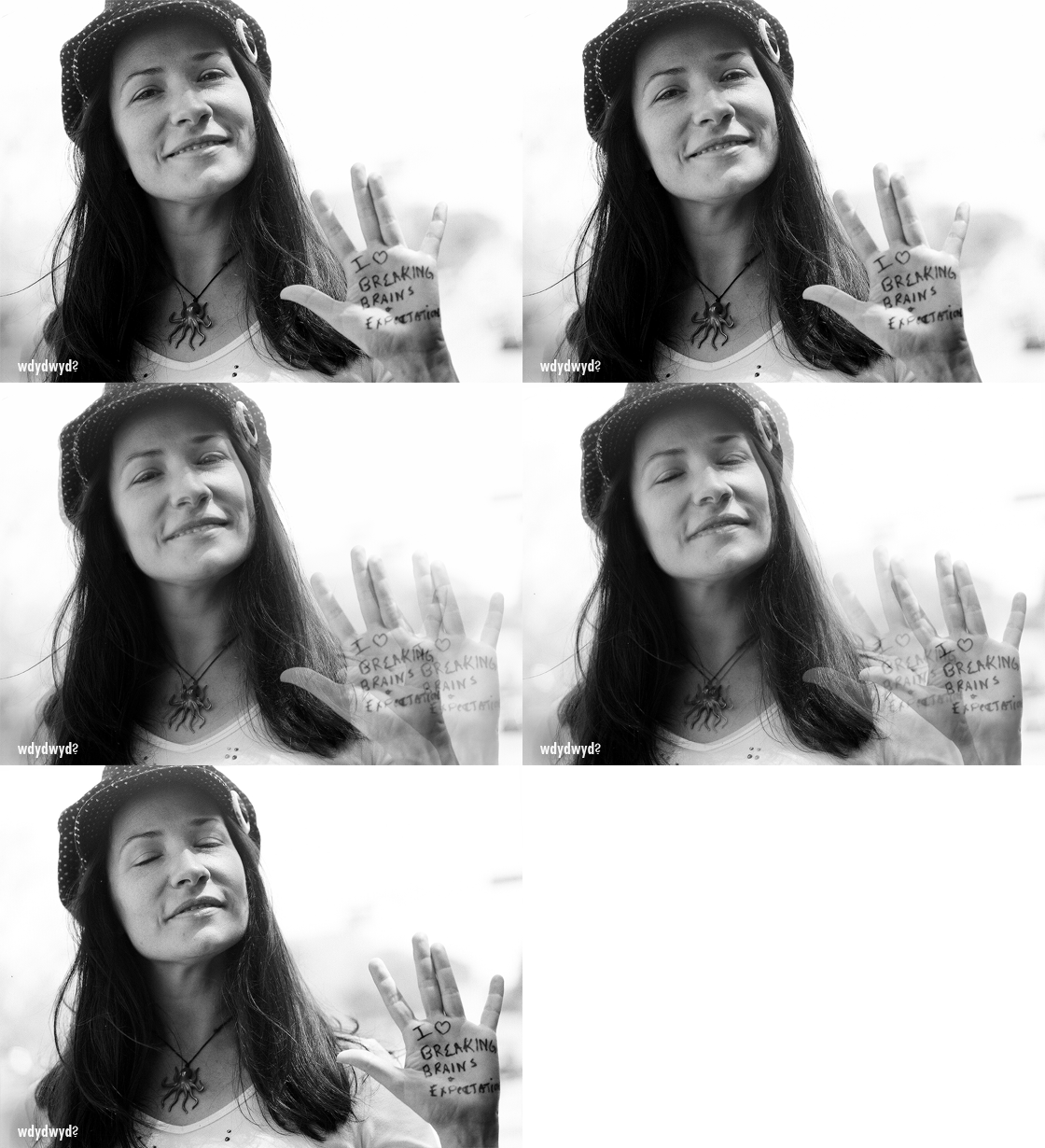
Throughout the school year at Orot, we invite groups of young women serving in Sherut Leumi (National Service) for in-service days (yemei iyyun). Often, I give a seminar called "Finding the 'Me' Among the Masses" (מצאית ה"אני" בתוך ההמונים), in which we speak about balancing the need to actualize our individuality with the needs of the community and the country. I always begin this seminar by doing an exercise called "Why Do You Do What You Do?" (or WDYDWYD), a seminar that's given in business and school settings around the world. I do a little exercise where I ask the students to spend five minutes drawing a picture that explains "Why they do what they do." 
It's harder than you think, because before you can answer the question "why", you first have to ask yourself, "What do I do?" - a question that can be as narrow as "Why am I sitting in this room?" and as broad as "Why am I serving in Sherut Leumi?" It's always an incredible exercise.
Each time I give the seminar, I also draw a picture. During the first years after our Aliyah, I always drew a picture of my family. I interpreted the question to mean, "Why are you giving this seminar in Orot today? Why did you leave the rabbinate and make Aliyah?" The answer, to me, was always for the sake of my family and my children. Yet, each time I drew that picture, it forced me to ask other questions: If I really am doing it all for my kids, why don't I spend more time with them? (This actually prompted me to take a day off from work and take them on a tiyyul.)
Perhaps the question we should ask people when we meet them for the first time isn't "What do you do?", but instead, "Why do you do what you do?" 
That question would lead to a much more fruitful and interesting conversation.

Monday, February 17, 2014

Man Seder Sweeping the Nation Even More Than I Thought!

Last week, I shared this post about the Man's Seder, a mock seder for men geared towards helping men lead a better and more meaningful Seder. Last night, I got this email from a member of Congregation Beth Shalom of Potomac, Maryland:
Hi Rabbi Spolter.
I read with interest the listing of shule's that have created a "Mens Seder Night". I am proud to tell you that this will be the 4th year that Beth Sholom (Potomac, Maryland) has conducted our "Guys Night Out and Seder Summit". I have attached our flyer and recently created Press Release, announcing this year's event.
Our event is truly a community event as last year we attracted over 320 guys and are expecting 400 this year. We are especially proud of our community leadership that has already signed up including the CEO of our Federation, CEO of our JCC, Headmaster of our Day school (over 1500 kids) and Israeli Embassy officials. Last year we also welcomed 6 Rabbis.  
Please keep Beth Sholom, Potomac Maryland in mind, as you continue to publicize this great event, taking place all over the country.
Thank you.
He also sent me this flyer:
 ...as well as the following press release:
FOR IMMEDIATE RELEASE:
Rachel Winer
PR Consultant
winerrac@gmail.com
248-320-6632

Guys Night Out & Seder Summit: Ribs, Scotch, Learning and More!
Hosted by Beth Sholom Congregation in the Washington D.C. area

Potomac, Maryland: In the spirit of the NCAA Men’s Final Four and MLB Opening Day, Beth Sholom Congregation, the largest Modern Orthodox Synagogue in the Washington, D.C. area, proudly announces its fourth annual BBQ, Scotch and Seder Summit. The event will take place on Sunday evening, April 6th, from 6:00-9:30 PM. Over 400 attendees are expected from near and far, as this is the largest event known of its kind to get “the guys” ready for seder leading.

Who are some of the guys you may see at our event? The CEO of the JCC of Greater Washington, the President of the JCC of Greater Washington, the CEO of the local Jewish Federation, Head of Charles E. Smith Jewish Day School, leaders from the Israeli Embassy, AIPAC, the World Bank, Rabbis from other local synagogues, community members, friends, fathers, sons and grandsons coming to town from all over the east coast.

This unique "men’s outreach event" reaches across all spectrums of Judaism attracting orthodox, conservative, reform, and unaffiliated Jews. Attendees will also have the opportunity to enjoy Passover insights from Beth Sholom’s recently installed Senior Rabbi, Nissan Antine. Rabbi expresses as he looks forward to leading this event each year, “This is a great event and can surely be re-created in other local Jewish communities across this country.”

The evening features a man’s perfect menu: Kosher BBQ ribs, fries, oven baked “fried” chicken, scotch and Passover wine. The program will incorporate "speed learning," with a focus on sharing ancient traditions to help make one's Seder more meaningful for all participants. Men will take home pocket-sized materials with key lessons for them to incorporate into their own Seders. There will also be a chance to win raffle prizes, think whiskies and sports memorabilia!

The goal for this event is to raise funds to support Beth Sholom, community initiatives, all while providing a great venue for a great Jewish experience. Last year, the Washington Jewish Week stated, "I've been covering Jewish events for well over 30 years, and this was one of the most important, meaningful events I've ever experienced…this was one of the few places I had been where Orthodox, Reform, Conservative, unaffiliated, ...every type of Jew felt comfortable." 

Beth Sholom is one of the most active shuls providing financial support to families in need, during Passover. To find out more information about Beth Sholom, or to register for the event, go to: www.bethsholom.org or call 301-279-7010.

First of all, I love the name: "Seder Summit". Secondly, the shul is really utilizing the program in an exciting way - combining the power of an educational event, a fundraiser, and a force for unity in the community. You can even register and pay for the program online. Sounds incredible!

Rabbi Elazar Muskin
So, what about your shul? I never believed that I had to reinvent the wheel when it came to good shul programming. I was quite happy to "borrow" programs from colleages that I felt would benefit my community. Just recently, I proudly told Rabbi Elazar Muskin from the Young Israel of Century City that my Pre-Rosh Hashanah speaker series was completely and totally ripped off from him (which is fine, because he shared it with a large group of rabbis at a Young Israel conference).
So - rabbis, shul board members, lay-people: Here you go! You've got a great program idea (and even a press release) ready to go. Your members will be excited, your shul will make money, and their Seder night will be enriched.
The only question is, is the Man's Seder (or "Four Cups" or "Seder Summit") that will happen in your city going to be at your shul, or at the shul down the street?

Friday, February 14, 2014

Man's Seder Sweeping the Nation: Now in Chicago. Next Stop: Your City?

It started with a simple idea probably ten years ago. After my wife Rena returned home from a Federation-sponsored "Women's Seder" (complete with orange and obligatory readings), I wondered why they sponsor programs like that for women, but nothing for the men. After all, in many homes, the men lead the Seder. Shouldn't they spend some time preparing? Moreover, the Seder represents one of the most important family educational experiences throughout the Jewish year. Parents actually must sit with their children and talk (and read) about Jewish events. There had to be a program to get men ready for the Seder! Indeed, there was.
What gets men to come to anything? Torah? Sure. But what if you added steaks - really thick ones? (Remember that in Metro Detroit, good meat restaurants are pretty rare.) And what about beer? Men, like beer, right?
Turns out that they do. The idea percolated for a year, until I finally decided to inaugurate what has since become an annual event at YIOP: The Man's Seder. Here's the flyer from my last year.


The event actually garnered a fair amount of Press. We had a great article in the Detroit Free Press our first year, and more publicity in the following years. Here's a piece from the Detroit Jewish News in 2008 (click on it to enlarge):


The program has spawned imitators and emulators, which I'm actually quite proud of. For years now, my good friend Rabbi Barry Gelman of the United Orthodox Synagogue of Houston has been conducting a Man's Seder (you can find some more great pictures from their Facebook  page here). Aish Detroit copied it almost immediately after I left. It's been popping up across the country. And now the Man's Seder, moving into the big time, is making its way to Chicago.
Apparently, Rabbi Ari Sytner of YU's Center for the Jewish Future, shared the idea for the Man's Seder at a lay leadership seminar. The idea took hold, and this year Congregation Or Torah will conduct its first Man's Seder. Only they've rebranded it, and are calling it: Four Cups.

I love it. I love the upgraded graphics, and the Chicago tough-guy theme. I love the sponsorships (why didn't I think of that?) Most of all, I love the fact that a program I thought of is really helping spread Torah and excitement about Pesach.
So, if you live in Chicagoland, make your way to Or Torah for a great night of learning. And if you don't live in Chicago, share this blog post with your rabbi, ritual committee, education committe, Men's Club - whatever. Man's Seder is sweeping the nation. Don't miss it!

Friday, May 10, 2013

A Uniquely "American" Torah Program: Tikkun Leil Shavuot, American Style

People often ask me about the difference between the rabbinate in Israel and in America.
My friend and colleague Rabbi Dovid Cohen recently released on his Facebook page the lineup for Tikkun Leil Shavuot. Here's the flyer.


I want to be clear: I am not questioning or criticizing Rabbi Cohen or the program in any way. If I had thought of it, I would probably be doing the very same program, although the meat thing is new to me. Sea Bass maybe. Cheesecake? Definitely. Ice Cream? Of course. But we never considered meat. Intriguing. Also, as I commented to Rabbi Cohen, he forgot to add on the bottom of the flyer the 7:30am visit to the local emergency room for the chest pains. A minor oversight.
What's fascinating to me is the overt way in which the flyer and the event focuses on the melding of the spiritual and the physical. If we take such things for granted, let's ask ourselves: when did rabbis become caterers? Why is there literally a full, descriptive menu on a Shavuot night flyer?
The answer, of course, is all about attendance.
Imagine the very same program with no food at all, or minimal food - some cola, maybe a plate of cake. How many people would attend? Let's assume that significantly more people will participate because of the food than would have otherwise. In addition, let's not discount the element of competition. I imagine that there are numerous other programs on the Upper West Side on the night of Shavuot. Why come to this one? Well, you can either draw them in with content or with food. The content seems good - interesting, motivating, and not too heavy. But is it that much better than one can get at another location?
So, to supplement the spiritual side, we turn to the physical.
I remember when we first started the Beit Midrash program at YIOP in Oak Park, I insisted that the program have fresh pastries and fresh coffee - not instant (Chas V'shalom!) I myself went to Costco every so often to ensure that we had not only the coffee, but the good cups as well. I believed (and still believe) that no one was coming for the coffee, but if you were wavering about going out on a cold Monday night in the winter in Suburban Detroit, a good cup of coffee wouldn't hurt. I still serve fresh ground coffee at my Parshat Hashavua shiur every week here in Yad Binyamin.
A good friend and colleague in Israel recently asked me what motivates American shul rabbis. I told him that rabbis feel a constant pressure to bring value to their current members and draw in new members. This makes intuitive sense. Fewer members = less dues = lower salary --> no job. So, while our primary focus is of course attending to the spiritual needs of our members (and potential members), rabbis always have one eye on the "trimmings" that will bring people through the doors to participate in the spiritually uplifting programming they offer.
That pressure comes to a head on the night of Shavuot. Does every shul really need to have its own program? After all, only a percentage of the membership actually shows up. Most people like to sleep at night, even on Shavuot. So they're essentially competing for the same participants. (Some people will always go to their shul. Others will go to the most attractive program). But how would it look for a shul to go dark on the night of Shavuot? And how would it look for a shul to have a program and then struggle to get a minyan at 5am? Not good.
So, what has emerged is an arms race between shuls not in the realm of the spirutual, but in the physical. You've got Ben and Jerry's? We've got Haagen Daaz. You've got franks and blankets? We've got Pastrami Stuffed Rolatinis (I've never even heard of a "rolatini". What is that? I assume it's made from meat.) I also like the way the courses are spaced. You want food? Then don't go shul-hopping -- because you might miss the duck with hoisin sauce.
This pressure made me dread the night of Shavuot. Literally, I would go into a funk during the week leading up to the event, knowing that no matter how great the shiurim and the spread, many of my members would gravitate to the local kollel, and someone would invariably ask the hated question: "How many people were there at YIOP?" I hated that question. Still do - especially because there was always great learning during the program, and the members who did come and stay up all night found the program uplifting and motivating.

Israeli rabbis view this phenomenon in the American rabbinate with horror. I cannot imagine an Israeli rabbi that I know producing such a flyer, or even participating in such a program. They're happy to give the shiur, and don't mind refreshments afterwards, but would recoil at such a blatant effort to suck people into a supposedly spiritual event. After all, they're rabbis and teachers. Not caterers.
Then again, they don't face the constant membership pressure. Even the ones who actually take a salary are at best part time, and don't often compete for members the way American rabbis do.  And, I daresay that many would say that they'd rather not be a rabbi if the job required them to cater parties in order to do the job. (Easy to say when your job isn't on the line.)
Who's right? Neither is right; it's not a question of right or wrong, but more a question of circumstances and needs. I repeat: were I in Rabbi Cohen's shoes, I would probably create exactly the same program, or one very similar, and I'm sure that across the New York region, many stomachs will be filled with gourmet food of one type or another over the five hour period between 12am and 5am on the eve of Shavuot.
And, of course, much Torah will also be learned. That, after all, is the purpose of Tikkun Leil Shavuot.

Wednesday, April 3, 2013

The Embarrasment that is the Women's Section in Many Orthodox Shuls in Israel

Rivkah Lambert Adler's piece lamenting the sorry state of the woman's section in Orthodox shuls is spot on. Many, many shuls in Israel, even in ostensibly modern communities, consign the women to a location where they can barely hear, much less see what's going on during davening. Take our shul, for example.
When we arrived in Yad Binyamin, the municipality was already well into the process of building the shul. The plans had long-since been approved, and changes of any kind weren't really much of an option.
When we finally inhabited the building, we realized that the architect, while he built a physically striking and beautiful building, had never spent much time in a shul, much less in the women's section. The women were seated in the balcony at the back, but in such a way that it was impossible for them to see anything while seated, as the wall separated the balcony from the main section was at least four feet high (and about a foot thick). Moreover, the entire section was built on a single level - not on graduated steps, so there was (and still is) no way for anyone behind the front row to see anything.
When the time came to buy the furniture, the shul quickly ordered the nice, comfy seats for the men's section, while the women sat in plastic chairs. Today, the women have been upgraded to nicer, plush office chairs, but they're still waiting for their Lavi seats. (That's in the works, I hear) We quickly replaced much of the wall with glass, but added decorative stickers on the glass that obscure the view to some degree.
It should go without saying that this situation would never, ever happen in an American Modern Orthodox shul. Before I left Michigan we were in the planning stages of finally replacing the old mechitzah, and we spent an inordinate amount of effort and energy trying to ensure the mechitzah that would allow women to feel part of the davening to the greatest possible degree. And yet, as Adler notes, if you tour many shuls in Israel you almost never find this type of attention given to the women's section. Why not?
Part of the blame for this situation lays with the men, of course. Men build the shuls and, for the most part, run them as well. Yet, to claim that it's only the fault of men would be less than accurate.
Back to our shul in Yad Binyamin. Almost immediately after we took possession of the building, it became clear that we had to quickly change the mechitzah wall. The shul sent out an email asking female members of the community to serve on the committee that would implement the changes, and of the women who responded, exactly none of them were Israelis. Only Anglos answered the call.
And, while Israeli women do complain about the cramped nature of the women's section, they aren't really active in trying to effect change. Why this is so is difficult to say. Some might suggest that after years of frustration, they've bothered trying. But I think that there's something else going on here as well.
In the United States, attendance at shul is an integral part of Orthodox Jewish life. Many, if not most women, attend shul each and every week. In my former shul, the women's section was as full as the men's each and every week, without fail. Shul wasn't just the domain of the men, at least on Shabbat.
That reality somehow hasn't made its way to Israel. While some women do attend shul regularly, and of course deserve a respectable women's section, far less women come to shul than men. Many women come to meet their husbands leaving shul and wait outside for them with their kids. Even many women whose husbands daven at an early minyan don't come to shul to daven - something their U.S. counterparts would usually do. Shul attendance and participation is just not seen as integral to women's religious lives. They come less and have less to do with the shul in general, which leads to the men (justifiably or not) putting less resources into the women's section.
We spent last Shabbat in Modiin, at the beautiful new shul in Buchman where my good friend Rabbi Shlomo Sobol serves as rabbi. The shul now sports three minyanim on Shabbat morning (so there's room for everyone), but on Friday evenings in the winter, when there's no early minyan, the place is packed. At least the men's section is. While men can't find a seat, there's more than enough room in the women's section.
While all of this doesn't excuse skimping on the women's section, it certainly does explain it. (Except at the Kotel. That's really an embarrassment.) The more women attend shul, participate in shul life, and take ownership over the shuls they belong to, the less we'll find the disturbing circumstances detailed in Adler's article.