Showing posts with label Yom Hashoah. Show all posts

Wednesday, April 8, 2015

The Tefillin of the Holocaust: Thoughts for Yizkor

Rav Tamir Granot begins his series of shiurim on Faith and the Holocaust at Yeshivat Har Etzion's Virtual Beit Midrash with an incredibly powerful story, which I feel bears quoting in its entirety. My grandfather's entire family was also decimated in the Holocaust, and around this time of year, especially as we recite the Yizkor on Pesach that falls before Yom Hashoah, I often think about how little I knew of him and his family. I know that his brother, who survived the war, abandoned his faith, while my Zeide did not. He was a tireless supporter of Israel, and sacrificed a great deal to ensure that his children enjoyed the benefits of a Jewish education. He didn't leave a pair of tefillin, but left a legacy of descendants that would make him quite proud.
I will share one of the most meaningful parts of this journey with you. When I celebrated by twelfth birthday, my grandfather, R. Tzvi Greenstein, z"l, phoned my father, ylch"t, and told him that he had decided to buy me tefillin for my bar mitzva. My father was surprised at my grandfather's alacrity, and mentioned that doubtless my other grandfather, R. Yosef, ylch"a, would also want to buy me tefillin, because I was the oldest grandson on both sides of the family. Remonstrance was of no avail: Grandfather Tzvi forced my father and everyone else to comply with his wishes. His insistence bore fruit, and several weeks later he purchased the tefillin.
My grandfather knew what he was doing. He did not merit to attend my bar mitzva. Shortly before my bar mitzva, he died peacefully in his sleep, kissed by God. He suffered no prior illnesses; he was seventy-two years old. In his drawer, we found two envelopes: one contained a standard will, and the other contained a piece of paper with the heading,
"My Heart's Desires." I will now share the latter with you:
B"H
Tzvi Greenstein, Kiryat Motzkin, 23 Harav Kook St.
My help comes from the Lord,
My Heart's Desires!
a. Do not, under any circumstances, perform an autopsy upon my body.
b. I sincerely importune you to bury me next to an upright, God-fearing individual.
c. I request that you do your utmost to bring me to burial on the day I die.
d. I request that you place the head-tefillin (sitting in the clothes closet, next to my prayer shawl and tefillin, in a special case) in my grave, next to my head, so that it will bear witness that under the most trying conditions I risked my life to perform the commandment of laying tefillin, which have [inscribed on a parchment] within them His oneness and His unity, may His name be blessed in the world.
e. I request that you place a very modest and simple headstone upon my grave, and engrave upon it the words attached to this letter.
I accept upon myself the yoke of the heavenly kingdom unreservedly, with no remorse or desire to repent of my decision. I believe with complete faith that You, God, are true and Your Torah is true forever, unto eternity.
Hear, O Israel, the Lord is our God, the Lord is One. God reigns; God has reigned; God shall reign forever and ever. Blessed be the name of His glorious kingdom, forever and ever.
Your faithful and devoted servant,
Tzvi Greenstein
Son of Shemaya and Sara Pesil, z"l, Hy"d (May God avenge their deaths)
These moving words were written by a Jew whose entire family – except for his brother Shelomo, ylch"t – was wiped out by the Nazis: both his parents, four of his brothers, and, above all else, his first wife and his only son. His wonderful declaration of faith at the end of the letter was neither a theological conclusion arising from the Holocaust nor even a decision arrived at in spite of it. This spark of faith, as I understand it, is the real reason he survived the trials of the Holocaust and had the strength to start a new family in Israel.
My grandfather's request regarding the tefillin was the surprising part of the letter. We had not known about the old head-tefillin he wrote about, which indeed was sitting in his closet. My grandfather spoke about the Holocaust a lot, but not in the first person. The story completing the picture, which was told only after his death, was that he had smuggled these tefillin into Auschwitz, and later into Buchenwald, where he was imprisoned during the war. Risking his life, he had put them on every day. Near the end of the war, he had been caught wearing them during his prayers, hiding behind one of the barracks. An S.S. officer began strangling my grandfather with the straps, and he would have completed his task, had God not been with my grandfather, for at that moment an air raid siren sounded warning of incoming Allied bombers. The German left him alone, and the head-tefillin had remained in his possession ever since.
In retrospect, I realized that, for my grandfather, the act of purchasing the tefillin completed the circle of his life: it was a joyous departure from the life that tefillin had imbued with meaning and force (and that, in the end, went with him to his grave). He left his gift for me, his grandson and successor, confident and joyful in the knowledge that the Jewish life he believed in would be continued by his descendants.

When I put on my tefillin, I have in mind not only the well-known kavvanot (mystical intentions) included in the "Le-shem Yichud" recitation, but also kavvanot and thoughts of continuity, gratitude to God, and remembrance and appreciation of my grandfather, z"l. In so doing, I reaffirm his tremendously powerful faith.

Monday, April 8, 2013

A Tiny Symbol of Resistance in the Lodz Ghetto: Cholent

I'm finding Yom Hashoah rather challenging this year. I'm not sure why. I just heard a fascinating talk given by a representative of Machon Shem Olam (which catalogs different forms of religious and spiritual resistance that took place during the Holocaust), and it seems appropriate to share one small example that the speaker shared.
This photograph, at face value, seems unremarkable.


It seems to portray a child emerging from a food distribution center. People stand in line, seemingly waiting to get in. And if you look carefully, you can see a Jewish policeman (with the armband) trying to keep order, perhaps.
Yet, historical records do not show that there were any food distribution centers of this type. People went to soup kitchens for meals, but never went home with full pots of food.
Rather, documentation (that he showed us) clearly indicates that this picture is a depiction of an age-old Jewish practice. For centuries, Jews who wanted warm food on Shabbat morning, would leave their cholent pots in the over at the bakery on Friday afternoon, and pick up their food on Shabbat morning. They continued to do so in the misery of the Lodz Ghetto; when food was as valuable a commodity as could be had, Jews still, to whatever degree was possible, observed the prohibition against cooking on Shabbat, risking the possibility that their food might be "stolen" by someone else when out of sight.

Tuesday, April 17, 2012

Thoughts on Yom Hashoah

National Gevurah
Interviewing a current Orot student for a public relations piece that I'm working on, she described a trip that she participated in to meet educational figures in action. Among the people who met with the group was Rav Sharon Shalom, who among the many other hats that he wears, is a lecturer in history at Orot. In addition, Rav Shalom is the Rav of Kehillat Kedoshei Yisrael, a shul founded by survivors of the Holocaust in Kiryat Gat.
Rav Sharon is an impressive person: a rabbi, scholar, Talmid Chacham and an academic. Oh yes - he's also Ethiopian.
Discussing her experience of listening first to a Holocaust survivor tell of his experiences, and then hearing from his forty-year-old Ethiopian rabbi, the student spoke about the powerful emotions she felt. Where else, she wondered, but the State of Israel, could someone who lived through the Shoah speak with pride about his black rabbi, who walked from Ethiopia to the Promised Land?
Where else, indeed?
Yom Hashoah is of course about the destruction and devastation. But it's that's only half the story. It's really Yom Hashoah V'hagevurah. As we note the massive loss of the Holocaust, we should also mark the bravery and strength of Am Yisrael to get up off the mat, look at the world squarely in the face and rebuild itself yet again, in its ancestral homeland, into a country for all Jews, no matter their country of origin or the color of their skin.

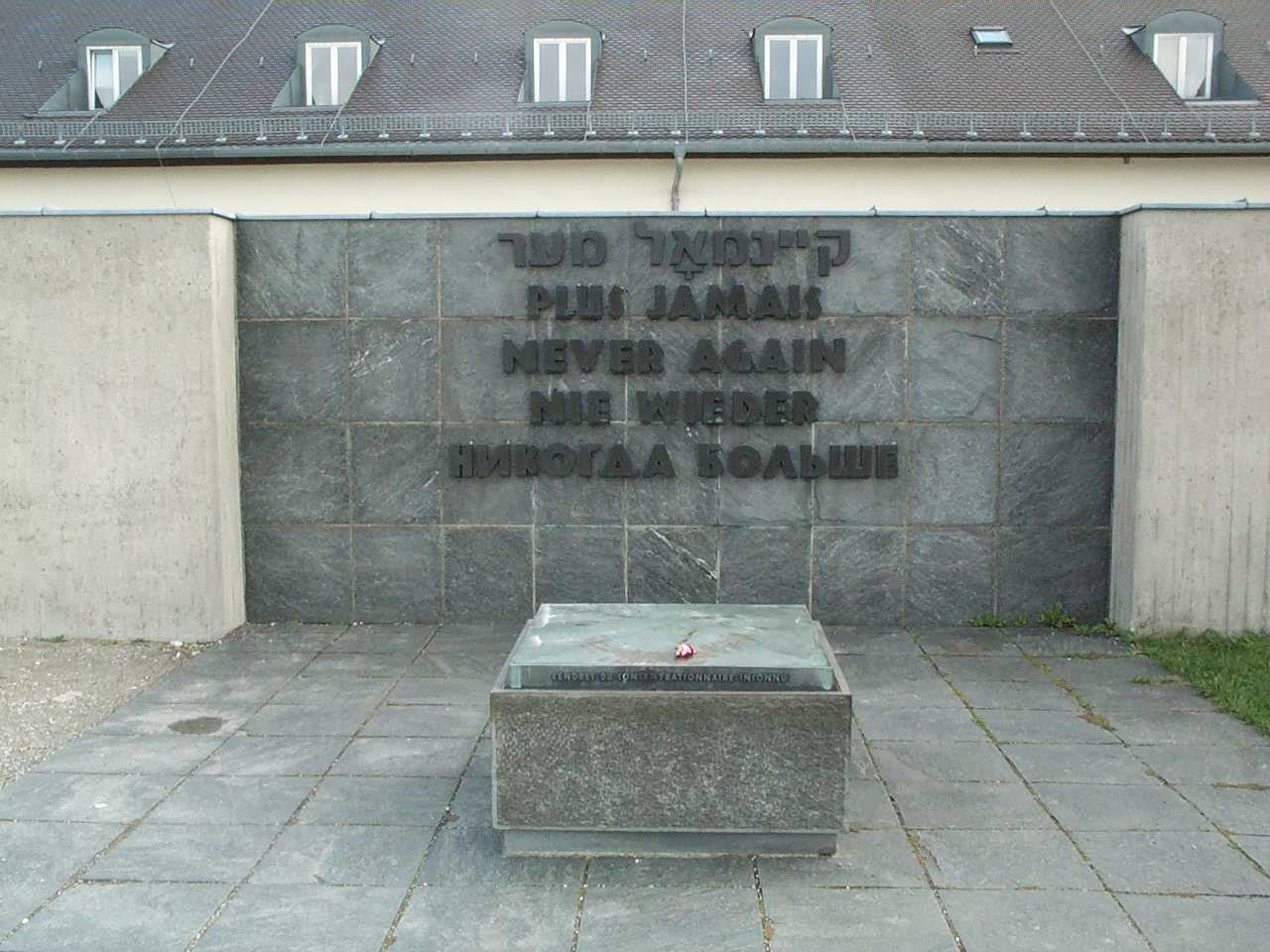
Never Again? No...and Yes.
The Memorial at Dachau
Even more than six decades after the fact, Yom Hashoah is a very frightening day for children (if not for adults as well). My son's school screened the film adaptation of "The Boy in the Striped Pajamas", which left him somewhat jarred. (I'm not a personal fan of the film or the book, which is, according to IMDB, "a story seen through the innocent eyes of Bruno, the eight-year-old son of the commandant at a concentration camp." Sorry, but only Hollywood would try to see the Nazis' side of the Holocaust, so that we should feel sorry for their innocent children.) In any case, the film led to a discussion about the Shoah and whether it could happen yet again. It's scary to watch a depiction of Jews marching towards their own deaths in the showers of a concentration camp. Bezalel, my twelve-year-old son, felt that the Holocaust could indeed happen again. If no one rose to protect the Jews of Europe, what assurances do we have today?
Moreover, Bezalel added, the Jews can lose. He's learning Navi, and noted that Jewish kings fought and lost wars against their enemies. So who is to say that even in Israel, even with the strength of the IDF, that we're safe?

I agreed with him. It could indeed happen again. Indeed I feel that the Jewish efforts (and the tens, if not hundreds of millions of Jewish dollars spent) to ensure "never again" seem naive and short-sighted. After all, who could have imagined that it could happen in Germany? No one believed it possible, even while it was happening. Moreover, there indeed are no shortage of people trying to kill us. After all, just last month we enjoyed yet more family time in our protected room, as our Arab cousins to the south shared some of their homemade and imported rockets. (Thanks!)
No, there are no guarantees. But, I told him, there is a critical difference. Something has indeed changed.Today, even as our enemies attack us, we stand up and fight. Indeed, we may (God forbid) lose and suffer a terrible defeat. But at least if we go down, we will go down fighting.
No one can say that never again will an enemy of the Jews rise to power on a wave of hatred, racism and fanaticism, hoping to exterminate the Jewish people. It's happened before, and probably likely to happen again, sooner than anyone would like to believe.
But we can say a different type of "Never again."
As long as their is a Jewish State, we will never again walk placidly to our own deaths without a struggle. We will "never again" allow an enemy of the Jews to kill us without a fight.
Of that, we can indeed be sure.

Sunday, April 11, 2010

As the Shoah Fades Away

Gary Rosenblatt wrote a moving piece about the gradual fading relevance of Yom Hashoah. I strongly agree with him. I remember as a child years ago attending Yom Hashoah commemorations at the Young Israel Shomrei Emunah in Silver Spring that were packed - standing room only. The entire community felt the need to participate, bring their children, pass the message on to the next generation.
Fast forward to the early 21st century. The attendance was so paltry that things got to the point where I wondered whether we should even have a community Yom Hashoah event. My friend and colleague Rabbi Yechiel Morris insisted (rightfully so), and he did most of the work putting the event together. But I always felt a twinge of embarrassment for the survivors. Year after year they would come, every year so much the frailer; each year one or two unable to make it to the program, or even in the next world. Didn't we owe them more? Could we not at least make a better showing? We could not.
And yet, my worry about the fading memory of the Shoah centers not on the Orthodox Jewish community. A community rooted in learning and study can never forget the sudden loss of some of its greatest luminaries, and the sudden decimation of great centers of learning and teaching. Moreover, the Orthodox community observes ritually the mourning of suffering and loss on Tisha B'av. Some of my most powerful Shoah images came from talks given by Mr. Manny Mittelman on Tisha B'av. The Orthodox community, which actively commemorates our suffering, will transfer Yom Hashoah to that fateful day (or perhaps to the tenth of Tevet, known in Israel as Yom Hakaddish haklali - the day of general Kaddish), where it probably should have been all along.
I worry more about the secular Jewish community which lacks these very rituals that form the basis of collective and religious memory. Without a Tisha B'av or a fast day or a framework within which to place the tragedy of the Shoah, as the Jews who suffered through the Holocaust first-hand die out, so will the communal need and desire to remember them and the Shoah.
Until the next one.