Showing posts with label Faith. Show all posts

Wednesday, July 11, 2018

Avoiding the Question, Or "Why David Kestenbaum's Sadness Makes Me Sad"

I feel sad for David Kestenbaum.

No, I don't know Mr. Kestenbaum, who is a producer-reporter for This American Life (although he used to be a particle physicist), a popular podcast that I sometimes listen to. But I'm sad, because he's sad (or at least he was - apparently, this is a repeat episode from a year ago).

Why is Kestenbaum sad? What's got him down as he brushes his teeth in the morning and goes about his day? A perplexing question called "Fermi's Paradox". Kestenbaum explains (I'm quoting from the transcript of the show, which is a conversation between TAL host Ira Glass and Kestenbaum that I've edited for brevity):
David Kestenbaum
So the story goes that this is 1950. Fermi's visiting Los Alamos, and they're sitting around at lunch. It's Fermi and a handful of other physicists and they start talking about extraterrestrials.

Ira Glass
One of the scientists who was there remembers that they talked about some New Yorker cartoon, which had flying saucers and cheerful aliens stealing our trash cans. They joked about it.

David Kestenbaum
And then out of nowhere, Fermi says something like, so where are they?

Ira Glass
Meaning?

David Kestenbaum
The aliens.

Ira Glass
And did people know what he meant?

David Kestenbaum
Yeah, somehow everybody knew exactly what he meant. The idea was basically that, like, the galaxy is this huge place, right? Hundreds of billions of stars. It's been around for billions of years. If you believe that intelligent life is something that just arises given enough time, where is everybody? Like, there have been billions of years, where civilizations could have developed and become way more advanced than we are and traveled from star to star, sent signals or something. Where are they? If that's right, where are they?

Ira Glass
This question became known as the Fermi Paradox, which goes like this. If it's so likely that intelligent life exists elsewhere, where is it? Why hasn't anybody shown up? And of course, the simple answer to that would be, well, nobody else exists.

David Kestenbaum
And I had never thought-- it made me think, maybe we're alone. I really thought that for the first time. Yeah, it made me really sad. I had never thought about it seriously before. I had always assumed that life was everywhere. But he's making a really serious point here. He's raising a tough question. The specific thought I was having was that this would mean that there's nobody out there who knows more than we do, like, about science, about-- there are no better songs. There are no better books. This is it, you know?

Ira Glass
So for months now, when David's brushing his teeth or doing nothing in particular, it'll hit him again. Maybe we're alone in the universe. Like this morning, on the train. Like, what we know is it. What we are is it.
The thing is, no one he talks to can really understand why it makes Kestenbaum so sad. They laugh off the question. What difference does it really make if we're all that there really is? Why does this question upset Kestenbaum so much? He never really explains what bother him, and other cannot really appreciate his angst.

I think that I understand what bothered him. But to me, what's sad about the whole story isn't that Kestenbaum is sad. The most upsetting aspect is the fact that he won't allow himself to ask the deeper question, and when he does, he rejects it out of hand.

*********

To address his question, Kestenbaum turns to Melissa Franklin, his physics professor from Harvard, who he thinks will at least understand the question. After humoring him for a bit, Franklin starts to ask him some serious questions.
What exactly do you mean by being alone? Let's properly define the question here. You're talking about no intelligent life or no life at all? What if there's one crappy plant on another planet? How would you feel about that? What if advanced life like us is just a mathematical improbability, a total fluke?
Professor Franklin concluded, "And then you would say, OK, if that's the case, I have to believe in God. So that's what you're saying."

You would think that as a physicist - an empirical person trying to understand scientific truth, Kestenbaum would react seriously to this question. He would consider it and its implications, and actually wonder whether this was what's really bothering him. But no. He responds with a sad, actually pathetic argument.
David Kestenbaum
How many physicists do you know who believe in God?

Melissa Franklin
Six.
That's his answer? He's been pondering a question for months, literally walking around in a funk from a question, and as soon as a serious thinker proposes that what's really bothering him is a much deeper question of faith and creation, rather than addressing the question seriously, he scoffs at it.

His answer isn't even an answer, and is actually irrelevant to the question. What difference does it make how many physicists believe in God? Maybe they're all under the spell of some cult. What about those six? Are they crazy? Have they lost their mind. Is that how science works? You take a poll of commonly held beliefs, and ignore the actual facts entirely?

Moreover, what if they Professor Franklin only knows six god-believing physicists because that's the circle of colleagues she has created for herself? According to a HuffPost article I just found (pretty easily), a recent Pew Research Center survey, "found that the percentage of scientists that believe in some form of a deity or power was higher than you may think — 51 percent."

Kestenbaum's response immediately made me think of the very first of C.S. Lewis' Screwtape Letters, which is a brilliant treatise about human nature and the cause of sin. In his letter, he explains how the devil (i.e. the yetzer hara) works very hard not by arguing with us about the facts. Quite the opposite. His most effective strategy is avoiding argument.


That's exactly what Kestenbaum does. Confronted with an argument, he avoids and deflects. Rather than try and address a difficult and challenging question, he responds by scoffing at the possibility that he might actually believe in God. After all, he's a physicist! And they don't believe in God, do they?

In fact David, many of them do. And while you once were a physicist, you're not really a physicist anymore. You're a journalist. And in the NPR world that you inhabit, they really don't believe in God, and really would ridicule you if you in fact did.

The fact that you cannot in fact see this makes me quite sad.


Monday, June 9, 2014

ChoppingWood Mailbag: Responding to a Comment about Belief

My cousin and good friend (and digital guru) Avi Greengart sent the following comment to my last post, which I started to answer and then realized that my answer is really a full blog post. I have received other responses which I will address in a future post (hopefully this week).

Avi writes,
Let's say your neighbor [who said that many, if not most Orthodox Jews in the community he grew up in doubt the divinity of the entire Torah] is correct. (Because he is.) Your response? You want people to believe things that they do not (without explaining why they should believe things that they do not). Then you want them to act in ways that will cause them to confront their non-belief. Are you sure that's a good idea?
--What if they don't know what they believe and their version of faith is to keep doing mitzvot anyway?
--What if they've given great thought to these issues and their conclusion is, "I don't believe the version taught to six year olds; Truth is actually Complicated."
--What if they absolutely do NOT believe in "the Divine nature of the Torah?" but know that it is a good way to live / don't want to break up the family because the spouse is a Believer?
My response:
First of all, thanks for confirming my suspicion that my neighbor is, in your mind, correct. I suspected as much, but I'm not "there". It's also important not to cast aspersions on the entire Orthodox community. I'll only say that it's a significant phenomenon, which is what prompted me to write about it. I'll take your comments in order, because I believe this discussion is really, really important (and will be following up with at least one more post).

"You want people to believe things that they do not (without explaining why they should believe things that they do not). Then you want them to act in ways that will cause them to confront their non-belief. Are you sure that's a good idea?"
I don't really think it's just me. I also would not say that it's just that "I want" people to believe in the divinity of the Torah. This is a fundamental belief essential to our identity both as a religion and as a people. I believe that this is what God wants. I don't know if I am, in my blog, addressing those people that don't believe in the divinity of the Torah. But I do feel that people when people struggle (because belief isn't an all-or-nothing value), then focusing on the "yes" side can and does reinforce faith.
Moreover, in my mind I was primarily addressing people who do have the faith and belief. I feel it's critical today to emphasize that fact. Belief and faith as ideals are under siege in Western society. Assuming that you can just withstand attack after attack without taking strong steps to counter those attacks isn't realistic. It's not enough just to believe (and I don't know if it ever was). At the back of Shacharit in pretty much every siddur you'll find the 13 Principles of Faith of Rambam. I was never raised to say those each day (yes, I blame my mother), but perhaps we need to teach ourselves, and especially our children to recite these 13 Principles - and not to just say them, but to also know what they mean).

What if they don't know what they believe and their version of faith is to keep doing mitzvot anyway?
I'm OK with that - not just OK, but quite supportive. Everyone struggles with faith, on some level, and to say, "I can't claim to have all the answers, but submit and fulfill the commandments" is, to my mind, a wonderful expression of faith.

What if they've given great thought to these issues and their conclusion is, "I don't believe the version taught to six year olds; Truth is actually Complicated."
I find your formulation to be part of the problem. We were taught at age 6 (and 2 and 3) that God created the world. I still believe that, despite the fact that I learned that piece of information at a very young age. I was also taught that God gave the Jews the Torah at Sinai, that God split the Sea and rescued the Jews from Egypt - both at a very young age. Still believe both. The fact that we're taught these things at a very young age doesn't affect whether they're true or not, nor does using supposed axioms like "Truth is actually complicated" - which sounds true, but is in fact misleading. 
This also goes to the heart of what you mean by "truth", which is a loaded philosophical question (and now I'm even starting to bore myself). Some truth is complicated, while other truth is quite simple. ה' אלקינו ה' אחד - "The Lord is our God, the Lord is One." Complicated? Of course you could delve into the matters of Oneness, and the names of God, and give a series of shiurim on the topic. I have. But it's also very simple: I believe in the One True God. And I'm neither ashamed, nor upset by the fact that I was taught this idea at a tender young age, and using that fact to denigrate basic beliefs is part of the cultural war against belief that I mentioned earlier.
Truthfully, I find it ironic, that the very same society that loves to promote the fact that "Everything we need to know we already learned in Kindergarten", and by buying books and posters promoting those universal truths, will then turn around and ridicule any universal faith truth that we teach to toddlers.

What if they absolutely do NOT believe in "the Divine nature of the Torah?" but know that it is a good way to live / don't want to break up the family because the spouse is a Believer?
I'm against breaking up families. I don't think parents have to agree. But if I was the believer, I'd be very concerned about how I was going to pass my faith on to my child, when my spouse, in subtle and not-so-subtle ways - sends the very clear message that the very faith most critical to me, and fundamental to my way of life, believes that it's a bunch of baloney.

Maybe then the lesson is to start asking these questions earlier in the process, perhaps while dating. 
Instead of asking the really important questions like: "Do you care if I wear pants and cover my hair?" or "Do you want to live in Teaneck or the Five Towns" or even "Are you planning on making Aliyah"?, perhaps young people should first, in all seriousness, begin asking each-other: "Do you believe that God gave the Jewish people the Torah?"

Monday, June 2, 2014

Back to the Basics this Shavuot

Two important blog posts have been troubling me recently: the now infamous Social Orthodoxy post, which I've blogged about already, and a recent post by Yoram Hazony about Biblical Criticism in Orthodox shuls.
That post prompted me to ask a neighbor the following question: How many of the members of the shul where you grew up believe in Torah MiSinai - that God gave Moses the entire Torah?"
His answer? You don't really want the answer to that question, do you?
This, to my mind, is the greatest threat to traditional Judaism today. It's not Tzniut, or Lashon Hara, or the Internet.
It's basic belief in the Torah.
Someone living in the Western world find himself consistently bombarded with messages that ridicule belief in the divinity of the Torah, and the authenticity of Jewish Tradition. This is especially true on college campuses. It's ironic, in a way. At the same time that Orthodoxy (the movement) is trendy, growing and popular, Orthodoxy (the faith) seems to be antiquated, ancient and increasingly out of touch.

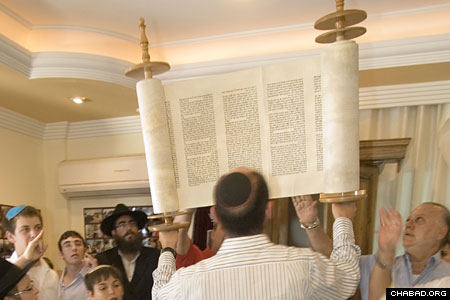
Every time we read the Torah in shul, after we're done reading someone is called to lift up the Torah, and the congregation proclaims aloud,
וזאת התורה אשר שם משה לפני בני ישראל על פי ה' ביד משה
This is the Torah that Moshe placed before the Children of Israel, from the word of God in the hands of Moshe
We actually point at the Torah (although I have no idea why people do it with a pinky), and some authorities insist that one actually must be able to see the words of the Torah when making this declaration. Commenting on the custom of lifting up the Torah Rav Eliezer Melamed writes,
וכל כך חשובה ההגבהה, עד שאמרו חכמים (מגילה לב א), שהגולל, והכוונה למגביה, נוטל שכר כנגד כל מי שעלה לתורה. ולכן ראוי לכבד בהגבהה את אחד מנכבדי הקהל.
So important is Hagbah that the Sages said (Megillah 32a) that the wrapper - meaning the person who lifts the Torah, takes the same amount of reward as every other person who received an aliyah. For this reason, it is worthy to honor with Hagbah an honored member of the congregation
Over the years, Hagbah has lost some of its luster. We give it young people who don't read the Torah, or strong people (if it's one of those old Torah's that weigh a ton). We don't give it much thought. I also wonder how many people think about the meaning of the sentence when reciting it at Hagbah. How many people who don't actually believe the sentence, say it anyway, without even thinking? How many of my neighbor's old shul-mates instinctively recite the verse, although if you asked them about it, they'd hem and haw and start talking about unfolding revelation.
In his list of the Foundations of Faith, Rambam writes,
היסוד התשיעי ההעתק, והוא כי התורה הזאת מועתקת מאת הבורא השם יתברך לא מזולתו, ועליה אין להוסיף וממנה אין לגרוע לא בתורה שבכתב ולא בתורה שבעל פה. שנאמר "לא תוסיף עליו ולא תגרע ממנו".
The ninth foundation is that of copying - that is that this Torah is copied from the Created, the Blessed God - and not from anyone else, and one cannot add nor subtract from it - neither from the written nor the oral Torah, as it is written, "You shall not add nor subtract from it."
We will soon celebrate Shavuot - זמן מתן תורתנו - the Time of the Giving of the Torah. It's the day that we celebrate the Revelation - the great moment when all of Israel stood as one, at the foot of a simple mountain, and literally experienced the giving of the Torah.
Do we experience Matan Torah on Shavuot morning? (Or are we too tired from a night of lectures, stale coffee and barbecue - if you're lucky - to even listen to the Torah reading, much less appreciate what it means?
This Shavuot, tell the story of Matan Torah to your children. Read them books on the event. Talk about what it must have been like to stand at Sinai with the Jewish people at that incredibly historic moment. Teach them the meaning of the verse וזאת התורה that they already know how to say. Make it real. And make it clear to them that you believe every word.
Because if they don't know - fully and completely - that their parents do actually believe in the Divine nature of the Torah, how can we ask them to believe it themselves?

Friday, May 9, 2014

What We Believe: It's Time to Start Talking about God Again - A Thought for Behar

Speaking with a rabbinic friend of mine, he mentioned a well-shared article called "The Rise of Social Orthodoxy", which describes leading an Orthodox lifestyle including keeping kosher, donning tefillin daily, keeping Shabbat - all without the inner belief that should be motivating such a lifestyle. Jay Lefkowitz writes,
And so for me, and I imagine for many others like me, the key to Jewish living is not our religious beliefs but our commitment to a set of practices and values that foster community and continuity. 
I said that I thought that the article reflected an extreme. After all, most members of Orthodox communities adhere to Orthodox beliefs, I argued.
My friend begged to differ. Many, he said, if not most members of "Modern Orthodoxy" are exactly like that.
"You mean they don't believe in Torah MiSinai? They don't believe in God?"
He seemed to think that they do not. When I insisted that the vast majority of the people that I knew did adhere to these beliefs, he suggested that I'm naive.
There's no doubt that belief in God, and especially the belief in the divine nature of the Torah, has been under attack by Western Culture for many years. I'm so accustomed to it that I tune it out. To what degree the denigrating comments in the media and the sarcastic attitude towards belief in God affects us is an open question.
But if the issue of fundamental belief truly is in danger, then it's time to start talking about it again. As a rabbis (and writer), I've spoken about so many ancillary topics: Torah study, prayer, Israel...the list goes on and on. But when's the last time you were in talk and the rabbi talked about God - and actually mentioned God Himself?

In one of his most famous comments, Rashi quotes the famous question of the Midrash: מה עניין שמיטה אצל הר סיני - "What's the connection between Shemittah and Mount Sinai?" Actually, Rashi's question revolves around the text. The Torah introduces the commandment of Shemittah (to leave the field fallow during the Sabbatical year) unusually: וידבר ה' אל משה בהר סיני לאמר - "And God spoke to Moses on Mount Sinai saying." Throughout most of the Torah, we find the usual introduction: וידבר ה' אל משה לאמר - "And God spoke to Moses saying." Here, the verse emphasizes that this commandment was issued on Sinai. What unique aspect of Shemittah can explain this unusual emphasis?
Interestingly, Rashi explains that it's not about Shemittah at all. Rather, it's about everything else.
אלא מה שמיטה נאמרו כללותיה ופרטותיה ודקדוקיה מסיני, אף כולן נאמרו כללותיהן ודקדוקיהן מסיני
Rather, just as with regard to Shemittah - all of its rules and details were given at Sinai, so too all [of the commandments] - their rules and details were [also] given at Sinai.
It's not just Shemittah. The entire Torah was given at Sinai. All the details of the Oral Torah, and the means to extrapolate those rules to our modern lives, were given by God to Moses at Sinai.
This is a core belief of Judaism - fundamental to the way we live our lives. When we don our tefillin in the morning, sure there's a sense of camaraderie and we're ensuring the future of the Jewish people. But that's not why we put on Tefillin. The Shulchan Aruch writes:
יכוין בהנחתם שצונו הקב"ה להניח ארבע פרשיות אלו שיש בהם יחוד שמו ויציאת מצרים על הזרוע כנגד הלב ועל הראש כנגד המוח כדי שנזכור נסים ונפלאות שעשה עמנו שהם מורים על יחודו ואשר לו הכח והממשלה בעליונים ובתחתונים לעשות בהם כרצונו וישתעבד להקב"ה הנשמה שהיא במוח וגם הלב שהוא עיקר התאוות והמחשבות ובזה יזכור הבורא וימעיט הנאותיו
He should concentrate when he dons [the Tefillin on the fact] that the Holy One blessed is He commanded us to don these four sections [of the Torah], for in them is the unification of His name and the Exodus from Egypt. [And we should place them] on the arm corresponding to the heart and on the head corresponding to the brain so that we remember the miracles and wonder that He did with us, for these teach us about His Oneness, and that He has the power and dominion above and below to do as He wishes. And he should subjugate his soul to the Holy One - which is in the brain and the heart, where the essential thoughts and desires are found, and in this way he will remember the Creator and minimize his desires.
That is why we wear Tefillin.
That is what we believe.

Wednesday, July 4, 2012

They Found the God Particle? Well, Sort Of...

The news is all abuzz abou the announcement of the discovery of the "God" particle, which really isn't a "God" particle at all, as its discovery sheds no information whatsoever on the origin of the universe. In fact, according to Wikipedia, scientists hate the name. Why is it called the "God" particle?
The Higgs boson is often referred to as "the God particle" by the media, after the title of Leon Lederman's popular science book on particle physics, The God Particle: If the Universe Is the Answer, What Is the Question? Lederman said he gave it the nickname "The God Particle" because the particle is "so central to the state of physics today, so crucial to our understanding of the structure of matter, yet so elusive," but jokingly added that a second reason was because "the publisher wouldn't let us call it the Goddamn Particle, though that might be a more appropriate title, given its villainous nature and the expense it is causing."
Still, the media loves the name, because it's much more exciting (and generates far more clicks) than, "The Higgs boson", which sounds much more like a bad rock band; or the name of a recent LeCarre novel.)
And yet, reading about the discovery in the Washington Post, which really tries hard to explain what the heck the Higgs boson is - and fails miserably - one paragraph caught my attention. Writing about how the scientists "found" the particle, we learn that they didn't actually find anything at all.
The CERN physicists did not see this new particle directly, because it disintegrates too quickly. Rather, they divined its existence from sifting through the debris of millions of high-energy subatomic collisions and then searching for clues that the Higgs had been there. It’s like divining the presence of an elusive snow leopard by studying thousands of criss-crossed paw prints. 
In other words, they didn't actually see the particle. That's impossible. They just saw evidence that it exists. Sounds a lot, actually, like the way we relate to God.
As we all know, we cannot see the existence of God. But the evidence of the Divine presence is all around us, if we just know how to look for it.
This morning, I was speaking with a neighbor whose wife just gave birth to a daughter (Mazal Tov Shapiro Family!), and he mentioned to me a TED Talks video about the miracle of birth. The speaker, Alexander Tsiaras of Harvard University, never mentions God, but alludes to God (it's almost as if a scientist can't explicitly say God), but he does say that the things that they saw in their scans of the body, "Just make you marvel. "It was hard," he says, "not to attribute divinity to [the beautiful, miraculous organization of the human body], because we kept seeing this over and over and over again in different parts of the body. "
You don't need a $17 Billion Large Hadron Collider in France to find a God particle. No, we cannot see God Himself. But the evidence of His existence is right before us, if only we know how to look.


Monday, September 12, 2011

The Limits of Faith - A Lesson from Rav Kook

The Gemara (Berachot 58b) relates a story about Rav Chisda, who upon seeing the ruins of the house of R' Chana bar Chanilai - who was a very rich, very generous man - became depressed. I'll leave out the middle of the story for now, (which I will address in another post soon). Ulla, who was with Rav Chisda at the time, tried to appease him by quoting a pasuk which says,
הַבֹּטְחִים בה'--  כְּהַר-צִיּוֹן לֹא-יִמּוֹט, לְעוֹלָם יֵשֵׁב.
"Those who have faith in Hashem are like Har Tzion, which cannot be moved, but abide forever."
On this the gemara comments,
"Just as Hashem promises to rebuild Har Tzion, so too will Hashem return the houses of the righteous (that were destroyed)."
On this point Rav Kook (Ein Ayah Berachot Vol II, p.  writes,
Bitachon is limited [only to the point] that we complete our efforts to the best of our abilities. That which our hands cannot reach - there is the place for Bitachon. For the place which our ablilies reveal, God forbid that we should use our Bitachon, for this isn't Bitachon, but instead foolishness and insolence towards Heaven."
I'm pretty sure that Rav Kook was talking about building the Land of Israel, and especially those who rejected Jews physically building the Land, instead insisting that we wait for a miraculous redemption. Yet, the message also applies to all aspects of our lives. God doesn't want to have Bitachon first. He wants us to act - to do our part, to the best of our abilities. After we've done that, then we turn to God with faith.
Then it's all up to Him.

Monday, October 18, 2010

The Latest Song Craze Here in the Holy Land

It started with Simcha, who learned the words first. Then, somehow, Petachya picked it up, and now the kids won't stop singing this song. As you listen, you'll notice that it's basically a hip-hop song that you'd expect to hear in a disco (From what I know. I don't frequent such places. Too old.). But then, if you listen to the words, you realize that there's something much deeper going on in a song from a seemingly secular Israeli pop star. I can't embed the song (it's been disabled, but you can watch and listen to the song here (live) and here. The lyrics are as follows (with translation):
בכל מקום כל הזמן
יש לכולנו מגדול ועד קטן
ימים יפים וגם פחות
וביניהם תשובה לכל השאלות
In every place, at all times,
we all, from young to old
have good days, and also less [good]
and in between them the answer to all the questions

יש אלוהים אחד גדול
הוא בעולם הזה נותן לנו הכול
בין אפלה לקרן אור
את הנתיב אנחנו רק צריכים לבחור
וזה ידוע החיים הם מתנה
הכול צפוי והרשות נתונה
there is One Great God
in the world who gives us everything
between the darkness and the ray of light
we only need to choose the [proper] path
and it is known that life is a gift
everything is expected, and the permission is given (that's a quote from Rabbi Akiva in Avot 3:14)

(Refrain)
מי שמאמין לא מפחד,
את האמונה לאבד
ולנו יש את מלך העולם
והוא שומר אותנו מכולם
He who has faith is not afraid
of losing that faith
and we have the King of the World
and he guards us from them all

(Second Stanza)
העם הזה הוא משפחה
אחד ועוד אחד זה סוד ההצלחה
עם ישראל לא יוותר,
תמיד על המפה אנחנו נשאר
וזה ידוע החיים הם מתנה
הכול צפוי והרשות נתונה
This nation is one family
one plus another one is the secret to success
we will always remain on the map
and it is known that life is a gift
everything is expected, and the permission is given
The words are surprising, even shocking, coming from a seemingly secular Israeli, and they clearly have touched a nerve in Israeli society. I have long believed that most, in fact the great majority of secular Israelis - are not as secular as we might believe. The cab driver who picked you up puts on tefillin each day. The secular lady you work with shares Shabbat dinner with her elderly mother each week. There's a tremendous amount of faith in this country that's looking for an outlet, if only we can find a way to tap into it. Not every song on YouTube gets 2.5 million hits.
There's also clearly a strongly political (and geopolitical) aspect to the song. "We will always remain on the map" clearly alludes to the Iranian threat, and the Jewish response not only of military strength, but also faith in God. I find it refreshing and quite powerful to see a spiritual response come not from the frum, but from the secular community. (You can also clearly hear the Breslover refrains of והעיקר לא לפחד כלל" - "and the essence is not to be afraid at all!" as well)
It's a catchy tune that kids really latch onto. If you teach in a Jewish school, would you teach it to your students? It's a great lesson in faith, in Hebrew, and also about Israeli society: secular, religious, faithful, Breslov - all mixed into one messy song.

Friday, September 3, 2010

Did God Create the Universe?

Did God create the universe?
I'm pretty sure that He did. It's a pretty strong tenet of Judaism, and every other religion as well.
Rambam opens his Mishnah Torah (Laws of the Foundations of the Torah 1:1) addressing precisely this point.
יסוד היסודות ועמוד החכמות, לידע שיש שם מצוי ראשון.
It is the foundation of foundations and the pillar of all wisdom, to know that there is a first presence.
(Question for discussion - and there's a lot of it - how can Rambam tell us that we must know that God exists? Isn't that a belief? Shouldn't he write, "to believe"? Also note that the first letter of the first four words spell out the name of God - yud - hey - vav - hey. Not a coincidence.)

Rambam's statement serves as a fundamental tenet of every other religion as well. That is, every religion except one: the religion of science.
That's right - science.
Why do I call science a religion? Because it has somehow evolved into a system of belief. The latest evidence: Physicist Stephen Hawking's new book in which he declares that, "God did not create the universe." Reuters reports:
In "The Grand Design," co-authored with U.S. physicist Leonard Mlodinow, Hawking says a new series of theories made a creator of the universe redundant, according to the Times newspaper which published extracts Thursday.
"Because there is a law such as gravity, the universe can and will create itself from nothing. Spontaneous creation is the reason there is something rather than nothing, why the universe exists, why we exist," Hawking writes.
"It is not necessary to invoke God to light the blue touch paper and set the universe going."
Here's what I don't understand: who made gravity? No matter how far back you go, there's a point at which you simply can't answer the question, "and who made that?" unless you invoke a higher being.
These theological pronouncements leave me baffled for another reason. I always understood science to be the study of something that you can prove. Wikipedia defines science as,
any systematic knowledge that is capable of resulting in a correct prediction or reliable outcome.
You observe something, posit a theory about it, and then go about the business of trying to prove whether the theory is true or not. Until it's been proven, it's just a theory.
Yet, for some reason, theory now takes on the role of truth. As soon as science postulates a theory that it really cannot empirically prove (evolution, big bang, etc.), the scientific world immediately accepts that theory as truth, especially when that theory challenges religious dogma.
Why do scientists feel so threatened by God? Why does Stephen Hawking feel the need to deny the existence of God due to his latest theory of M (which I'm sure I'd never understand)? Why is science on such a crusade against God? Even more to the point, if Stephen Hawking is willing to define truth despite the fact that he cannot prove his assertion, the according to my understanding, he's not acting like a scientist.
No, he's a theologan. And not a very good one.

Monday, January 18, 2010

The Fine Line: Faith and the Tragedy in Haiti

About a week after a major tragedy - often a natural disaster, a rather predictable cycle ensues.
  1. The tragedy occurs
  2. Some theological spokesman makes a questionable pronouncement about Divine wrath and the reason for the tragedy
  3. One or many secular columnists latch on to the pronouncement, pouncing on it with religious fervor, negating any possibility of the connection of the Divine to said events.
This week, we've watched the cycle unfold:

Step 1: Earthquake in Haiti. Terrible Suffering
Step 2: Pat Robertson became the "first responder," saying that after the Haitians made a pact to worship the Devil two hundred years ago, they've suffered terribly ever since. Not such a smart thing to say on national TV. (Or maybe it is. I don't have my own TV network. Pat knows his viewers.)
Step 3: Self-described atheist Christopher Hitchens, author of most recently, "God is Not Great", wrote a scathing, sarcastic, biting piece in Slate magazine essentially describing Pat Robertson as a moron, as well as anyone else who might believe that God has anything to do with earthquakes.
The Earth's thin shell was quaking and cracking millions of years before human sinners evolved, and it will still be wrenched and convulsed long after we are gone. These geological dislocations have no human-behavioral cause. The believers should relax; no educated person is going to ask their numerous gods "why" such disasters occur. A fault is not the same as a sin.
However, the believers can resist anything except temptation. Where would they be if such important and frightening things had natural and rational explanations? They want the gods to be blamed.
He writes well - and convincingly.
But then I wonder: what's a believing person to think? Sure, Hitchens can bask in his atheism and proclaim: these things just happen. There's no reason. That's life. It stinks.
But I don't agree with in any of those statements. I believe in an infinite, Almighty, all-compassionate God, who maintains a constant and unending watch over the entire world. I also read the Torah, and believe that its timeless lessons apply no less today than they did when conveyed thousands of years ago.

I find it somewhat striking that this terrible devastation occurred precisely as reading about the terrible plagues that God brought upon the people of Egypt. When reading the Torah, the makkot get pretty harsh. They not only bother, annoy and disturb. They kill, maim and destroy, ultimately resulting in the deaths of thousands of Egyptian first-born, be they elderly adults or newborn infants. In an instant every single one of them was dead.
Sounds familiar.
At some point it starts to feel excessive. It stopped being about letting the Jews go. After all, if the Pharaoh wants to free the slaves, why then would God "harden his heart" only to slam him and his people once again. The Torah clearly spells out the reason for these continued plagues:
וַיֹּאמֶר ה' אֶל-מֹשֶׁה, בֹּא אֶל-פַּרְעֹה: כִּי-אֲנִי הִכְבַּדְתִּי אֶת-לִבּוֹ, וְאֶת-לֵב עֲבָדָיו, לְמַעַן שִׁתִי אֹתֹתַי אֵלֶּה, בְּקִרְבּוֹ
And the LORD said unto Moses: 'Go in unto Pharaoh; for I have hardened his heart, and the heart of his servants, that I might show these My signs in the midst of them; (Shemot 10:1)
Commenting on this first verse Ramban explains:
הודיע הקב"ה למשה שהוא הכביד את לבם עתה אחרי שפחדו ממנו בברד והתודו על עונם. ואמר לו הטעם כי עשיתי כן, למען שאשית בקרבם אלה האותות אשר אני חפץ לעשות בהם שידעו מצרים את גבורתי, לא שאעניש אותם יותר מפני הכובד הזה
God informed Moshe that he hardened their hearts now, after they already feared Him from the hail and confessed their sins. [God] said to [Moshe] that the reason that I did this was so that I will place in their midst these signs that I wish to do to them, so that they will know My might, and not so that I punish them any more due to their own stubbornness.
According to Ramban God inflicted the last few plagues - the most difficult, devastating plagues - in order to demonstrate His might not only to the Jewish people, but to the world.

Rav Yosef Karo, author of the Shulchan Aruch writes (see Orach Chayim 227),
על הזיקים, והוא כמין כוכב (א) היורה כחץ באורך השמים (ב) ממקום למקום ונמשך אורו כשבט; ועל רעדת הארץ; ועל (ג) [א] הברקים; ועל הרעמים; ועל רוחות (ד) שנשבו א בזעף, (ה) על כל א' מאלו, אומר: בא"י אמ"ה עושה מעשה בראשית; (ו) ואם ירצה יאמר: (ז) בא"י אמ"ה <א> שכחו וגבורתו מלא עולם.
[If one sees a] constellation - which is a kind of star shooting like an arrow across the breadth of the sky from place to place, and its light stretches like a staff; and on the shaking of the earth; and on lightening; and on thunder; and on winds that blow with great power - on any one of these one should recite [the blessing] "Blessed are you God, our God the King of the world, who performs acts of creation." And if he wishes he should say, "Blessed are you God, our God the King of the world, whose power and might fill the world."
I can just imagine Christopher Hitchens writing in Slate Magazine back in Egypt - except back then they would have called it "Papyrus.com". Plagues happen. Hail happens. Firstborn die. God didn't do this. Moses didn't do this.
But imagine that God wanted to make the world aware of His presence through natural means. What could He do? A Hurricane? Did that. Tsunami? Same. Earthquake? Ditto. And each and every time, the world looks on and says: "There is no God. These things just happen. What did the little children do? Why would God want to punish them?" Yet, this attitude always presupposes the notion that we understand how and why God operates and can therefore negate the possibility that He would perpetrate such an act.
I don't make any such claims. Nor do I know the reason why the earthquake took place in Haiti specifically, nor why Haitians bore the brunt of this tragedy.
But I emphatically believe that God did perpetrate this earthquake - as He does so many major and minor events that transpires in the world, from the ones we struggle with, like the earthquakes and illnesses and tragedies; but also the ones that we accept and take for granted: the births and accomplishments; the triumphs and successes. God's "fingerprints" mark every event, whether we look for them or not; whether we can see them or not.
Because claiming that earthquakes just happen and that their victims suffer meaninglessly seems to me to be the cruelest attitude of all.

Friday, January 8, 2010

Faith In the USA

In this now-famous clip, Fox News senior commentator Brit Hume advises Tiger Woods to switch from Buddhism to Christianity. After all, says Brit, if Tiger wants complete repentance and absolution, Buddhism doesn't offer total cleansing. (I'm not an expert on Buddhism, but I'll take him at his word.) "I don't think that faith offers the kind of forgiveness and redemption offered by the Christian faith. My message to Tiger would be turn to the Christian faith and you can make a total recovery, and you can be a great example to the world."
I have no problem with Brit Hume proselytizing on TV. In fact, I'd rather more people profess their faith actively. If people don't like it, they'll stop watching Fox News and Brit will stop doing it. What does bother me is Brit's uniquely American view of religion: the faith of "what's in it for me?"
It would be one thing if Brit said, "Everyone should be Christian because that's what I believe to be the true faith." But that's not what he said. He said that Tiger's looking for forgiveness and redemption. And he can't get what he's looking for in his own religion. So he should abandon that faith for a set of beliefs that will give him what he wants.
Last I checked, religion was something people adhered to because that faith articulates eternal truths that connect us to the Eternal. It would be nice if I liked everything about what my faith teaches me. But some aspects of faith can be uncomfortable, difficult and challenging. I hope that's why Tiger's a Buddhist: because he believes in Buddhism.
But Brit Hume seems to think that you can change religions like you change shirts. If this one isn't working for me, then I can just put on another one that offers me the services and theology that work for my lifestyle right now. Buddhism not offering absolution? Not to worry - just switch! Christianity will work for you.
The way I see it, the faithful religious person slips and sins. Judaism is quite clear about that. Every person sins. And then he must struggle with the guidance his faith gives him in dealing with and repenting for his sin. That guidance might not give him what he wants - instant, total forgiveness - but it will help him struggle through the process of cleansing and redemption.
Switching faiths for convenience doesn't really change matters much. All it means is that you truly believed neither in the faith you abandoned, nor in the one you picked up. It's just what works for you now.
And that's the true religion of the United States.