Showing posts with label Yom Haatzmaut. Show all posts

Thursday, April 27, 2017

Audio Shiur: The Three Oaths - Why Some People Don't Celebrate Yom Ha'atzmaut - and Why They're Wrong

Audio Shiur:
The Three Oaths - Why Some People Don't Celebrate Yom Ha'atzmaut - and Why They're Wrong

The three oaths appear in a very famous passage in Masechet Ketubot, and represent one of the basic texts of the anti-Zionist movement. We begin the shiur with a "hook" from Parashat Metzora

Click here to navigate to the shiur on YUTorah.org.

Click on the player below to play the Shiur or right click here to download)


Did you know that this shiur is available as a free podcast on iTunes? Click here to subscribe - and leave a comment and rating so more people will find the shiur! Thanks!

Friday, April 25, 2014

Audio Shiur: Why You Should Live in Israel According to Rav Shaul Yisraeli

Audio Shiur:
Why You Should Live in Israel According to Rav Shaul Yisraeli


Rav Yisraeli, in essay on Yom Ha'atzmaut, offers a number of suggestions why it's better for a religious Jew to live in Israel than in Passaic. But his final answer, quoting Rav Kook, sets our sights much, much higher.

Click here to navigate to the shiur on YUTorah.org.

Click to play the Shiur (or right-click to download)

Sunday, April 14, 2013

Audio Shiur: Yom Haatzmaut and the Shalosh Shavuot

Audio Shiur:
Yom Haatzmaut and the Shalosh Shavuot

There's a very famous Gemara in Ketubot (110-111) that discusses the "Three Oaths" related to the return of the Jewish people to the Land of Israel. While some see the three oaths as a primer text on why not to inhabit the Land, I see in them a good source for the religious and spiritual significance of the modern State of Israel.
Yom Ha'atzmaut Sameach!

Click here to navigate to the shiur on YUTorah.org.

Click to play the Shiur (or right-click to download)


Now you can subscribe to this shiur as a podcast, directly from iTunes! To subscribe, click here.

Monday, April 30, 2012

Yom Ha'atzmaut in Israel vs. in the Diaspora

Even though I'm no longer an actively practicing pulpit rabbi, I remain connected to many of my rabbinic friends, and somewhat active in the rabbinic community. To that end, I receive (and sometimes participate) in a rabbinic email list, which discusses fascinating topics, issues and challenges pertinent to rabbis of all stripes.
Each year, as Yom Ha'atzmaut approaches, the rabbis begin a series of discussions about the religious observances of the day, including whether and how to recite Hallel, tachanun, and the suspension of the mourning practices of Sefirat Ha'omer. I recently wrote a response not to any particular email, but to the entire genre, as it highlighted a substantial gulf between the observance of these holidays here, and the way that we observed them in the States. Then, my good friend Rabbi David Brofsky sent a moving response, which I am also sharing. (Note: While the email list is private, I have removed any reference to members of the group, and only share my own and Rabbi Brofsky's words with his permission.)

Inevitably, it seems, each year the same discussions arise in some form. Do we recite hallel, when, with a brachah or without? Did the Rav recite hallel? What's the position of the Chief Rabbinate? I know that the questions come from a desire to adhere precisely to the letter of the law, but feel that sometimes they overshadow the true nature of the day. Instead of focusing on the nisim and yad hashem, we occupy ourselves with whether to say hallel with our without a brachah, and which rabbanim advocate what (which is sometimes also code for "is or is not a big enough Zionist").

[A certain rabbi] asked about what actually takes place here. In my religious yishuv Yom Ha'atzmaut is treated as a fully religious holiday. People came to shul on YH eve dressed by and large in white shirts (which is pretty much like Shabbat), we recited a tefillah chagigit
(without hallel), and on YH morning the shul recited Hallel with a brachah. More to the point, the davening itself had a celebratory tone - in the way that people prayed. It wasn't a rushed, weekday morning davening, but more like the relaxed davening of a minor holiday. This might have much to do with the fact that no one had to get to work. To be honest, I find myself
in an unusual situation, in that personally I don't recite the brachah, following the practice that has become accepted in the United States (as communicated from Rav Soloveitchik). But I haven't communicated this to my children, and they recited a normal hallel with a brachah - which is the accepted, universal practice here in Israel in the community where I live.
I see no reason to confuse them.

Personally, I long for a time when these discussions take a backseat to the univserval acceptance on Yom Ha'atzmaut as a religious event; when our communities will see it as such, and spend more time thanking God for the State of Israel and the sovreignity of the Jewish people in our Homeland, than allowing the nuance of ritual, as important as it may be, to distract us.

 ***********************************************************************

Rabbi David Brofsky
I would like to add a few thoughts to R. Spolter's email, which focussed on the content and experience of Yom HaAtzmaur, from the perspective of one, like R. Spolter, who lives in Israel.
To be honest, when I lived in America, I found great difficulty connecting to the religious side of Yom HaAtzmaut. Yes, my "Zionism" was solid, as was my firm belief that the establishment of the state of Israel and its continual existence is a miraculous event- the largest event to affect the Jewish people in almost two thousand years, and obviously one must give thanks to HKB"H. However, the feeling was somewhat dry, and often, I felt that Yom HaAtzmaut events were "hijacked" by who I perceived as "nationalists"- who did not necessarily emphasize the religious aspect of the say (or at least I thought then).

After living in Israel for almost two decades, I must relate the following: 
1. Yom Ha-Zikaron: There is no day similar to Yom Ha-Zikaron in the secular or religious calendar. Chazal were aware that despite the intensity of the aveilus of Tisha BeAv, Aveilus Yeshana (old mourning) is important to commemorate, and we should all merit feeling it in the depths of our soul, but it is still Aveilus Yeshana. We all know, however, that the intensity of a shiva house in which a young woman and children have lost their husband/father is far more intense than Tisha BeAv. That is Aveilus Chadasha. (New mourning) Yom HaZikaron is Aveilus Chadasha. One listens to the radio, watches the television, attends ceremonies in military ceremonies- and simply spends the day crying. If one has not personally known a soldier that was killed, or a civilian killed in a terror attack, then one is certainly connected in another way; one remembers the incident, mourns those who have lost their lives, cries for the widows and children left behind. There is nothing like it. Halavay our feelings on Tisha BeAv should be so intense; halavay the nation should mourn on our religious days of mourning as they do on Yom HaZikaron.

2. Yom HaAtzmaut: R. Spolter noted the festive mood during davening. In many religious communities, tefillot yom haatzmaut, especially hallel, are the most heartfelt of the year. For me, this reminds me of R Hai Gaon's understanding of hallel on leil ha-seder: shira. It is praise which is not imposed, like the regalim, or even lke Chanukka, which the Chasam Sofer
suggests may even be mi-deoraisa! - but rather which comes from the feelings and experiences of the kehilla. Imagine if we really felt that we were saved by the hand of God on Chanukka, or that if the salvation of Purim was still felt! Imagine if we really felt as if we had just left Egypt and were marching towards the land of Israel! Here, the niflaot Hashem (wonders of God) are apparent to all. The feeling of what was, what could have been, what could be (which we all try to feel during the tzomos and chagim during the year- as that is partially their purpose!) is felt by all. (Incidentally, one who experiences Yom HaAtzmaut in such a manner cannot fathom how one can omit tachanun on Tu B'shvat or pesach sheini, but say it
on Yom Ha'atzmaut. Similarly, one cannot understand the objection to suspending nihugei aveilus for the day- just as shiva is set aside for a regel.)

It is possible that the commemoration of Yom HaAtzmaut in chutz la'aretz should be different- as the expectation that one so intensely feel gratitude to HKB"H may not be reasonable. In addition, culturally, the American equivalents, Memorial Day and July 4, are, to the best of my
memory, days of shopping family get-togethers (also noble activities...). But I feel that rabbinic leadership outside of Israel should at least understand what these days are to a religious-zionist Israeli, and hopefully, as R. Spolter suggested, the discussion of how to make Yom
HaAtzmaut a more intensely/religiously felt holiday should take a greater role in these yearly discussions.
Tuesday, April 24, 2012

The Halachic Significance of Yom Ha'atzmaut

I take it as a given that Israel's declaration of independance in 1948 represents a momentous day in Jewish history, with fundamental implications not just on the future of the Jewish people, but also on our very definition. Yet, is there also halachic meaning to the fact that we, as a nation, once again control our own destiny? I just heard a short talk from Rabbi Professor Neria Guttel (my boss), where he asserted that indeed there is halachic significance to Yom Ha'atzmaut. I'll share one example that he cited.
The Gemara in Megillah (14a) wonders why we don't recite Hallel on Purim, and offers several explanation. Among them we find:
1. Because we don't say Hallel for miracles that took place outside of the Land of Israel
2. The reading of the Megillah constitutes a form of praise, obviating the need to recite Hallel.
Rava adds a different perspective.
רבא אמר בשלמא התם הללו עבדי ה' ולא עבדי פרעה, אלא הכא הללו עבדי ה' ולא עבדי אחשורוש? אכתי עבדי אחשורוש אנן
Said Rava, Regarding [the Exodus from Egypt when the nation did recite Hallel], we can say that "these [the Jewish people] are the servants of God and not servants of Pharaoh. Yet here [in the Purim story], can we say that "these are the servants of God and not the servants of Achashverosh?" We are still the servants of Achashverosh.
According to Rava, the fact that God saved the entire Jewish nation from annihilation on Purim is not sufficient justification to recite Hallel, because they remained the subjects of the King Persia afterwards as well. As great as the salvation was, as long as the Jews remained subject to the whim of a foreign ruler, they should not recite Hallel.
We can derive, of course, the opposite rule as well. Living in an era that witnessed the rebirth of the Jewish nation, we can proudly proclaim that we no longer live as "subjects of Achashverosh." Whether we like the government's decision or dislike it - it remains a Jewish decision, made by the Jewish nation.
For that fact alone, we must declare thanks and praise to the Creator.

Wednesday, May 11, 2011

Audio Talk - Yom Ha'atzmaut 5771 - Israel, and our Ability to Change

Audio Shiur:
Yom Ha'atzmaut 5771 - Israel, and our Ability to Change

I gave this (short - 25 minutes) talk to the members of the YU Israel Kollel as well as the students of Yeshivat Torat Shraga, on the eve of Yom Ha'atzmaut 5771, as we began the celebrations for the 63rd birthday of the modern State of Israel.


Click here to download the shiur, or here to navigate to the shiur on YUTorah.org.


New! Now you can subscribe to this shiur as a podcast, directly from iTunes! To subscribe, click here.

Wednesday, April 29, 2009

Thoughts on Independance - Yom Ha'atzmaut 5769

Independence is really not a very Jewish notion.
In fact, we put a great deal of stock in "dependence," which is precisely the opposite term. What is independence? The dictionary defines independence as "freedom from control or influence of another or other." I get to decide. It's up to me. No one controls me, and no one tells me what to do. But Judaism teaches us that that we're as far as we can possibly be from independent.
We depend on God for pretty much everything, from the rooster's call that wakes us in the morning to the very slumber that lulls us to sleep each night. We bless God for every physical act we take during our lives, from eating to sleeping to using the bathroom. We follow "commandments" which is another nice way of saying that we do what we're told to. The very first thing that a Jew says the moment she wakes up each morning? Thank you. Modeh Ani - thanks, God, for my soul. I wouldn't have woken up without you. That's not independence. It's anything but.
All of this raises serious questions as we approach the celebration of "Yom Ha'atzmaut" - Israel's Day of Independence. Are we truly independent? Who did we declare independence from? What did we declare on the 5th of Iyyar, sixty-one years ago? And what does that say about us today?

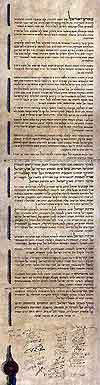
I know - I'm kind of nitpicking about a word. But it's an important word. I've asked around, and no one can tell me why we call it Yom Ha'atzmaut. We just do. Looking at the Megillat Ha'atzmaut - Israel's Declaration of Independence, there's really not very much mention of independence at all. Sure, it announces of הקמת מדינה יהודית - "the establishment of a Jewish state" in the Land of Israel. But when the State was declared in 1948, there certainly was a need to 'establish" a state, but there was no need at all to declare our independence. The British Mandate had ended. No one really wanted Israel - other than the Arabs, of course. Who were we declaring "independence" from?

Why then don't we call it the מגילת ההקמה - "the Declaration of Establishment"? Why not call the holiday יום ההקמה - "the Day of Establishment"? Good questions. My guess is that there's no small amount of irony in the fact that Israel modeled much of itself after the United States. In the U.S., we call the document that gave birth to the country the "Declaration of Independece." We call July 4th, the day we commemorate its signing "Independence Day". So Israel did the same, despite the fact that we didn't declare independence at all. It's even a "mitzvah" (stated jokingly, but everyone still does it) of the day to celebrate with barbecues - all over the country. Sound familiar?

Today, as we celebrate our "independence", we must do so with the understanding that we're just as dependent on God as we ever were. Our enemies threaten to destroy us, and they're growing closer than ever to having the ability to do just that. While our standing in the world is relatively good, let us not kid ourselelves for a moment that it could change in an instant. So we sing Hallel to God for our dependence on Him, and give thanks to Him that He has given us the opportunity to live in a country that we can finally call our own.

Thursday, April 23, 2009

The Gift of Tzara'at, on Yom Ha'atzmaut

By Rabbi Reuven Spolter, Director of Recruiting and Special Projects
What's the worst gift that you've ever received? When I got married, my wife and I received a plastic platter in the shape of a fish. We found it both strange and rather ugly. So we kept it. Each of us has a gift like that. I'm sure we've all gotten pretty bad gifts. But in each case, at least someone tried to give you something nice – even though it turned out to be a miserable failure. But what if your neighbor "gave" you the flu – on purpose? Would you consider it a "gift"?
Parshat Metzora relates the very unusual appearance of nigei batim, blemishes that appear on the walls of one's home. The Torah describes the procedure requiring the removal of the tzara'at in order to purify the home. Yet, the language describing this particular tzara'at raises an important question. In other cases of tzara'at, the Torah describes the affliction in neutral language: אדם כי יהיה בעור בשרו שאת – "if a person has in his skin a blemish…" The Torah doesn’t make any judgments about the wound. It's there. How should he act? But when describing tzara'at of the home the Torah says,
כי תבאו אל ארץ כנען אשר אני נותן לכם אחזה, ונתתי נגע צרעת בבית ארץ אחזתכם
When you come into the land of Canaan, which I give to you for a possession, and I put the plague of leprosy in a house of the land of your possession.
The word ונתתי doesn't really mean "and I put." It means "and I give," which leads us to wonder, what type of gift is tzara'at on one's home? I can think of many things I'd rather have instead of having to knock down parts of my home. Why then does the Torah use the verb לתת – "to give" when describing tzara'at of the home?
Rashi gives the famous answer that the Emorites hid money in the walls of their homes before the Jews conquered the land. So, when Jews moved into their homes, the homes broke out with hives, so that when the people knocked down the walls they found the money.
But the Yalkut Meam Loez (Vayikra page 153) answers the question in a way that can give us new appreciation for the trials and tribulations that we have experienced this past year in the Land of Israel.
When they originally built their homes, the Emorites dedicated their construction to their idol of choice, thus infusing these homes and buildings with a רוח טומאה – a spirit of impurity which would defile anything that dwelled in those homes. Because Hashem wished to give us the Land and that His presence should dwell in it, He did not wish for his Shechinah to dwell in a place of Tum'ah. For this reason, he sent blemishes in the walls of the homes containing the defilement, so that the people could remove them and purify their new homes, themselves, and their new Land.
Meam Loez asks us to see trials and tribulations from a new perspective. Although difficult to appreciate, sometimes destruction is actually constructive. If we succeed in removing the spirit of Tum'ah, and replace it with a sprit of purity, then the tzara'at was indeed a gift, even if it didn't seem so at first.
This week we'll celebrate the 61st anniversary of the great gift from Hashem that is the State of Israel. Like tzara'at habayit, sometimes we might feel tempted to look at the difficulties and struggles that Israel must deal with and think, "Some gift. Who needs all these troubles?" Why did we have to add more names to the list of the fallen during the past year? Why must we keep fighting wars to defend our right to live in our God-given Land?
But when we place these struggles in context and see the tremendous growth, bounty and blessing that is the State to not only the Jewish people, but to the world, we realize that we have a lot to be grateful for.
And one day we will also realizes that even the blemishes – which we commemorate on Yom Hazikaron before we celebrate Yom Ha'atzmaut – were a necessary part of the process that brings about the needed purification of Eretz Yisrael.