Showing posts with label Vayigash. Show all posts

Friday, January 6, 2017

Audio Shiur: Parashat Vayigash - Yosef's Revelation

Audio Shiur:
Parashat Vayigash - Yosef's Revelation

What does Yehuda's speech tell Yosef that he did not already know? Why does Yosef then reveal himself?

Click here to navigate to the shiur on YUTorah.org.

Click on the player below to play the Shiur or right click here to download)


Did you know that this shiur is available as a free podcast on iTunes? Click here to subscribe - and leave a comment and rating so more people will find the shiur! Thanks!

Wednesday, December 16, 2015

Parshat Vayigash - the Wagons of Yosef

Audio Shiur:
Parshat Vayigash - the Wagons of Yosef

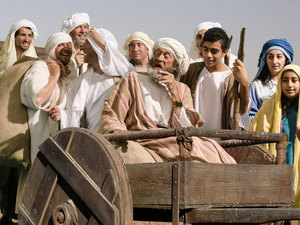
According to the Midrash, Yosef specifically sent wagons to pick up his father in Cana'an, but also to send him a secret message. What was the nature of that message? Did Yaakov get the message? Do we?

Click here to navigate to the shiur on YUTorah.org.

Click on the player below to play the Shiur or right click here to download)


Did you know that this shiur is available as a free podcast on iTunes? Click here to subscribe - and leave a comment and rating so more people will find the shiur! Thanks!

Friday, December 30, 2011

Dvar Torah for Vayigash - Showing the Good

I gave this D'var Torah as a sermon at the Young Israel of Oak Park eight years ago, after my brother's wedding. Yet, the message still strongly resonates with me today. My brother's wedding marked the last of my siblings to marry - and in two short weeks the first of my nephews will stand under the Chuppah. We all face challenges but also enjoy many blessings. But, what emotions do we wear on our faces (and sleeves)? Do we broadcast joy or worry? In the end, what we choose to focus on - and share with others - is up to us.
You can download a pdf of the Dvar Torah by clicking here.

Friday, December 25, 2009

Where Will You Be in Ten Years? Thoughts for Vayigash

With the close of the first decade of the 21st century, media outlets are rife with retrospectives of the past decade: the decade in pictures, the decade in news stories, the decade in movies. (Truth be told, when I look at the lists of top movies from the decade, I've never heard of most of them.) But one podcast that I enjoy asked a poignant question: where were you ten years ago? It's a good question, because it also begs the next question: And where will you - and do you want to - be in ten years.
After learning that Yosef was still alive, Ya'akov decides to travel to Egypt to see his long-lost son. On the way down, he stops to offer sacrifices to God, who appears to him in a vision during the night. God tells him,
אל תירא מרדה מצרימה, כי לגוי גדול אשימך שם
Do not fear from descending to Egypt, for I will make you a great nation there (46:3)
Rashi (along with most everyone else) notes that clearly Ya'akov feared something. What did he fear? Rashi answers that, "he was upset that he was forced to leave the Holy Land." It's a nice idea, and certainly highlights the value of living in Israel - but it doesn't answer the question: what made him afraid? The Zohar gives a different answer:
Said Rabbi Yeisa: When Israel traveled down to the exile in Egypt, a great fear and dread fell upon him. Said to him the Holy One blessed be He: "Why are you afraid? Do not fear from descending to Egypt." From the fact that it says, "Do not fear," it's clear that he was afraid. [Ya'akov] said to [God], "I fear that my children will be destroyed." He said, "I will make you a great nation there."
In essence, Ya'akov feared not the near future, but the distant future. What would be not next year, but in ten, twenty, a hundred years? Would his children survive the spiritual wasteland of Egypt? Would they suffer debilitating persecution that could destroy them? Or perhaps would they end up assimilating into a warm, welcoming Egyptian land? We can well understand Ya'akov's worry at this point in time, and his fear for the future.

Ten years ago, right about this time, I was actually asked where I would be in ten years. I was the rabbi at Agudas Achim in West Hartford, and it was time to move on. By the time we decided to try out for new shuls, it was really the beginning of the year (and only one shul - the Young Israel of Oak Park) was looking for a rabbi. On Saturday night, during the "Ask the Rabbi" session, someone asked me, "Where do you see yourself in ten years?" What they really wanted to know was, "Do you see us as a stepping-stone for your next rabbinic job?" But that's not what they asked. So I answered, "In ten years I see myself living in Israel, together with all of you." Truthfully, at the time I didn't mean it. I had no concrete plans to move to Israel. I thought it was a rather clever dodge of an unfair question.
But when I think of how my life has changed during the past ten years, I find it difficult to think of a way in which it has not changed. We've been blessed with two additional children. I've changed jobs - and cities (actually countries) twice. And yet, none of this happened on its own. I feel that my life has followed a path - with each decision leading to the next, big or small.
All of this makes me wonder: what about the next ten years? I think it's a good, and important question not because we can know the future - nor should we try - but more because the visions we have for our long-term future can focus our behavior. If I want to see myself as a computer programmer in ten years (I don't - it's just an example), at some point during that time I'm going to have to take a class or two in that field. If I want to be living in Israel in ten years, that requires not a little bit of life-tweeking as well.
At the same time, long-term planning does not mean agonizing about the twists and turns of life. Personally, I'm quite good at worrying, specifically about the near future. Aliyah has proven to be an ongoing lesson in patience; doing my part, and waiting to see how things play out; making my hishtadlut, and putting things in the hand of the Almighty.
I guess that's the sense of balance we all need. Ten years is a sizable chunk of time - a significant portion of one's life. So we need to have a vision of where we want to see ourselves in ten years' time, and make the small course corrections that will hopefully steer us towards that goal. But we also must recognize that we are subjects of God, whose plans and infinite wisdom far outstrips our feeble vision. So, armed with our visions of the future, we place ourselves in His hands and pray for the best.

Wednesday, December 23, 2009

Audio Shiur: Parshat Vayigash - Is It All Really for the Best?

Audio Shiur:
Parshat Vayigash: Is Is All Really for the Best?

Yosef's reaction to his brothers' sale so many years earlier leaves us literally shocked. He seems not only to absolve them of responsibility, but even tells them that their actions were somehow divinely inspired. Really? How much action comes from us, and how much from God?

Click here for the audio link, or listen in the handy audio player supplied below.

Wednesday, December 31, 2008

Making the Hard Choices - Table Talk for Parshat Vayigash

Why is it that at times, the thing that we want is probably not very good for us? Like that pint of Ben and Jerry’s? Or Facebook? (After all, do we really need to know what every person we know is doing at every moment of the day? When do “friends” become a distraction?) Yaakov’s fears in Vayigash remind us that sometimes the path towards growth involves traveling the road that we fear the most.

After Yosef reveals himself to his brothers, he insists that they return to Canaan to collect Ya’akov and move the family down to Egypt. Ya’akov, while excited about his reunion with Yosef, reacts with fear. What will happen to him and his family and to the promise of Eretz Yisrael? If you think about it, his fears make sense. He knows what’s available to his grandchildren in Egypt: the Internet, that crazy Egyptian music, and the clothing and culture. Sound familiar? (OK – maybe they didn’t have email back then.)

His fears are so well-founded that Hashem must address them, telling Ya’akov:

אל תירא מרדה מצרימה, כי לגוי גדול אשימך שם
“Don’t be afraid to go down to Egypt, for I will make you a great nation there.” (Bereishit 46:3)

Yet, Yaakov’s questions make sense. Why should he bring his entire family down to Egypt? Couldn’t Yosef send them food and let them stay in the Promised Land? Why does Hashem want the entire family to move to Egypt?

S’forno explains that staying in Canaan would have actually been more dangerous and detrimental than moving to Egypt. He says that Hashem tells Ya’akov, “If your children stay here, they would marry the nations of the land and become intermingled with them. But in Egypt that won’t happen, ‘because the Egyptians will not eat bread with the Hebrews (43:32). In this way, they will become a great nation.” S’forno says that Hashem wanted Ya’akov to move his family to Egypt precisely because life would be harder for them there. They would be rejected as outsiders, never accepted or integrated into Egyptian society. But in that way they would grow to be a great nation – and a Jewish nation.

Sure, it would have been easier to stay in Canaan. But taking the easier path would have undoubtedly led to assimilation, intermarriage, and the slow but definitely decline of Yaakov’s family and legacy.

Thank God, none of us (I hope) face this challenge of intermarriage and assimilation directly. We understand the importance of maintaining a sense of identity and individuality as Jews, no matter where we may live. But we do face the larger question each and every day: do we take the easy path which we want or the harder path that we need? Do we sit down to the computer to check our email (yet again), or use that half-hour to learn about the parshah? Do we choose the ice cream (easy and good) or make that salad (hard, but also good in a different way?

These choices are really up to us.

Thursday, December 13, 2007

Table Talk -- Vayigash 5768

Chanukah challenges our entrenched notion of Jewish strength. We generally associate Jewish strength with spiritual strength – with a steadfast devotion to our heritage; a stubborn willingness to sacrifice for our beliefs, and our refusal to abandon Jewish beliefs at any cost. After all, after almost two thousand years of exile, we have scant examples of any other type of Jewish strength.

Yet, the Torah clearly envisions a very different type of strength. God wants the Jewish people to have not just spiritual strength, but physical strength as well. He wishes us to develop economic strength, academic strength, and personal and military strength. And, while we celebrate the miracle of the candles and the spirituality of Chanukah, we would never have kindled those lights were it not for the willingness of the Maccabis to fight for their independence.

This notion of Jewish strength appears in our Parshah. The Torah tells us that when Yosef brings his family to Egypt, ומקצה אחיו לקח -- "some of his brothers he took" to present to the king. Which brothers does he bring? Why does he only bring some of them, and not them all?

Rashi presents two options, first suggesting that Yosef brings the weakest of his brothers before the Phar'oh, because he worries that if Phar'oh would see the stronger, more powerful brothers, he would draft them to lead his military. (It's interesting to note that Yosef makes a great effort to separate and shield his family from the larger Egyptian society.) So who are the weaker brothers? They are Reuven, Shimon, Levi, Yissachar and Binyamin - the brothers Moshe only names once and not twice in his final blessings in the Torah.

What surprises me most about this list are the second two names: Shimon and Levi. These very same brothers single-handedly wiped out the entire city of Shechem - albeit after mass circumcision. Still - these are the weak brothers?!

It makes me wonder just how powerfully strong the other brothers must have been.