Showing posts with label YIOP Bulletin. Show all posts

Friday, May 23, 2008

Our Message to the Shul at the YIOP Dinner

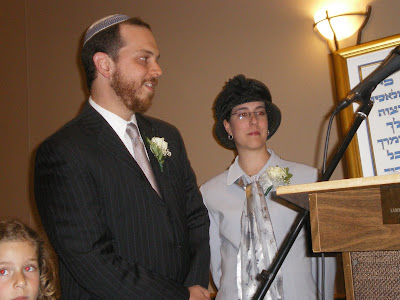
Wow! Thank you all for being here, to share this very special, emotional and meaningful night together with us.
We see this not as an end, but as a siyyum; You see, every time one finishes a major piece of Torah study, he or she makes a siyyum. But a siyyum isn’t an end. It’s rather a marker, a point of reference, between one leg of a journey and the next. This dinner isn’t the end. Rather, it the conclusion of one chapter of our lives and the beginning of another.
Every Siyyum begins with the הדרן – May we return to you. And that’s truly how we feel here tonight. Even though this dinner – and this honor – marks the end of our tenure as Rabbi and Rebbetzin, nonetheless we don’t feel as if we’re leaving. We’re just ending one phase of our relationship with each other that will continue over time.
דעתן עלך ודעתך עלן – Our minds are on you – and your minds are on us – what better way to describe the special relationship that we have with each other? לא נתנשי מינך – we will never forget you, ולא תתנשי מינן – and we know that you will never forget us. Even though we’re leaving Oak Park, we cannot ever forget the special friendships that we have forged during the seven years that we spent here, and we are confident that our efforts and energies will be remembered here as well.
יהי רצון...שתהא תורתך אמנותנו בעולם הזה ותהא עמנו לעולם הבא –
Here we describe not just our wishes when we complete a siyyum, but also what motivated us to enter into a rabbinic career as well. What attracted us to the rabbinate – and what we will most miss, is the idea that everything that we do; every class and program, every phone call, every container of soup, every chavrusa and meeting; every hospital visit and shiva call – even every social program and lunch meeting – is infused with spirituality.
Then we go into a litany of names; the family of רב פפא – חנינא בר פפא, רמי בר פפא, נחמן בר פפא – the ten sons of Rav Pappa. Why do we list these ten children of Rav Pappa during a siyyum?

Rena: Don’t get any ideas.

No, we mention Rav Pappa’s sons because whenever he made a siyyum, he would invite his sons and share his joy and accomplishments with his family; and, when he shared those values with his sons, they also grew to become great Torah scholars as well. But to my mind, Rav Pappa’s sons also remind us of the value of family. First and foremost, our immediate family. Even though they’re young, our children never chose a rabbinic life. They were born into it. And they’ve often had to share their father and mother with others, when it was hard to do so. They didn’t always want another babysitter. And sometimes, even though they didn’t have a choice, they understood, and waited for us to finish yet another conversation after davening, and shared their family events and occasions with all of you.

Rena: Simcha, Bezalel, Leah, and Petachya, we thank you and we love you.

We also give great thanks to our parents who are here with us tonight. It’s never easy having your children live so far away, and we know that next year will be even more difficult. But our parents have never given us anything but support, encouragement and pride. They have set shining examples for us to follow. My father was a man dedicated to knowledge and study of Torah. He was a man of great intellect and intelligence, and while he died when I was young, his passion for learning and teaching is forever imprinted in my mind. My mother taught me what it means to teach others, and to be dedicated to your students.

Rena: My parents have always led lives dedicated to community, to chesed, and to personal growth. I have fond memories of night-time meetings at our home, for one cause or another. My mother has served as AMIT chapter president, PTA president of 2 schools, and coordinator of the shul’s Mishloach Manot. My father’s quiet leadership gives Rabbis and principals the ability to take him into their confidence.

For their support, love, devotion and dedication we thank them, and only hope that we can repay them by following in their footsteps and raising our children with their vision and values.
But family, especially in this shul, is a much broader concept. We have shared so much: joy and sadness, celebration and mourning. My greatest joy comes when I see a father with his child davening together on a Shabbos morning, or a father or mother learning with their child at Mibreishit, dancing together at Simchat Torah,

Rena: or Presenting at Parshapalooza.

I miss the members of our shul who are no longer with us, from the oldest to the youngest. We had the privilege of knowing people so many years beyond yours; to appreciate their warmth and wisdom and charm; to know people outside our immediate age group, and be better people for it.
I appreciate the support of those members who constantly give their time and energy to ensure the day-to-day operation of the shul, particularly the shul presidents during my tenure: Eddie Katz, Rabbi Judah Isaacs, Dr. Steve Lorch and David Barth
Rena: and Ezrat Nashim Presidents Lynne Schreiber and Margery Klausner --
– and the many people who give of themselves day-in and day-out, to run the office, check the lights, pay the bills, run the minyanim, coordinate an incredible dinner, raise funds, run programs, lead our youth, and the scores of other tasks – big and small - that make this shul run.
But there are so many smaller families within this family: any daily minyan man understands the camaraderie, the friendship that grows when you daven together each and every day, and enjoy a really good cup of coffee (with or without the booze), and a story or a joke.
There’s the family of the Beit Midrash, which gathers each Monday night to learn, either with a chavrusa, in a shiur for men and women together

Rena: Or for women only.

And the family that developed at the Tuesday parshah shiur, and the Wednesday morning Parshah shiur – both very different groups of women, yet somehow we have been able to forge a sense of closeness and familiarity that always allows me not only to teach, but to learn from m as well. My Thursday lunch and learn at Cohen, Lerner and Rabinowitz – always a great lunch, with great conversation and great learning, and the special bond of our Thursday night shiur. In addition, we formed other groups as well:

Rena: Yoga on Wednesdays, or a Taharat Hamishpachah study group, and the monthly book group. Ezrat Nashim’s Board, and the many important committees – especially the Chesed committee

And the Living Room Limud group, and the Saturday night learning group, and the men of the Man’s Seder. Each of these smaller groups created cohesive bonds, with its own dynamic and energy. But together, these groups form a much larger family; a shul of warmth and caring that really is special and unique, and does not exist in many other places.
הערב נא ה' אלקינו את דברי תורתך בפינו: We pray that Hashem makes the words of His Torah sweet in our mouths. As you all know, Torah learning has been a mission of mine here at YIOP, and I give thanks for the many subjects and topics I have had the privilege of studying together with you. Together we’ve learned Parshat Hashavua, four sedarim of Mishnah,

Rena: the teaching of Nechama Leibowitz, Taharat Hamishpachah, Tehillim, Women and Tefillah, Women in Tanach – are you sensing that there’s a theme here? You’re wrong. Don’t forget the 13 principles of the Rambam.

Almost three books of Navi, parts of gemara Kiddushin, Sanhedrin, and the first half of Brachos, אם הבנים שמחה, אורות, and many writings of Rav Soloveitchik. We have learned about the chagim, about fatherhood, about Judging Others; about the Halachos of Shabbos and Kashrus. The list goes on and on. And we thank you for sharing so much Torah with us, as we learned and laughed and grew as Jews and parents and people.
The siyyum concludes first with thanks, and then with a prayer. First, we give thanks: מודים אנחנו לפניך ה' – we give thanks to God, that He has given us the great privilege to serve this close-knit, incredible community
שאנו משכימין – that we get up and go to shul early.

Rena: early?

OK – five minutes late.
שאנו עמלנו -- That we immersed ourselves in our community; you welcomed us with open arms, and gave us the sense of עמלות – of depth and intimacy, but with a sense of passion, dedication and hard work. We exerted energy on behalf of this community: to defend the values of Israel; of Torah, of Orthodoxy; To promote the sanctity of the things we hold dear; to uphold the values of kashrus and the honor of the Torah;

Rena: and the right to have a kosher Dunkin Donuts.

אנו רצים– I like to run; if you’ve been to the JCC you know that;

Rena: I don’t run.

Let us conclude with the prayer at the end of each Siyyum: יהי רצון לפניך ה' –
May it be Your will Hashem our God, that just as You have helped us serve the Young Israel of Oak Park, so may You help us serve כלל ישראל, to begin new projects and promote the values of Judaism in the future; to learn and to teach, to safeguard and to perform, and to fulfill all the words of Your Torah’s teachings with love.
May the merit of all our parents, mentors, teachers and friends stand with us and our children, that the Torah shall not depart from our mouths nor the mouths of our children, and our children’s children forever. May there be fulfilled for us the verse, “When you walk, the Torah will guide you. And when you lie down, it will watch over you. And when you wake up, it will converse with you.”
ה' עז לעמו יתן ה' יברך את עמו בשלום – Hashem will give strength to His people; Hashem will bless you, us – the people of Israel – בשלום – with peace.
Thank you so much.

Friday, May 2, 2008

United We Stand - YIOP Bulletin for May 2008

Two men are sitting in a park in Munich, reading newspapers. One is reading the Yiddish newspaper, and the other is reading Der Sturmer (the Nazi paper).The first one looks at the second one's paper and asks, "Why are you reading that trash? Can't you see how biased and anti-Semitic it is?"

The other one answered, "Look at what you're reading. Nothing ever in there but bad news. I already know how bad things are. I don't need to read about it. So I pick up the Sturmer, and what do I see? The Jews have all the money. The Jews own all the factories. The Jews are in control of the entertainment industry. The Jews can dictate the actions of governments. The Jews are the most powerful people in the world... I read all that, and I feel so much better!

As I approach the final months of my time as rabbi of YIOP and the shul finds itself in the throes of a rabbinic search, I find myself worried about the future – not just my own, but of our shul. While I might be leaving, I have invested my heart and soul into what I believe is a crucial institution in our community. But the future holds great danger for our shul that I feel must be discussed and addressed if YIOP can continue to grow and prosper.

The great challenge of any representative organization – any school, shul, club or group – is to grow large enough to be able to offer the services that people need, without being so large that it no longer reflects the values of its members.

Halachah embedded in our tradition the notion that no man is an island. I cannot begin to approach God on my own with the same power, quality and intensity that I can in a community. Without the company of others there is no kaddish, no kedushah, no Torah reading – none of the elements so critical to connecting with God. In establishing these rules, our Rabbis ensured that we understand and appreciate the power of the community to further our personal and spiritual growth.

Today we live in an era of specialization. Instead of reading a newspaper written for everyone, I only read the news I want to read on the internet. I only watch the news that agrees with my point of view. We live in a time of individuality, where the only important question is “what’s good for me?” “What’s in it for me?” “What’s most comfortable for me?” While it might be uncomfortable to share experiences with people unlike ourselves, it’s through those very encounters that we grow and develop.

In the Jewish world, the specialization has become known as shtiebelization. On every block a shtiebel pops up in a home or basement, meeting the needs of a small but specific group. It’s either a group of friends, or a group that likes davening in a specific way. For whatever the reason – even the proximity of the shtiebel to their couch – the shtiebel works for the small group it serves. And when Shabbos ends, so does the allegiance to the shteibel, until next Shabbos.

Even larger shuls have gotten into the act. In many major cities, large shuls have become conglomerates housing numerous smaller shuls and minyanim, from hashkamah early Shabbos morning to the main minyan to the teen minyan to the “young married” to even late minyanim. This way, every group is happy, but remains under the umbrella of the larger shul.

I dare say that if we had a large enough membership, YIOP would move in this direction. I would love to have a hashkamah minyan at YIOP, and we even tried to get one started, but we could never get enough people to ensure a minyan on a regular basis. We tried coordinating a teen minyan for several years, but could never create a critical mass of teens willing to exert the effort and energy necessary to keep the minyan going. We’re simply not large enough to be a classic “large shul.”

On the other hand, we are large enough to encompass a diverse community of members both demographically and religiously. Our members span from the very young to the very not-so-young; from the non-religious, who have no real Judaic background, to members who learn with a chavursa and daven in a minyan each and every day. And each of these memberships asks: what’s in it for me? Is this the shul that I want to be a member of? How do we serve each subgroup when the group is not large enough to become an independent entity within the shul?

We can’t. While our shul might be centrally located, it’s equally far both from Huntington Woods and Southfield. Other than the members who live in the Jewish apartments, every single member of our shul passes at least one – and sometimes many other shuls on their way to YIOP. Unless we learn that we have more to gain from strengthening each-other and remaining united than we do pursuing our own needs, YIOP’s future seems bleak indeed.

We must therefore focus on the positive aspects that our shul brings to the community. We are the only shul in Oak Park that holds an appeal for two different yeshivas during the year. We invite speakers from across the Orthodox spectrum; we take part in Modern Orthodox symposiums and Yarchei Kallahs at the kollel. And we do all this while being true to ourselves, celebrating Yom Haatzmaut and taking pride in our support of the State of Israel. Our shul has a full-time rabbi who promotes the interests of its membership throughout the community, through teaching, speaking, writing and advocacy, as well as broader communal involvement. What shtiebel can make that claim?

And finally, our shul is large enough that anyone – really anyone looking for a spiritual home to help him or her grow – can find a place. And this place is not only comfortable; it’s warm, nurturing, genuinely caring and devoted to its members. We would never have that feel if we had four minyanim. We would never know each other well enough to create the sense of family that we have developed over so long.

So the next time something happens in the shul that upsets you: whether someone wants the shul to take a position more right-wing than you’re comfortable with; or perhaps there’s an event or a class that you don’t think is really appropriate for our community, instead of asking yourself, “Is this really my shul? Is this a shul where I want to belong”, try and look at it another way: I am proud to belong to a shul that represents a diverse and unique group of members.

After all, isn’t that what Klal Yisrael is really all about?

Thursday, February 21, 2008

Another Rabbinic Candidate For Consideration: But Would He Even Get an Interview? (YIOP Bulletin March 2008)

Here at shul, I sometimes collect the mail in the morning when the secretary is away. If you’ve ever seen my desk, you won’t be surprised to know that the mail can sometimes become buried under an avalanche of papers only to be discovered during the monthly purge. Well, to my chagrin I discovered an additional resume that I quickly forwarded to the YIOP search committee. Because of the unusual circumstances and late date, they asked me to share the details of this candidate with the entire congregation without revealing his name so that the membership can quickly consider this candidate.

Education: Studied under the greatest Torah scholars of the time; extremely knowledgeable in all areas of Torah law, and additionally other secular disciplines. Speaks numerous languages fluently, and also proficient in secular law.

Age: Unclear – but at least in his mid-nineties

Work Experience: has been a leading figure in the Jewish community for decades, with extensive experience both in Israel and abroad.

Other information: Outspoken and passionate, yet can seem overbearing and preachy. Has been known to wander in the streets wailing, crying in mourning and wearing sackcloth and ashes. Seems temperamental and unwilling to demonstrate flexibility in trying situations. Also, he goes by his secular name, and not his given Jewish name.

What are the odds that we would ask this candidate to submit a video, much less invite him for a probo (that’s the Yiddish word for rabbinic try-out) in our shul? First of all, he’s too old. Moreover, who needs an erratic candidate prone to publicity stunts in the community? Oh well, I guess he’s got no shot. There’s only one problem: in rejecting this candidate, we’d be rejecting a man who literally saved the Jewish people from destruction.

You see, this resume belongs to none other than the male protagonist of Megillat Esther, Mordechai the Jew.

Let’s go through his resume one more time:

Education: The Mishnah (Shekalim Chapter 5 Mishnah 1) tells us that “Petachyah was in charge of the bird-related sacrifices [in the Temple, and] Petachyah is [really] Mordechai. Why was he called Petachyah (meaning “opener of God”)? Because he would open with words and explain them, and he knew seventy languages.” The commentators explain that the offering of bird-related sacrifices required the knowledge of ornithology and other sciences. From an educational perspective, Mordechai was what we would call today “the complete package.” Steeped in Torah knowledge in wisdom, he expanded his appreciation for God and His world by studying the sciences, languages and the world around him.

Age: That’s a tough one, but by the time the Purim story rolls around, he must be pretty old. The Megillah tells us that he was exiled from Jerusalem “with the captivity which had been carried away into exile with Yechonya King of Yehuda, who Nevuchadnezzar the king of Bavel had carried away into exile.” (Esther 2:6) That exile takes place in the year 3327 (approximately). The story of Esther takes places between the years 3394 (when Achashveirosh makes his first party) and 3405. Let’s assume that Mordechai -- who served in the Sanhedrin -- is no more than twenty years old during his expulsion. That would make him ninety eight at the end of the Purim story, so if he’s applying to work at YIOP, he’s no spring chicken. But, even at his advanced age he can still ride a mean horse (when led by Haman) and overhear whispered conversations, (see the story of Bigtan and Teresh), and as YIOP does not discriminate on the basis of age, we cannot exclude him on the basis of his age.

Work Experience: With his proficiency in Torah, his experience in the Sanhedrin and his long history of leadership in the Jewish community, clearly this would be a plus.

Other information: Ah, now things get sticky. He can be unpatriotic, unwilling to attend national events (i.e. Achashveirosh’s party for the people of Shushan) for religious reasons, possibly ostracizing the Jewish community in the eyes of the government. He ignores the local laws, refusing to bow down to Haman when every other rabbi and Jewish leader begs him not to make a fuss. He makes public spectacles when he sees fit, crying and wailing in the streets even outside the royal palace. And he uses his secular name – Mordechai, and not his religious name – Petachyah, for reasons we’re not sure about. Finally, for the past number of years he’s been out of the professional rabbinate entirely, working as a magistrate in the local secular courts.

What would we do if our shul received Mordechai’s resume for consideration? Would we give it proper deliberation and deem him a viable candidate, inviting him to meet the shul for Shabbos? Or would we consider him too old, too brash, too unstable and unpredictable, too old-world – to even consider giving him the job?

Sure – he’s all of those things. But it’s those very qualities that would give us cause to reject him as our spiritual leader – which help him and his niece Esther save us all.

Thursday, January 24, 2008

YIOP Bulletin for February 2008 - Mussaf Mishpachah: You Asked – And we’re Answering

YIOP has always prided itself as a shul that focuses on our families, especially on Shabbos. We invest our time, energy and space to create childcare for children every Shabbos and Yom Tov. Our youth groups meet every Shabbos to provide programming for elementary school children. But, despite these efforts, we still struggle as a congregation to find a good way to include our older children in Shabbos morning davening. While Steve Katz’s incredible efforts with the Teen Minyan brought great results, ultimately an entire minyan each week became to difficult to maintain.

Aliza Sosne, our new family education coordinator, has been working hard speaking to parents throughout our community to try and address this and other problems. She’s working on programming and events to make our shul an even more inviting place for families to grow. To that end, it’s a great pleasure to introduce our first exciting new program: Mussaf Mishpachah.

Mussaf Mishpachah will be a parent-child Mussaf service that will meet once a month in the small shul, beginning on Parshat Tetzaveh, February 16th. It will be a separate Mussaf service that will begin after the rabbi’s speech on Shabbos morning, and will be open to any parents with their children who wish to attend – but no parent will be admitted without a child. We will encourage Bar Mitzvah boys to lead the Mussaf, and any younger children can lead Anim Zemirot and Adon Olam. The davening will include a short D’var Torah either by an adult, or preferably a child, and will conclude with a fun cholent Kiddush. This davening will include a little more singing and ruach, and hopefully create a meaningful davening experience.

But this program will only succeed with your help: we need parents to make the effort to come with your pre-teen children, and expend the energy to make the minyan an enjoyable and spiritual experience.

Monday, December 24, 2007

Jewish Family Education Comes to YIOP - YIOP Bulletin for January 2008

As an institution that positions itself in the center of the Orthodox community, YIOP has, thank God, attracted a wide array of members from a broad spectrum of the Orthodox community. We offer programs that cater to adults and children, attempting to address their spiritual, educational, and even social needs. But during my tenure at YIOP, our shul and community demographics have shifted. We need to adjust the programming that we offer to mirror those shifts.

Most synagogues, where many of the children attend Hebrew school at the shul, find a great divide between the kids who were required to attend supplementary school and their parents who drop them off at Hebrew school but remain uninvolved in their religious or spiritual growth. To bridge that divide, Federation coordinates and partially funds a program called J.E.F.F. – Jewish Education For Families, under the auspices of the Alliance for Jewish Education (AJE). This program places a professional Jewish family educator on the staffs of area synagogues who creates meaningful Jewish education not for children or parents, but for families as a whole.

YIOP faces different challenges than other non-Orthodox synagogues. YIOP families usually send their children to local day schools, obviating the need for a religious school. Very invested in religious life, our families usually attend davening if not weekly, then at least monthly. That being said, in light of the many pressures Orthodox families face, the need for family programming and education is pressing and very real.

  • With the growing cost of day school education, the day school education that was once taken for granted is no longer a given. A small but growing number of families are opting out of full-time Jewish day school, and our shul must make an effort to help pick up the slack in programming and activities.
  • We are thankful for the growing number of Ba’alei Teshuvah in our community. Yet many families find themselves in the unusual situation of a knowledge gap between children and their parents. Our children, with their full-time education, quickly surpass the Jewish knowledge and ability of their parents, who did not benefit from a formal Jewish education. Clearly, we must provide opportunities and programs to allow families to study Jewish content together, hopefully bridging that knowledge gap and allowing families to grow religiously together.
  • While member families do attend davening fairly regularly, the davening setting isolates different family members rather than bringing them together. The Mechitzah obviously separates between men and women. Children participate in Shabbos groups, and small children attend babysitting. While each component serves an important function in our shul, they often separate families instead of uniting them. For this reason, we see a need to create other opportunities to bring families together in a religious context, through creative programming, additional services and other venues.
  • Finally, with our fast-paced, busy lives, parents spend less time than ever with their children. We are no exception to this rule. Our can – and must be – a venue to help bring families together and give them opportunities for interaction and relationship building in a positive religious atmosphere.

To address all of these needs, I approached the AJE to inquire about the possibility of hiring a Jewish Family Educator at YIOP. Working closely with Lisa Sobel Siegmann, the coordinator of the JEFF program at the AJE, we began the lengthy process of applying to the program, received approval, sought possible coordinators, and are finally ready to begin the program. We would never have reached this stage without the help, advice and support of many individual members including Stine Grand, Dr. Michelle Sider, Dr. Jonathan Frogel and Amy Schlussel, and the generous support of two anonymous donors.

This month we have hired Mrs. Aliza Sosne –a longtime YIOP member – to serve as our Jewish Family Eduator. Aliza, who begins January 2nd, brings a sense of passion and energy to her new position, and I am very excited about the great programming that she will bring to our community.

Hiring a family educator is really uncharted ground for YIOP, but I believe is a crucial step both to enhance the lives of our members and also to ensure our shul’s future. Still, for the JEFF program to truly succeed, it will need your participation. So, take the time and energy to get involved. Help Aliza plan and program. Come with your family – and learn and enjoy. And know that by taking an active role in our new Family Education program, you’ll not only be helping our shul, but you’ll be educating your family, and hopefully growing closer to God and to each-other at the same time.

Friday, November 23, 2007

An Alternative Chanukah Gift Guide

I remember it like it was yesterday. Sitting in a hospice room in Hartford Hospital, Bill Schulman (not his real name – but the story is true) lay dead in the bed next to me as I waited, together with Bill’s wife for the funeral home to come, and for Bill’s son to arrive from France. When her son finally arrived, we sat down at the small table to talk about funeral plans. As we began talking, Bill’s son stopped the conversation and asked a question (with his father still lying there in the room) that I’ll never forget: “When can we probate the will?”

I wondered what could make a person so selfish, self-centered and crass. Bill’s son answered my question, albeit unknowingly, during the shiva. Speaking lovingly about his father he told me, “We were always the first ones on the block to have anything. We had the first basketball hoop, the first color television – my father always bought us anything we wanted.” Indeed.

America celebrates its holidays – especially the religious ones – by doing what we do best. We buy stuff. I feel bad for Christian clergy. After all, America has transformed one of their holiest holidays of the year into a crass commercial extravaganza that now begins the day after Thanksgiving. We can’t even digest our turkey properly, as we have to rise at 5am to beat the crowds for the doorbusters. We all get “gift guides” in the mail: in newspapers, magazines, catalogues, brochures and mailings of all shapes and colors. And this commercialism colors our attitude towards our own holidays as well. Who doesn’t buy Chanukah gifts for their children or grandchildren? Do gifts have anything to do with Chanukah at all? And, most importantly, if we’re going to give gifts, what should we give that will enhance, and not detract from the greater message of Chanukah?

In all honesty, Chanukah gifts fly in the face of everything that the holiday represents. At the same time though, I must admit that I will be buying and giving my own children presents this Chanukah. Why? For three reasons: my parents gave me presents on Chanukah, my kids expect them, and it’s not fair to make them the only children in town who did not get anything for Chanukah. We have ingrained the notion of “presents” too deeply into our social consciousness to ignore them completely. But if we do give gifts, we can use those gifts to both express our love, and convey values that we hold dear.

First and foremost, gifts should be expressions of affection. They should not only say, “I love you,” but “I care about you and your interests.” For that reason, I’ve never been a big fan of giving money as a gift (unless the recipient really needs the money to cover expenses). A gift of money conveys the clear message that “I don’t really know what you want, so go buy it yourself.” But that check also says, “I couldn’t think about what you’d want and go out and purchase that thing for you. So get it yourself” If you’re giving a child or grandchild money for their college fund – great! But otherwise, think about what they like; their hobbies or interests and values – and get them something that matches those interests. If they don’t like it, let them return it (and don’t be hurt). At the very least, they’ll appreciate the fact that you took the time and energy to find something specifically for them. And when the item is gone – or lost or broken – the value of that time and thought and energy investment will endure.

If you’re buying something for a child, I have come to realize that our kids have way, way too much stuff. From electronics to games to music to toys, they have so many things that they don’t use a vast majority of them. Today’s latest and greatest device will by lying on the shelf next by next week. They don’t need another cellphone, or video game or television. So why not give a gift of time: get them a lesson with a tennis instructor, or tokens to the batting cages; tickets to a concert of a (kosher) musician or take them to a sporting event. And then take them there yourself – and give them time alone with a parent – which is what many kids really want most anyway. That way, when the game is over, the memory will endure but not gather dust in their room.

Finally, we often find ourselves trying to buy gifts for people who don’t really need anything – usually adults. What can you give to someone who – if he or she wants something – can and will go out and buy that thing themselves? You can give them something. You can value what they value. When I want to thank someone for a favor or give them a gift – and they really don’t want anything from me, I have found that a great gift is giving to a tzedakah that they like in their honor. That gesture (a) really does help others (b) is a great way to spend money and (c) strongly conveys to the recipient that I not only value them, but their values as well. That, to my mind, is a great gift.

Gift-giving season can be challenging, strenuous and difficult – even if you didn’t get up at 4am on Black Friday. But, with thought, care and consideration, giving gifts can be an opportunity not only to make our loved ones happier – but to make them better people as well.

Have a wonderful, warm, light and meaningful Chanukah!

Wednesday, October 24, 2007

Davening Decorum: Making What’s Good Even Better - YIOP Bullentin November 2007

Talking in shul is an age-old problem – perhaps as old as shuls themselves. Rabbi Yom Tov Lipman Heller, the author of the Tosfot Yom Tov (a commentary on the Mishnah), penned a misheberach in honor of those who refrained from talking during davening as far back as the 17th century. I personally believe that we talk in shul for a number of different reasons (some more legitimate than others):
  1. We feel disconnected from the words that we say. If we knew and understood the prayers better we would talk less.
  2. We haven’t seen our friends since last week, and see shul as a time to reconnect and catch up. After all, in Hebrew we call a shul a Beit K’nesset – “house of gathering” and not a Beit Tefillah – “house of prayer.”
  3. There are a number of times during the davening when all we do is listen. From misheberachs to announcements to the repetition of the Shemoneh Esreh, throughout much of the davening we sit passively, not engaged in prayer. That passivity lends itself to a certain sense of restlessness and boredom, so we talk.
  4. Finally, and perhaps most importantly, davening is long on Shabbos and Yom Tov mornings, and we often find it challenging to refrain from making a comment to a friend.
One comment doesn’t really hurt. But when everyone – or too many of us – make that one comment, the cacophony has the potential to ruin what could be a powerful spiritual experience.
The OU’s most recent Jewish Action magazine includes an article by Rabbi Danny Frankel, the executive director of the Young Israel of Woodmere in New York. Rabbi Frankel describes a concerted effort by the leadership and membership of their shul to change the culture of their shul from a “talking” shul to a “non-talking” shul. They made of number of significant changes, from having the members of the shul sign a “no-talking pledge,” to moving around some of the davening, to adding educational components about the davening to the rabbis’ talks.
Lately we have, to some degree, let things slip a little bit and allowed the conversation to grow inside our shul. To combat this trend, we don't need drastic changes. If we focus on small but subtle changes, we will improve the flow and tone of davening in shul.
  1. First and foremost, each of us must check ourselves. We all have some quick and innocuous small comment to make to a friend. Unfortunately, all too often it’s neither small nor quick, and results in a conversation that disturbs others and disrupts the tone of the davening. If each of us makes an effort to be better about our own talking in shul, that collective effort will bring a dramatic improvement.
  2. No one is perfect, but we are all mutually responsible. If we’re talking and someone asks us to stop (nicely, of course), don’t get insulted or upset. They’re right. We should stop. So, instead of getting angry and firing back, take the comment to heart and either take the conversation outside, or delay it until davening ends.
  3. As a shul, we also need to improve the flow of the davening and minimize delays. If you’re given a kibbud or aliyah, please be present for the aliyah or kibbud to avoid unnecessary delays. In addition, if you want your family members named during a misheberach, make up a card with all of those names clearly written for the gabbai to read. It’s not fair to make the shul wait while someone tries to remember his wife’s cousin’s sister (on her father’s side).
  4. Finally, we will be making other small changes to try and increase the flow and minimize talking opportunities during the davening. They might not be what you’re used to, so give yourself time to adjust to them to let us see if they really do make a difference in the level of talking during the davening.
If you struggle keeping up the pace of davening, it's better to slowly recite less of the prayers than to run through too many words without understanding them well. Take the time to read some of the prayers in English, and make an effort to learn the meanings of the Hebrew prayers, especially the Shema and Shemoneh Esreh. The investment of time that you make in understanding the davening will pay great dividends for years to come. Also, Rena gave a shiur on Tehillim that covered many of the Psalms that we recite during the davening. Her lectures are available to listen to online on our web site (www.spolter.net/mrs_spolter.htm) as well.
If you're interested in some reading material that will aid in understanding davening, I'd like to suggest the following titles that focus on davening or developing a closer relationship with God. You can find each of these books in the YIOP library, but do not remove them from the shul building.
  • Family Redeemed, The Lonely Man of Faith, and an article called "Prayer as Dialogue" in Reflections of the Rav, Volume 1, all by Rabbi Joseph B. Soloveitchik
  • Rigshei Lev: Women and Tefillah, by Menachem Nissel
  • How to Get Your Prayers Answered, by Rabbi Irwin Katsof (not in the YIOP Library)
  • Living Inspired, by Rabbi Akiva Tatz
  • The World of Prayer, by Rabbi Dr. Elie Munk
  • Rabbi Schwab on Prayer (based on the teachings of Rabbi Shimon Schwab)
  • If You Were God, by Rabbi Aryeh Kaplan
We make a strong effort to maintain a sense of decorum in our shul, with significant success. But we still need to remain vigilant about the decorum inside the shul, to ensure that during our davening we converse not with each other, but with God.

Monday, August 20, 2007

YIOP Bulletin September 2007: A New Year for Torah Learning

Rosh Hashanah is a time for resolutions: we resolve to grow as people – to be better friends and relatives, more attentive and caring to those around us. We resolve to change ourselves, working harder to root out behaviors that we know we should change. And finally, we resolve to become better, more knowledgeable Jews, in order to grow closer to God.
As I have said many times before, the very best way to grow in our own Judaism is through the study of Torah. Torah study has the power to accomplish each of these goals: it can make us better, more sensitive people. It can give us internal, spiritual strength to withstand temptations and desires. And finally, the more we know about God and His Torah, the closer we can become to Him.
Because I never miss an opportunity to plug a YIOP program or shiur, I thought that I would take this space to share with you some of the new and ongoing YIOP shiurim beginning this month at the Beit Midrash program. Some shiurim are new, others have moved, while others remain the same.
Our Monday evening Beit Midrash program begins its sixth year this September with several important changes. First and foremost, instead of having a special pre-Rosh Hashanah program, we will begin the regular class schedule during September which will continue through December. In addition, we have several staffing changes. Rena Spolter will not be giving her class on Torat Nechama, and as we bid farewell to Kollel Torah Mitzion members Asaf Cohen and Shai Urim, we welcome new member Rabbi Ze’ev Friedlander, and a new shiur from a longtime community member. Please note that all shiurim are open to both men and women.

Monday Nights at 8:00pm:
Navi Melachim with Rabbi Spolter – the popular summer Navi shiur continues this year on Monday nights, as we study the Book of Kings. We will learn about the reign of King Solomon, the construction of the first Temple, and the tragic split of the monarchy. Please bring a Navi with you.
Kuzari with Kollel Torah Mitzion Rosh Kollel Rabbi Bezalel Safra: Rabbi Safra will continue his study of the Kuzari, one of the seminal works in Jewish thought, in Hebrew.
Mitzvot and the Meaning, with Rabbi Ze’ev Friedlander: While we intuitively know about many of the different commandments found in the Torah, a good number still remain a mystery. What commandments comprise the 613 found in the Torah? How can we understand the meaning behind them? Join Rabbi Friedlander to study the Sefer Hachinuch, a classic work on the commandments.
Chafetz Chaim with David Tenenbaum: Rabbi Israel Meir Hakohen Kagan (also known for his classic work called Chafetz Chaim), wrote his work to teach others about the dangers of gossip, slander and other dangerous forms of speech. In addition to studying the text, this class will offer an in depth discussion of the laws and how they apply to our every day lives and conversations, and will be a very rewarding learning experience.
9:00pm: Ma’ariv
9:10pm: Gemara Brachos with Rabbi Spolter: The Gemara shiur moves from Tuesday evening at the Kollel to Monday evening as an addition to the Beit Midrash. This weekly shiur, now in the third chapter of Brachos, offers a fascinating look at the nature of davening today, giving us a better understanding not just of how we’re supposed to daven, but how the halachic process molded the modern-day davening that we know. While you don’t need to know how to read the gemara on your own, a basic ability to follow along in Hebrew-only texts is required for this shiur.

If you’ve been a regular participant in our Beit Midrash, I look forward to welcoming you back, and ask you to bring a friend with you. But if you haven’t been to shul on Monday night, I encourage you to join us. There really is something for everyone, and I know that making Torah learning a regular part of your life at the beginning of each week will have a profound impact on the rest of the week as well.

In addition, the Beit Midrash has continued to flourish and thrive due to the generosity of our members, who have sponsored individual nights of learning in memory or honor of a friend or loved-one. Should you wish to sponsor an evening of Torah study at our shul for $54, please either sign up on the bulletin board outside the Beit Midrash, or contact me directly.

As we look forward to the upcoming chagim, Rena and I and our entire family wish you a שנה טובה ומתוקה – a sweet, happy and healthy New Year.

Rabbi Reuven Spolter

Sunday, July 29, 2007

The Power of Change - YIOP Bulletin August 2007

Here in Michigan, we’re no strangers to the forces of change. In fact, we’re now experiencing the painful results of resistance and indifference to change, as economic forces, international trade agreements and numerous other factors have conspired to throw us into the slump we find ourselves in now. But perhaps, more than anything, Michigan finds itself in its one-state recession because of an unwillingness to change. The auto companies continue to produce gas-guzzling cars irrespective of the rising cost of fuel. Unions continue to demand and expect significant concessions from these companies, irrespective of the prospects of the companies’ viability. Politicians refuse to continue to promote the notion that we should enjoy all of the benefits of the past, irrespective of our ability to afford them.
We make all of these mistakes, and many more, because most of us abhor change. We are creatures of habit. We like our routines, enjoy our regular activities, have the same friends and acquaintances, and don’t often try new things because we find the very notion of change painful and difficult. In the words of British novelist Arnold Bennett, “Any change, even a change for the better, is always accompanied by drawbacks and discomforts.”
Yet, change is perhaps one of the only constants of life. Change is all around us: the world continues to develop and grow, both for the better, and for the worse. We change professionally, personally, intellectually and emotionally. Our community changes, ever so subtly and gradually, but definitively. Our families change and grow. Our jobs change – whether we transfer to a different firm or company, or simply take on new responsibilities. And yet, despite all this, we still resist change.
Perhaps that is why Judaism considers change an integral aspect of religious life. After all, as the month of Elul begins, we blow the shofar each morning at the end of davening to awaken ourselves to begin the process of Teshuva. Sure, we translate the word תשובה to mean “repentance” or “return,” but isn’t that just a fancy way of referring to change? In order to “repent” or “return” we must change the way we do things: the way we act and react to each-other; the priorities that set the agenda for the way that we lead our lives. Sometimes I think that because we undergo the Teshuva process in the religious arena of life – in shul, during davening – we allow ourselves to divorce that process from what we consider “real life”: from our jobs and marriages, from our friendships and families.
But if we think about the High Holidays as a time not just of Teshuva, but a time of “Opportunity for Change,” then other avenues begin to open themselves to us. Perhaps someone needs to change jobs, because the one he has now doesn’t allow for any real family time. Someone else might need to consider changing friendships, because her current relationships are negative and destructive. And to me, these changes are much more fundamental, significant and all-encompassing than any particular ritual commitment, as important as that may be.
To highlight the importance of this notion of change, YIOP’s annual Pre-High Holiday lecture will revolve around the topic of “Navigating Change.” As always, we have the privilege of hearing from wonderful and enlightening speakers local and regional speakers and educators. They include our rebbetzin Rena Spolter, Rabbi Yehuda Gettinger, a Rosh Yeshiva from South Bend, Indiana, Rabbi Yehoshua Ellis, who teaches throughout the community and runs the Lidrosh Institute, and the ever-popular Rabbi Leiby Burnham of Partners in Torah. Also, the series concludes with a family Shalosh Seudos and the Shabbos Shuvah Drashah.
While it’s hard to think about the High Holidays, Rosh Hashanah will be upon us before we know it. And if we embrace the possibility for change within ourselves, our shul, and our community, that openness and willingness to change also gives the potential for incredible spiritual growth.

Wednesday, June 27, 2007

YIOP July Bulletin -- Three Weeks Halachah Guide

Different places and times have unique and specific attributes – both good and bad. The Land of Israel has a greater holiness than other places in the world. The high holidays are a time of holiness and closeness to God. But Jewish tradition considers certain times of the year inauspicious as well. The month of Av has historically been a difficult period in for the Jewish people. Whether we remember the mistakes and sins of our people in the desert (think golden calf), the destruction of both Temples in Jerusalem two thousand years ago, or even the war in Lebanon last year, these three weeks in July bring with them worry and concern.

For this reason, we maintain practices of mourning and sadness during these weeks to heighten our own personal awareness of the calamities that befell the Jewish people and encourage us to evaluate ourselves personally and spiritually as well.

Below is a short primer on the basic halachot of the Three Weeks and Nine Days. If you have any additional questions, please feel free to contact me by phone (248-967-3652) or email (rabbispolter@yiop.org) at any time.

The Three Weeks (17th of Tammuz – Rosh Chodesh Av, July 3rd – 24th)

In their attack on Jerusalem, the Romans breached the walls of the city on the 17th of Tammuz. As that breach marked the beginning of the end of the Jewish kindom, the rabbis instituted a public fast on that day. While the true period of mourning begins in the month of Av, Jews have accepted the custom to begin mourning on the 17th of Tammuz. We refrain from making weddings, parties and other joyous celebrations. In addition, we refrain from taking haircuts, listening to music or attending shows for the entire three week period.

The Nine Days (1st of Av – 9th of Av, July 16th – July 24th)

These nine days mark the classical mourning period for the destruction of the Temples. In the words of the גמרא, “when Av enters, we reduce our joy.” We refrain from purchasing significant new items such as expensive clothes or anything that would require making a שהחיינו, (like a Subzero freezer), conducting home improvement projects such as painting or remodeling, and even engaging in avoidable litigation. It’s just not a good time to start new projects.

Tisha B’av

Monday July 23rd – Tuesday, July 24th

Fast begins

9:02pm

Ma’ariv and Eichah

9:10pm

Shacharis and Kinos

8:00am

Chatzos (midday)

1:39pm

Minchah I

2:30pm

Tisha B’av Films

5:00pm

Minchah II

8:30pm

Fast Ends

9:46pm

We also don’t wear freshly laundered or pressed clothing during the Nine Days (so wear your clean clothes at least one time beforehand – underwear not included). We don’t bathe for pleasure, so we don’t go swimming in a pool or lake. When we bathe and shower, to ensure that we’re only showering to get clean, we only take quick, lukewarm or cold showers. It’s not about being dirty; it’s about refraining from activities that make us feel good. Therefore, we also don’t eat meat or drink wine on weekdays (we don’t mourn on Shabbos) during the Nine Days.

Erev Tisha B’av (July 23rd)

In order to prepare for the long fast, it’s a good idea to drink plenty of water throughout the day. We call the final meal before Tisha B’av the סעודה המפסקת – concluding meal. Because this meal takes on many elements of mourning, before this final meal, we eat a full, normal meal to prepare ourselves for the fast, finishing a short time before the onset of Tisha B’av. (It’s a good idea to eat a meal rich in starch.) Following that meal, we wash again, and eat bread and hard-boiled eggs, both dipped in ashes, while sitting on the ground. We eat this meal as individuals, and not together as a family, so we don’t bentch together.

Tisha B’av (July 23rd – Tuesday, July 24th)

Chazal designated Tisha B’av as the Jewish day to remember all the calamities that have befallen the Jewish people throughout history. We mark the day by reading Megillat Eichah, Kinos (Lamentations), and focusing on tragedies that have devastated us for so many years, from the destruction of the Temples, to the Crusades and massacres of the Middle Ages, up to and including the Holocaust of European Jewry and Arab terrorism in the Middle East. On Tisha B’av we refrain a number of different behaviors:

  1. Eating and drinking, from sunset on Erev Tisha B’av until nightfall of Tisha B’av
  2. Washing and bathing, except for hand-washing in the morning and cleaning soiled hands
  3. Wearing leather shoes (canvas sneakers are fine)
  4. Marital relations
  5. Study of Torah (other than the calamitous and sad aspects that we learn on Tisha B’av)
  6. Anointing oneself (Actually, I’ve never seen anyone pour oil over himself, but they used to do it during the times of the Talmud, and apparently, it feels good. So don’t do it. Please DO use deodorant.)
  7. If you can take the day off and focus on the sad nature of the day, do it. It’s a very good thing to do, and will better sensitize you to the meaning of the day. If you can’t, it’s best not to go into work until chatzos (midday – see the chart above)
  8. We also sit on the ground (or on low chairs) for the first half of the day, until chatzos.

One of the most difficult aspects of Tisha B’av is the challenge of making it meaningful. Somehow, after shul in the morning we find ourselves engaged in our normal daily activities. How do we make the day meaningful in the mournful spirit that we know Tisha B’av is supposed to be?

It’s not a day for shopping or pleasure trips. If you can, read a book or watch a film about the Holocaust. Write letters to victims of terrorism in Israel. Make the day meaningful in a constructive manner. Have your children make cards for the Israeli soldiers still held in captivity. Don’t give them candy or ice cream; tell them that it’s a sad day, a fast day, and that they should feel that sadness as well. Have them draw pictures of Moshe breaking the לוחות הברית – the two tablets. Teach your children through your demeanor and the day’s activities that this is not a normal day – it’s a day of sadness and lamentations to allow us to feel the pain of our fellow Jews.

The Gemara tells us that כל המתאבל על ירושלים זוכה ורואה בשמחתה – “anyone who mourns for the destruction of Jerusalem will merit seeing it in its glory.” We make these three weeks, the Nine Days, and Tisha B’av meaningful, in the prayer that God transforms our sincere sadness into joy, gladness and celebration.

Thursday, May 10, 2007

A Quiet Kashrus Resolution

Many of you might remember that a few months ago, the JCC in West Bloomfield considered allowing non-kosher catering at the JCC, thereby threatening the kashrus status of Milk and Honey, the only upscale kosher restaurant in Detroit. If you don't remember, check the post here. At the same time, the restaurant is still operating, remains kosher, and seems to be running as it always had. Did the issue die a quiet death? Hardly. Through the diligent efforts of a number of members of our community, the JCC decided to maintain its kashrus policy, thereby ending the crisis.
First and foremost, numerous members of the Jewish community communicated with the JCC leadership -- both lay and professional -- regarding the importance of maintaining Milk and Honey as a kosher restaurant, and emphasizing the value that the restaurant brings to the JCC as an institution. Kudos for that.
Secondly, the rabbinic leadership on the Vaad maintained a unified stance against the possibility of having non-kosher catering in the JCC and allowing Milk and Honey to remain a kosher restaurant. Had the JCC board heard different messages from different members of the Vaad, they would have easily been able to argue that there was room to allow non-Kosher catering and still maintain kashrus on site. This was an important lesson about just how much we can achieve when we present a unified front to the community.
Third, many members of the non-Orthodox community came forward, especially those with a stake in the Jewish Academy, whose new building will be the second and third floors of the main JCC building. Having a non-kosher restaurant in the same building as the Jewish Academy would not have been a tenable situation.
Fourth -- and probably most significantly -- the leadership in Federation -- both lay and especially professional, communicated the impact that this decision would have on the entire community to the JCC Board, and strongly pushed for the maintaining of the status quo, allowing Milk and Honey to remain kosher. Moreover, the Jewish Federation has encouraged the JCC to apply for funding to supplement some of the financial hit that it takes in lost revenue because it maintains a kosher-only policy. If you read that and didn't think that's a big deal, think again. It's important to emphasize that in many other communities around the country, federations are the organizations pushing against traditional values like Kashrus. Here, we see precisely the opposite - where our federation is pushing for the values and needs of the traditional community, even when it's going to cost some money. Again, that's a testament to the unique sensitivity of our federation's leadership, and also to the Orthodox community's continued involvement with federation activities.
Finally, we must also thank the members of the JCC Board. While I disagree with their initial desire to allow non-kosher catering at Handleman Hall, I understand the financial realities and pressures that they face. In the end, they too compromised for the sake of the community's well-being, and shouldered a greater financial burden in the process.
I guess one of the great lessons from this episode is the importance of our involvement in the broader community. If we close ourselves off from the larger community, then when we have needs and concerns, we have no one to turn to. On the other hand, experience shows us that when we engage with Jews from across the religious spectrum on a host of issues, they open themselves to the needs of our community as well.

Wednesday, March 21, 2007

Community Redemption -- For the YIOP April Bulletin

Somehow, the Pesach story seems more real and immediate this year than in years past. The notion of a single man riling up his people, and coaxing them to destroy the Jewish people doesn't seem that farfetched this year. Having watched the president of Iran make genocidal statements, all while attempting to develop his country's ability to deploy nuclear weapons, I find the words of the hagadah chilling:

והיא שעמדה לאבותנו ולנו שלא אחד בלבד עמד עלינו לכלותנו אלא שבכל דור ודור עומדים עלינו לכלותנו והקב"ה מצילנו מידם
"and this [rule] has stood for our forefather and for us: that not only one stood against us to destroy us. Rather, in every generation, they stand up against us to destroy us, and the Holy One Blessed be He saves us from their hands."

The Gerrer Rebbe, using a play on the words of the hagadah, suggest an additional understanding to this passage that carries an important message for us. We normally translate the words שלא אחד בלבד -- to mean "for not only one -- i.e. Pharoh sought to destroy us. But he explains that the words שלא אחד -- can be understood to mean "since we are not one," -- בלבד -- "alone." Thus, the hagadah teaches us that because we do not act in a united manner, our enemies are able to stand over us to destroy us. Jewish unity is the greatest power that we can muster, and our disunity our greatest potential weakness. Unity does not mean that we give up on our principles. Rather, it means that when we find common ground, we work together on the issues that bind us together as a people.
Each year for many years, the Metropolitan Council of Young Israel has sponsored a community-wide Yom Ha'atzmaut celebration, either at YIOP or at the Young Israel of Southfield. Together, we have mourned the loss of Israeli soldiers and citizens who gave their life defending and protecting the state, and we celebrate the tremendous gift of the State of Israel that God has bestowed upon us. Yet, each year I found myself wondering whether the Orthodox community could reach out to the broader community to share in our Israel commemoration and celebration. After all, support for Israel spans the denominational spectrum, and it represents one of the few issues that binds us as a people.
So, for the first time, we will commemorate Yom Hazikaron and celebrate Yom Ha'atzmaut truly as a community. On Monday night, April 23rd, the two Young Israel shuls will join together with Congregation Beth Shalom, Temple Emanuel, and other congregations and organizations for a true community-wide celebration. In addition, we will have our regular traditional minchah and celebratory ma'ariv at the JCC as well.
During the prayer for the State of Israel we recite in shul each Shabbos, we thank God for the State of Israel, and we call it ראשית צמיחת גאולתנו -- "the beginnings of the flowering of our redemption." Each year at Pesach we hope and pray that this "beginning of a flowering" continues to develop and grow into a full-blown redemption. Perhaps if we cause a little more unity in our community, we can coax that flower to blossom just a little more this year.