Showing posts with label Shavuot. Show all posts

Monday, June 2, 2014

Back to the Basics this Shavuot

Two important blog posts have been troubling me recently: the now infamous Social Orthodoxy post, which I've blogged about already, and a recent post by Yoram Hazony about Biblical Criticism in Orthodox shuls.
That post prompted me to ask a neighbor the following question: How many of the members of the shul where you grew up believe in Torah MiSinai - that God gave Moses the entire Torah?"
His answer? You don't really want the answer to that question, do you?
This, to my mind, is the greatest threat to traditional Judaism today. It's not Tzniut, or Lashon Hara, or the Internet.
It's basic belief in the Torah.
Someone living in the Western world find himself consistently bombarded with messages that ridicule belief in the divinity of the Torah, and the authenticity of Jewish Tradition. This is especially true on college campuses. It's ironic, in a way. At the same time that Orthodoxy (the movement) is trendy, growing and popular, Orthodoxy (the faith) seems to be antiquated, ancient and increasingly out of touch.

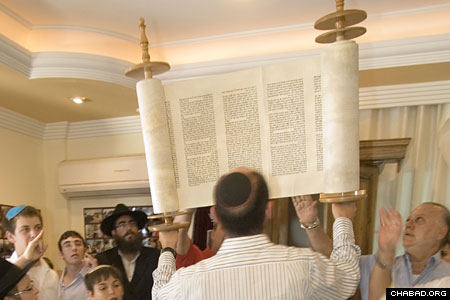
Every time we read the Torah in shul, after we're done reading someone is called to lift up the Torah, and the congregation proclaims aloud,
וזאת התורה אשר שם משה לפני בני ישראל על פי ה' ביד משה
This is the Torah that Moshe placed before the Children of Israel, from the word of God in the hands of Moshe
We actually point at the Torah (although I have no idea why people do it with a pinky), and some authorities insist that one actually must be able to see the words of the Torah when making this declaration. Commenting on the custom of lifting up the Torah Rav Eliezer Melamed writes,
וכל כך חשובה ההגבהה, עד שאמרו חכמים (מגילה לב א), שהגולל, והכוונה למגביה, נוטל שכר כנגד כל מי שעלה לתורה. ולכן ראוי לכבד בהגבהה את אחד מנכבדי הקהל.
So important is Hagbah that the Sages said (Megillah 32a) that the wrapper - meaning the person who lifts the Torah, takes the same amount of reward as every other person who received an aliyah. For this reason, it is worthy to honor with Hagbah an honored member of the congregation
Over the years, Hagbah has lost some of its luster. We give it young people who don't read the Torah, or strong people (if it's one of those old Torah's that weigh a ton). We don't give it much thought. I also wonder how many people think about the meaning of the sentence when reciting it at Hagbah. How many people who don't actually believe the sentence, say it anyway, without even thinking? How many of my neighbor's old shul-mates instinctively recite the verse, although if you asked them about it, they'd hem and haw and start talking about unfolding revelation.
In his list of the Foundations of Faith, Rambam writes,
היסוד התשיעי ההעתק, והוא כי התורה הזאת מועתקת מאת הבורא השם יתברך לא מזולתו, ועליה אין להוסיף וממנה אין לגרוע לא בתורה שבכתב ולא בתורה שבעל פה. שנאמר "לא תוסיף עליו ולא תגרע ממנו".
The ninth foundation is that of copying - that is that this Torah is copied from the Created, the Blessed God - and not from anyone else, and one cannot add nor subtract from it - neither from the written nor the oral Torah, as it is written, "You shall not add nor subtract from it."
We will soon celebrate Shavuot - זמן מתן תורתנו - the Time of the Giving of the Torah. It's the day that we celebrate the Revelation - the great moment when all of Israel stood as one, at the foot of a simple mountain, and literally experienced the giving of the Torah.
Do we experience Matan Torah on Shavuot morning? (Or are we too tired from a night of lectures, stale coffee and barbecue - if you're lucky - to even listen to the Torah reading, much less appreciate what it means?
This Shavuot, tell the story of Matan Torah to your children. Read them books on the event. Talk about what it must have been like to stand at Sinai with the Jewish people at that incredibly historic moment. Teach them the meaning of the verse וזאת התורה that they already know how to say. Make it real. And make it clear to them that you believe every word.
Because if they don't know - fully and completely - that their parents do actually believe in the Divine nature of the Torah, how can we ask them to believe it themselves?

Sunday, May 12, 2013

Forcing Our Children to Accept the Torah?

As parents, we ofter struggle whether and when to coerce our children to behave appropriately. And, when we address this issue in the context of religiosity, the question becomes all the more pressing. Sure, we can force our children to live as religious Jews during their formative years. But is that really what we want? Don't we want them to want to follow the mitzvot on their own?


On Shavuot we specifically celebrate Ma'amad Har Sinai, and the beautiful, awesome power that the Torah describes as the Jewish people received the Torah. Chazal describe the Revelation as a kind of wedding between God and the Jewish people, establishing an eternal bond between us that can never be severed.

Yet, a famous Gemara (Shabbat 88a) relates that, at least according to one opinion, getting us to the Chuppah required some serious arm-twisting.
 ויתיצבו בתחתית ההר: א"ר אבדימי בר חמא בר חסא מלמד שכפה הקב"ה עליהם את ההר כגיגית ואמר להם אם אתם מקבלים התורה מוטב ואם לאו שם תהא קבורתכם
"And they sat at the bottom of the mountain" (Shemot 19) Said Rav Avdimi bar Chama bar Chasa: This teaches us that the Holy One held the mountain over them like a barrel and said to them, 'If you accept the Torah, good! And if not, there will be your grave.'
According to the Gemara, despite the wonderful declaration of נעשה ונשמע, the Jewish people weren't altogether ready to fully accept the requirements of the Torah. So God made them an offer they couldn’t refuse. Literally. "Take My Torah," He told us, "Or that will be the last decision you ever make."

According to Rashi's interpretation of the Gemara, this troubling statement leads the Gemara to raise a critical question.

א"ר אחא בר יעקב מכאן מודעא רבה לאורייתא
Said Rav Ada bar Yaakov: from this verse we see a great criticism against the Torah.
What is the criticism against the Torah? Rashi explains that should God bring a claim against the Jewish for failing to follow the Torah [and ask them], "Why did you not fulfill the Torah that you accepted upon yourselves?" they could reply that they only accepted the Torah out of coercion. It's a powerful question. How can we be held responsible for not keeping a Torah that we never willingly accepted? And, because God coerced us with the threat of death to accept the Torah, why should we endure terrible punishment for failure to keep an agreement that we never really wanted?

The Gemara never offers a satisfying answer to this question. Yet, Rava seems to respond to the question by implying that in the end we did accept the Torah willingly.

אמר רבא אעפ"כ הדור קבלוה בימי אחשורוש דכתיב (אסתר ט) קימו וקבלו היהודים קיימו מה שקיבלו כבר
Said Rava: Nonetheless, they still [willingly] accepted [the Torah] in the times of Achashverosh, as it is written, "They fulfilled and accepted" – [meaning that] they fulfilled that which they had already accepted.
Yet, this enigmatic, troubling section raises more questions than it answers. If we never really willingly accepted the Torah until the era of the Purim story, why were the Jewish people punished and expelled from the Land of Israel during the First Temple Period? After all, they had not yet willingly accepted upon themselves the covenant with God. How then could God fairly hold them accountable for failing to adhere to an agreement they never really wanted?


Rav A.Y. HaKohen Kook zt"l, in his Ein Ayah commentary, offers a different interpretation of this passage in the Gemara, based upon his understanding of the crucial nature of coercion in Torah education. He writes,

Free will is a specific form of content through which a person improves his ethical stamina. For this reason, he has specific control over its parameters and scope. But free will itself is part of the essential character of a human being – about which it is not relevant to describe as a freedom. We are not free to want or not to want. Free will is the essence of life itself, and life is given to us without our choice. We control the bending of our will to one of two directions, to the right or left. There we find the hand of choice.

If the Torah was simply the expression of the ethical content of humanity, it would have been worthwhile to have been given with complete free choice. But in truth, the Torah is the expression of the unique individuality of man, as he is. Violation of the Torah is an estrangement of a person – an estrangement from himself…for this reason, it was appropriate that the Torah should be revealed in this matter an essential, fundamental revelation…
Rav Kook's language can sometimes be confusing, so I'll explain.

God gives us freedom to make choices in order to allow us to improve upon ourselves. Yet, some aspects of our existence were never given to free will. God never asked us whether we want to breathe or not. We do – without choosing to, without free will. God never asked us whether we want free choice. It's essential to being a human being. Once we have free choice, then we must use that freedom to choose wisely and appropriately.

The same rule applies to the acceptance of the Torah.

According to Rav Kook's philosophy, the Torah isn't a force or power external to us that we must internalize, study and accept. Rather, the Torah represents the essential, inner spiritual nature of the Jewish people. We are the Torah, and it is us. For this reason, it wouldn't make any sense for us to have the freedom to choose whether to accept the Torah or not, because that would be akin to choosing whether or not we wished to exist or not.

That, explains Rav Kook, is exactly what the Gemara teaches us. According to his understanding, Rav Acha bar Yaakov isn't asking a question, but making a critical assertion:

א"ר אחא בר יעקב מכאן מודעא רבה לאורייתא!
Said Rav Acha bar Yaakov, from here we see a great proof to the Torah!
At Sinai, when God figuratively held the mountain over our heads and forced us to accept the Torah, He was telling us that the Torah was essential to our very being. Without the Torah we would cease to exist! The greatest proof of this fact is that God didn't ask us whether we want it. Rather, He forced us to accept it without free will, because you cannot accept something that's already essential to your very existence.


To me, Rav Kook's powerful passage carries another important message as well. Coercion isn't wrong or inappropriate. Rather, it's an essential element of the transmission of Torah.

Look at it this way: Do we ask our children whether they want to go to school, or recite Shema at night or go to shul? We don't, nor should we. We coerce our children in order to internalize certain critical behaviors in their lives. We want the Torah to be an essential part of them.

Hopefully, at some point in their lives, these behaviors will become so essential to their identities that they'll continue to adhere to them after we no longer force to do so. But it starts with coercion –as well it should.

Should I force my children to follow the truth of God's Torah, and make it an essential part of them? To this question, my answer is an unequivocal "Yes."

After all, that's how we got the Torah in the first place.

Friday, May 10, 2013

A Uniquely "American" Torah Program: Tikkun Leil Shavuot, American Style

People often ask me about the difference between the rabbinate in Israel and in America.
My friend and colleague Rabbi Dovid Cohen recently released on his Facebook page the lineup for Tikkun Leil Shavuot. Here's the flyer.


I want to be clear: I am not questioning or criticizing Rabbi Cohen or the program in any way. If I had thought of it, I would probably be doing the very same program, although the meat thing is new to me. Sea Bass maybe. Cheesecake? Definitely. Ice Cream? Of course. But we never considered meat. Intriguing. Also, as I commented to Rabbi Cohen, he forgot to add on the bottom of the flyer the 7:30am visit to the local emergency room for the chest pains. A minor oversight.
What's fascinating to me is the overt way in which the flyer and the event focuses on the melding of the spiritual and the physical. If we take such things for granted, let's ask ourselves: when did rabbis become caterers? Why is there literally a full, descriptive menu on a Shavuot night flyer?
The answer, of course, is all about attendance.
Imagine the very same program with no food at all, or minimal food - some cola, maybe a plate of cake. How many people would attend? Let's assume that significantly more people will participate because of the food than would have otherwise. In addition, let's not discount the element of competition. I imagine that there are numerous other programs on the Upper West Side on the night of Shavuot. Why come to this one? Well, you can either draw them in with content or with food. The content seems good - interesting, motivating, and not too heavy. But is it that much better than one can get at another location?
So, to supplement the spiritual side, we turn to the physical.
I remember when we first started the Beit Midrash program at YIOP in Oak Park, I insisted that the program have fresh pastries and fresh coffee - not instant (Chas V'shalom!) I myself went to Costco every so often to ensure that we had not only the coffee, but the good cups as well. I believed (and still believe) that no one was coming for the coffee, but if you were wavering about going out on a cold Monday night in the winter in Suburban Detroit, a good cup of coffee wouldn't hurt. I still serve fresh ground coffee at my Parshat Hashavua shiur every week here in Yad Binyamin.
A good friend and colleague in Israel recently asked me what motivates American shul rabbis. I told him that rabbis feel a constant pressure to bring value to their current members and draw in new members. This makes intuitive sense. Fewer members = less dues = lower salary --> no job. So, while our primary focus is of course attending to the spiritual needs of our members (and potential members), rabbis always have one eye on the "trimmings" that will bring people through the doors to participate in the spiritually uplifting programming they offer.
That pressure comes to a head on the night of Shavuot. Does every shul really need to have its own program? After all, only a percentage of the membership actually shows up. Most people like to sleep at night, even on Shavuot. So they're essentially competing for the same participants. (Some people will always go to their shul. Others will go to the most attractive program). But how would it look for a shul to go dark on the night of Shavuot? And how would it look for a shul to have a program and then struggle to get a minyan at 5am? Not good.
So, what has emerged is an arms race between shuls not in the realm of the spirutual, but in the physical. You've got Ben and Jerry's? We've got Haagen Daaz. You've got franks and blankets? We've got Pastrami Stuffed Rolatinis (I've never even heard of a "rolatini". What is that? I assume it's made from meat.) I also like the way the courses are spaced. You want food? Then don't go shul-hopping -- because you might miss the duck with hoisin sauce.
This pressure made me dread the night of Shavuot. Literally, I would go into a funk during the week leading up to the event, knowing that no matter how great the shiurim and the spread, many of my members would gravitate to the local kollel, and someone would invariably ask the hated question: "How many people were there at YIOP?" I hated that question. Still do - especially because there was always great learning during the program, and the members who did come and stay up all night found the program uplifting and motivating.

Israeli rabbis view this phenomenon in the American rabbinate with horror. I cannot imagine an Israeli rabbi that I know producing such a flyer, or even participating in such a program. They're happy to give the shiur, and don't mind refreshments afterwards, but would recoil at such a blatant effort to suck people into a supposedly spiritual event. After all, they're rabbis and teachers. Not caterers.
Then again, they don't face the constant membership pressure. Even the ones who actually take a salary are at best part time, and don't often compete for members the way American rabbis do.  And, I daresay that many would say that they'd rather not be a rabbi if the job required them to cater parties in order to do the job. (Easy to say when your job isn't on the line.)
Who's right? Neither is right; it's not a question of right or wrong, but more a question of circumstances and needs. I repeat: were I in Rabbi Cohen's shoes, I would probably create exactly the same program, or one very similar, and I'm sure that across the New York region, many stomachs will be filled with gourmet food of one type or another over the five hour period between 12am and 5am on the eve of Shavuot.
And, of course, much Torah will also be learned. That, after all, is the purpose of Tikkun Leil Shavuot.

Wednesday, May 30, 2012

Staying Up All Night on Shavuot

I have a confession to make: I don't really enjoy staying up all night on Shavuot. Several days before Shavuot, I'd be in a kind of funk about it. It's not fun to be so tired that you can't keep your eyes open - and then to have to learn Torah during that time.
Truth be told, the original minhag is not just to stay up all night learning. Rather, there's a specific text, based originally on the Zohar, that is recited throughout the night of Shavuot called, "Tikkun Leil Shavuot." As a born-and-bred Ashkenazi, I'd never even heard of this text. But, when I got to Israel, I found that while we Ashkenazim learn in Chavrutot and sit through shiurim, the Sephardim sit around a huge table basically going through a huge book (while munching on nuts, rasins and assorted cakes.) I'm sure that there are Chassidim who recite this Tikkun as well, but, as I mentioned above, I had never even heard of it before moving to Israel.
When I was a shul rabbi, I really didn't have much of a choice. We needed to have a night-long program, and I needed to build it. People volunteered to teach, but I always gave the final shiur - the 4am to 5am slot. It seemed unfair to dump it on someone else.
But, to be honest, how much can one truly concentrate on prayer after having been awake all night? Add to that yetziv pitgam and you've got a mini-nap in Aramaic. I can't say that I was actually standing during the reading of the Ten Commandments during any of those years. Who remembers? And then we'd eat a quick bite, stumble home and fall into bed, while my wife had the enviable task of keeping the kids quiet while I tried to sleep. Chag Sameach!
In America, it's livable, because at least you have the second day to actually spend with your family. (The first day is completely shot). But in Israel, where we only observe one day of Yom Tov, the Tikkun Leil Shavuot kills the whole day - and the wy

So, for the past couple of years, I've done something a little a little different. I learn for a few hours, and then at about 2am, head to bed. After a good night's rest of six hours, I head to shul for a normal, pleasant, meaningful davening.
It's been terrific. This year I learned pirkei Avot from 10:30 - 11:00pm, Mishnah with Bezalel until about 12am, Gemara with Simcha until 1am, and then attended a shiur until 2am. (I say attended because while the shiur must have been good, I didn't catch all that much of it. Did I mention that it was in the middle of the night? I find it much easier to give a shiur at that time than to listen to one. I wonder what my audience thinks...)
Moreover, davening was really good - half-empty, but pleasantly quiet, and it was also one of the first times that Petachya followed the Torah reading together with me. We heard the Ten Commandments together, which was quite a meaningful experience, which I would not have had at 5am. (truthfully, I doubt I would have heard much of anything).

I mention all this because one of the blogs that I follow, but a young rabbi with a shul in Israel (he's anonymous - calls himself Rav Tzair), wrote about the fact that his whole shul followed this exact schedule. The shul ran a tikkun until 2am, and did not conduct and early, early minyan.

There's a place for staying up all night, if you can focus and concentrate while learning seriously, and it won't ruin your entire Yom Tov. Otherwise, getting some real learning in for a couple of hours, and then turning in for the night, seems like a good way to go.


Sunday, June 5, 2011

Read this Article. Shavuot is Coming

Last week, I wrote a long article critiquing Rabbi Shmuly Yanklowitz's short piece on why not to make aliyah. (I didn't realize just how widely that piece made the rounds. What in the world was it doing in the Florida Sun-Sentinel?) Then, a few people pointed me to this really important article by Daniel Gordis that's now making its way around the Interwebs. (the rest of this post will make much more sense to you if you read Gordis' article first) and it dawned on me that the two are in some ways connected.
Looking back, I think what bothered me most about Rabbi Yanklowitz's article was a subtle tone that while Israel is clearly important, there are more important things in Judaism, most specifically, acts of kindness.
While Israel remains the destiny of the Jewish people, we also must not abandon the Diaspora. Firstly, the Torah demands that we, as a nation, commit to pursuing justice; to be warriors against injustice, it behooves us to be stationed everywhere around the globe. This work as an ohr l'goyim, a light unto the nations, is our raison d'être.
I already addressed his specific article extensively, but I think what worries me most is the underlying discomfort with Jewish particularism.  The sense that I get is that, "It can't just be about Israel. It can't just be about the Jewish people. There must be more. I don't want to just care about the Jews. I want to fix the world."
Last month, Rabbi Michael Broyde penned a powerful piece about his sense of pride upon his son's graduation from his officer training course in the IDF. (On a personal and unrelated note, I identified strongly with his wistful lament about his inability to share in his son's accomplishments in person. His lament was one of a number of different emotions that contributed to my decision to make aliyah. I didn't want that to be me.) His article expressed a sense of pride in his son's desire to serve the Jewish people through his service in the IDF, which elicited the following comment:

Why is this man happy that his kid is joining a foreign army? It sounds like a lack of loyalty and hakarat hatov to the country which actually does protect the flourishing of Jewish life. I would of course have no problem with an Israeli child fighting Israels wars. If he needs to kill a Palestinian child to protect himself, its regrettable but it may happen. But what business does an American child have pulling the trigger on a Palestinian one? Is an abundance of feeling now enough to justify entering someone else’s fight?
In truth, I should not allow comments on a blog to surprise me or upset me. But where have we come to when Jews (ostensibly) consider the IDF a "foreign" army, and see a true disconnect between themselves and the citizens of the State of Isreal?

I get the sense that this tendency underlies the unwillingness of some liberal rabbinical students to embrace Jewish particularism and peoplehood described so eloquently by Daniel Gordis. They don't identify with the ideas that we are a unique people; that we are a persecuted nation with enemies; and that we must care first and foremost for each other.
This week Jews around the world will celebrate Shavout. Most people think that Shavuot marks the day that we received the Torah - and they're correct, but only partially. On that day on Sinai we didn't just get a book or a guide or a way of life. Rather, by accepting the Torah we entered into an eternal covenant with God. It's actually an explicit passage in the Torah:
ועַתָּה, אִם-שָׁמוֹעַ תִּשְׁמְעוּ בְּקֹלִי, וּשְׁמַרְתֶּם, אֶת-בְּרִיתִי--וִהְיִיתֶם לִי סְגֻלָּה מִכָּל-הָעַמִּים, כִּי-לִי כָּל-הָאָרֶץ. וְאַתֶּם תִּהְיוּ-לִי מַמְלֶכֶת כֹּהֲנִים, וְגוֹי קָדוֹשׁ:  אֵלֶּה, הַדְּבָרִים, אֲשֶׁר תְּדַבֵּר, אֶל-בְּנֵי יִשְׂרָאֵל. 
Now therefore, if you will listen to My voice indeed, and keep My covenant, then you shall be My own treasure from among all peoples; for all the earth is Mine; and you shall be unto Me a kingdom of priests, and a holy nation. These are the words which you shall speak unto the children of Israel.'(Shemot 19:5-6)

It's not just about receiving the law and tradition of the Torah. On Shavuot, far more than on Pesach, we became a nation - God's nation - with all that this implies: a fealty first and foremost to each-other; a Land; a way of life; an obligation to create a place that reflects God's dominion in the world.
I marvel at times how easily we forget the first blessing of the Birchot Hatorah - the blessings that we recite on the Torah. Even before we read a word, we bless God,
אשר בחר בנו מכל העמים ונתן לנו את תורתו
Who chose us from among the nations and gave us the Torah.
We need to refocus on this specific point. With all the freedoms that the United States has granted the Jewish people and the universal equality championed by the West, Judaism isn't just about a way of life. It's about belonging to a nation. It's about putting our Land and our people first, and doing our best to ensure that all of us live our lives in a manner that reflects the will of God.
Only when we do that do we possibly have the chance to truly repair the world.

Monday, May 17, 2010

Rut: Model of Excellence

John W. Gardner was an internationally-known thinker and leader who promoted the common good and improved the lives of millions of Americans. He once wrote, "The society which scorns excellence in plumbing because plumbing is a humble activity, and tolerates shoddiness in philosophy because philosophy is an exalted activity, will have neither good plumbing nor good philosophy. Neither its pipes nor its theories will hold water."
Gardner’s words are as true today as they were when he wrote them in the 1960’s. We all believe in the importance of excellence. But are we striving for excellence as a community? Are we teaching our children excellence? Do we talk about excellence for our families?
Perhaps we don’t strive for excellence because it’s so hard to define. I looked up “excellence” in the dictionary. Webster defines excellence as, “the state, quality, or condition of excelling.” Thanks very much. What does that mean? While we might not have such an easy time defining excellence, Chazal teach us that you know it when you see it.

To read the full piece, click here to download the file in pdf format.
(Note: I gave this as a drashah at YIOP a number of years ago.)

Wednesday, May 27, 2009

More Shavuot Material!

I'm happy to share with you some additional Shavuot material, including an audio shiur on Megillat Rut, as well as a drashah that I wrote about Rut and Excellence that I gave in YIOP about five years ago.

Audio Shiur:
Selfishness and Selflessness in Megillat Rut
These two themes form an underlying motif throughout the Megillah. A close look both at the text and the Midrashim on the text reveal a critical message for us as we prepare for Shavuot.
Click here for the audio link, or listen in the handy audio player supplied below.


Drashah
Rut and Excellence - Click here to download a pdf file of the drashah.

Saturday, May 23, 2009

Milchig Matan Torah

As much as Shavuot means a long night of learning and copious quantities of coffee, many of us also identify the holiday of receiving the Torah with cheesecake. While we might not be able to enjoy those sinful milchig deserts during the rest of the year, because we traditionally eat milchig meals on Shavuot we can enjoy the cheesecake and ice cream that we normally forgo. You have to wonder: why do we eat milk meals on Shavuot?
The most famous reason, quoted by the Chafetz Chaim (see Mishnah Berurah 494:12) in the name of the Mogen Avrohom, is that when the Jewish people returned to their homes after the harrowing, exhausting experience of receiving the Torah, they did what all Jewish people do when we get home – they went and stood in front of the refrigerator with the door open. (At least that’s what the men did.) Only this time, there really was nothing to eat, for a very simple reason. Before they had accepted the Torah, they could eat anything they chose – meat and milk together; improperly slaughtered meat – anything. But, staring into that fridge on that monumental morning, they realized that not only was the half-eaten corned beef sandwich on the bottom shelf not kosher; all of their dishes were treif and would have to be kashered as well. Then came the epiphany! As complicated as meat preparation is according to the Torah, with the shechitah and de-veining and kashering and salting and soaking – milchig food requires none of that confusion. So, until they could get their act together, learn the new halachah and prepare a proper kosher hot dog, they decided to stick with milchigs. So they all promptly rushed to the drive in at the Mount Sinai Dunkin Donuts, which ran out of bagels in under an hour. (Or so I hear.)
For this reason, we too enjoy milchig meals on Shavuot. In the spirit of fraternity with our forefathers of so many years ago, we reenact their sacrifice of barbecue for the sake of the Torah, and make do with pizza, cheesecake and ice cream on Shavuot.
But what if don’t have it in me? What if it’s just not Yom Tov for me without a roast, or meatballs, or steak? In fact, don’t the rabbis tell us precisely this idea? The Gemara does say that that אין שמחה אלא בבשר ויין – if you want to truly enjoy Yom Tov, which the Torah commands us to do, you cannot really have enjoyment without meat and wine. So, as good as that ice cream is, how am I supposed to enjoy Shavuot without a nice piece of roast? Or a steak? Or a hot dog? Or all three?
According to the Ramo, I’m not. Yes, I should eat milk. But then, I should also eat meat. You got that right – we should eat both, at the very same meal!
Commenting on the Shulchan Aruch (סימן תצ"ד), Ramo – Rabbi Moshe Isserles – explains that,
“There is a custom in some communities to eat dairy foods on the first day of Shavuot. It seems to me the reason is similar to the two cooked foods that we take on the night of Pesach to remind us of the Pesach offering and the Chagigah offering. Similarly, we eat dairy food and then we eat meat food, and we need to bring with these foods two breads on the table, which represents the altar, to remind us of the two breads that they would bring in the Temple on Shavuot.”
I’ll explain. On Shavuot, the Torah commands us to bring as one of the offerings in the Temple a sacrifice called the שתי הלחם, literally meaning, “Two breads.” We call this the “two bread” sacrifice because God commands the כהן to offer two breads as a sacrifice on Shavuot. (No, it’s not a very creative name, but it does get the point across.) Just as on Pesach we put different foods on the seder plate (the shankbone and egg) to remind us of the different sacrifices offered in the Temple, on Shavuot people wanted a way to remember the “two bread” sacrifice as well. This is where the milk and meat enter the picture. The Shulchan Aruch (in Yoreh Deah 89:4) writes that one may not use bread that was served in the course of a meat meal for a dairy meal, even if the bread remained untouched. (This rule applies only to cut bread and not whole challahs or rolls.) Therefore, I cannot used challah leftover from my fleishig Shabbos lunch to make French Toast on Sunday morning. (On a personal note, I try not to cut up huge amounts of challah if we’re having a small family meal for this reason. This way, I leave the uncut challah on the side, ready for my kids’ cream cheese sandwiches during the week.) Armed with this information, we can now understand why people have the custom to eat both milk and meat on Shavuot.
When, on Shavuot morning, I smear my cream cheese on my challah, I now can’t use that same challah if wanted to switch to meat and eat salami. Halachah requires me to get another loaf of bread instead – two breads! Thus, I remember the שתי הלחם – the “two bread” sacrifice of the Temple. Brilliant!
You’re probably wondering why we don’t just use the two challahs we use on every Shabbos and Yom Tov to remember the שתי הלחם. I suppose we could, but this way, we’ve actually created a minhag that allows me to have my (cheese) cake and eat (my steak) too! I think that this is one custom that every family should adopt. Just make sure to eat the milchig part first, or you’ll be sitting down for one long, long, meal.