Tuesday, April 24, 2007

Table Talk -- Acharei Mos Kedoshim 5767

אחרי מות-קדושים תשס"ז

Where does meat come from? While you and I know that it comes from a cow, or a sheep, as your three-year-old the very same question. It would not surprise me at all if she answered: “One Stop Kosher.” After all, if you’ve never seen a animal slaughtered, and never witnessed the salting and soaking of the meat to remove the blood, how would you know that meat did grow on trees shrink-wrapped in plastic?

Our parshah relays the commandment of כיסוי הדם – the covering of the blood. After the slaughter of an animal, God commands us to cover the blood of that animal that spilled on the ground with dirt. But, this rule doesn’t apply to all animals. The Torah divides kosher animals into two basic categories: בהמות – domesticated animals such as cows and sheep, and חיות – undomesticated animals like deer. The rule of כיסוי הדם – covering of blood -- applies only to fowl and חיות – undomesticated animals. Why must we only cover the blood of the undomesticated animal, but not the blood of the domesticated animal?

Kli Yakkar suggests that the root of this commandment stresses the need for us to be sensitive and appreciative of the nature of blood. We find this commandment in the context of the prohibition to eat any type of blood. The Torah stresses that blood represents the spirit of all living things. While God permits us to eat the flesh of other animals, the spirit belongs to Him alone, so God forbids us from consuming any type of blood. Therefore, because the Jewish people regularly offered the blood of domesticated animals as sacrifices to God, there was no need for any additional prohibition. We would never keep for ourselves that which we offered to God alone. But because we never offer חיות – undomesticated animals – as sacrifices to God, we must carry out the additional action of covering the blood to remind us that the animals belong, first and foremost, to God Himself.

That leaves me to wonder: while we might have appreciated the value – and ownership – of blood during the times of the Temple when we offered sacrifices, is there any way for us to compensate and have that same level of understanding and appreciation today? Isn’t it interesting that our society, with all its infatuation with blood and violence (see my sermon from last week), goes out of its way to insulate itself from any kind of real blood?

Wednesday, April 18, 2007

Table Talk -- Tazria Metzora 5767

תזריע מצורע תשס"ז

When the Cohen declares the metzora­ – a person afflicted with tzara’as – to be healed, before the metzora can return to the Jewish camp and mainstream society he must undergo a process of atonement. The Torah teaches us that during this ritual he must use two birds, a branch of cedar wood, a branch from a hyssop bush and a red string. Why must he take these particular elements?

The Midrash explains that because tzara’as afflicts an individual due to spiritual failings, each element in the atonement process carries an important message to him. Our rabbis identity lashon hara – slander and evil talk – as a primary cause of tzara’as. Thus, he must bring birds, animals known for their propensity to chirp and chatter, to remind him of what initiated his ailment. Furthermore, the cedar – a tall and strong tree – remind him of the haughtiness and self-importance that allowed him to speak ill of another and put himself in his precarious predicament. Finally, the hyssop bush, a low-growing shrub, reminds the sinner that only because he lowered himself did God heal him from his ailment.

What’s the red string for? That’s a good question to discuss around the table, but I’ll give you a hint: think Yom Kippur.

Thursday, April 12, 2007

Table Talk for Shemini 5767

We all look for signs: signs that we’re doing the right thing, signs of God’s hand in the world. But, while we wait for God, the Torah actually tells us in this parshah how to get God to appear before us.
After giving Aharon complete instructions for the sacrifices that would offer atonement for the Jewish people, the Torah tells us that they took all the necessary ingredients for the sacrifice, “and gathered the entire community, and they stood before God.” (Vayikra 9:5) The Moshe said, זֶה הַדָּבָר אֲשֶׁר-צִוָּה ה' תַּעֲשׂוּ--וְיֵרָא אֲלֵיכֶם, כְּבוֹד ה' – “this is the thing that God commanded you to do, that the glory of God may appear to you.” (9:6) Simply put: do this, and God will appear. The only question is: do what?
First and foremost Moshe is speaking about the sacrifices. If Aharon properly performs the sacrificial rituals, God promises to appear. But we cannot offer sacrifices today. Can something else bring God’s presence? Fortunately, different commentators understand “this thing” in new ways. The Midrash teaches that it refers to circumcision. Ohr Hachayim, in a beautiful piece, suggests that God wants the people to mentally and spiritually prepare themselves to stand “before God” (see verse 5 above). Yet, perhaps we can offer an even simpler solution.
Immediately preceding the promise of Providential appearance, God tells Moshe to gather the people. Maybe that’s “the thing.” The more the people – the Jewish people – gather together as one unit, the greater our ability to bring God’s Providence into the world.

Wednesday, March 21, 2007

Table Talk -- Vayikra 5767

Parshas Vayikra, which focuses primarily on issues relating to sacrifices, begins in a rather unusual manner. God tells Moshe that any person -- אדם -- "a man" who wishes to bring a sacrifice, תקריבו את קרבנכם -- "you shall bring close your offering." Why does the verse begin in the singular (אדם -- one man) but end in the plural (קרבנכם -- your sacrifices)?
Once the author of the Ollelos Ephraim, Rabbi Ephraim of Lunshitz, approached his local magistrate to make a request on behalf of the local Jewish community. Immediately, an anti-semitic priest demanded that the magistrate refuse the rabbi's request on the grounds that the Jews were bitter enemies of the non-Jewish population.
"That's a pretty strong accusation," the magistrate told him. "Do you have any proof?"
"Indeed I do, and the rabbi will back me up. Does it not say in the Talmud that the Jews are called אדם -- "a man" and the nations of the world are not called אדם. So if we're not men, we must be animals in the eyes of the Jews -- and they come to ask us for favors!?"
The rabbi smiled and explained: We find four words in the Hebrew language to refer to human beings: איש, גבר, אנוש and אדם. Each of those formulations can appear in plural form except for the word אדם. There is no Hebrew plural form for that word.
Therefore, in telling us that the nations of the world are not called אדם, our sages convey to us the diverse natures and interests of the different nations of the world. After all, Russia might have different priorities and interests than Italy. Yet, the Jewish people are אדם -- a single unified people. Even when they come from different places and speak different languages, they still remain united and care for one another. When one Jew suffers anywhere in the world, every other Jew suffers with him.
The magistrate smiled and turned to his priest. "Indeed," he said, "see how true the rabbi's words are! For he comes before me for his fellow Jews, and not for his own personal benefit."

Community Redemption -- For the YIOP April Bulletin

Somehow, the Pesach story seems more real and immediate this year than in years past. The notion of a single man riling up his people, and coaxing them to destroy the Jewish people doesn't seem that farfetched this year. Having watched the president of Iran make genocidal statements, all while attempting to develop his country's ability to deploy nuclear weapons, I find the words of the hagadah chilling:

והיא שעמדה לאבותנו ולנו שלא אחד בלבד עמד עלינו לכלותנו אלא שבכל דור ודור עומדים עלינו לכלותנו והקב"ה מצילנו מידם
"and this [rule] has stood for our forefather and for us: that not only one stood against us to destroy us. Rather, in every generation, they stand up against us to destroy us, and the Holy One Blessed be He saves us from their hands."

The Gerrer Rebbe, using a play on the words of the hagadah, suggest an additional understanding to this passage that carries an important message for us. We normally translate the words שלא אחד בלבד -- to mean "for not only one -- i.e. Pharoh sought to destroy us. But he explains that the words שלא אחד -- can be understood to mean "since we are not one," -- בלבד -- "alone." Thus, the hagadah teaches us that because we do not act in a united manner, our enemies are able to stand over us to destroy us. Jewish unity is the greatest power that we can muster, and our disunity our greatest potential weakness. Unity does not mean that we give up on our principles. Rather, it means that when we find common ground, we work together on the issues that bind us together as a people.
Each year for many years, the Metropolitan Council of Young Israel has sponsored a community-wide Yom Ha'atzmaut celebration, either at YIOP or at the Young Israel of Southfield. Together, we have mourned the loss of Israeli soldiers and citizens who gave their life defending and protecting the state, and we celebrate the tremendous gift of the State of Israel that God has bestowed upon us. Yet, each year I found myself wondering whether the Orthodox community could reach out to the broader community to share in our Israel commemoration and celebration. After all, support for Israel spans the denominational spectrum, and it represents one of the few issues that binds us as a people.
So, for the first time, we will commemorate Yom Hazikaron and celebrate Yom Ha'atzmaut truly as a community. On Monday night, April 23rd, the two Young Israel shuls will join together with Congregation Beth Shalom, Temple Emanuel, and other congregations and organizations for a true community-wide celebration. In addition, we will have our regular traditional minchah and celebratory ma'ariv at the JCC as well.
During the prayer for the State of Israel we recite in shul each Shabbos, we thank God for the State of Israel, and we call it ראשית צמיחת גאולתנו -- "the beginnings of the flowering of our redemption." Each year at Pesach we hope and pray that this "beginning of a flowering" continues to develop and grow into a full-blown redemption. Perhaps if we cause a little more unity in our community, we can coax that flower to blossom just a little more this year.

Wednesday, March 14, 2007

Table Talk -- Vayakhel-Pekudei 5767

The Torah divides the 613 mitzvos into two types of commandments: 248 positive and 365 negative commandments. This number also corresponds to parts of the body. According to rabbinic count, the body consists of 248 limbs and 365 sinews. In fact, we mention this number during the prayer for the sick -- רמ"ח איברים ושס"ה גידים. And, this number also appears with regard to the mishkan in our parshah.
While both Vayakhel and Pekudei deal with the construction of the mishkan, Pekudei sums up the final construction and including a tally of the money and materials used in the process. In the parshah, the Torah tells us that they "made" and "built" and "created" numerous times in numerous ways, using some form of the word לעשות -- from the root ע.ש.ה. -- meaning "to do" or "to make."
Rabbi Yitzchak Karo, author of the work "Toldos Yitzchak" actually counted how many times that the root of the word appears in Pekudei. Not surprisingly, the number of times that the verb עשה appears in the parshah comes to 248. This numeric connection reminds us of the inherent connection between our bodies and the holiness that we can achieve with them. By following God's commandments, we have the power to transform our physical selves, quite literally, into a mishkan -- a sanctuary for God.

Friday, March 9, 2007

Milk and Honey and the JCC

Thankfully, and due to some very hard work on behalf of numerous individuals, we - inside the Orthodox community -- enjoy a very productive and beneficial relationship with the broader Jewish community. This has allowed us to partner in a number of different important communal areas of concern, from Jewish education, to support for Israel, to communal needs. It is in that spirit that I'm writing about a recent development in the hope that we can again positively communicate with the members of the larger community, and solve a looming communal problem.

As we all know, the JCC in West Bloomfield houses the Milk and Honey Restaurant, the only upscale kosher dining establishment in Southeastern Michigan. Milk and Honey, run by Matt Prentice, is cholov yisroel with a mashgiach temidi, and in a recent review by an outside expert, received an excellent review for its kashrus -- a source of great pride for Mr. Prentice. It is an important resource for members of the observant community who need a venue for business meetings, celebrations, or just a nice night out.

As you might guess, Milk and Honey alone would at best struggle for financial viability. Without Friday nights and Saturdays, let alone holidays, a restaurant cannot cover its own expenses. Yet, in an agreement with the JCC, Matt opened Milk and Honey five years ago and also became the exclusive kosher caterer at the JCC and Handleman Hall. He agreed to pay minimum rents assuming that with the beauty of the room and his catering expertise, he would easily be able to cover those minimums and the expense of the restaurant. Unfortunately, the events never materialized at the JCC. The income never came, and Matt was forced to pay out of his own pocket to cover the minimum rent agreements.

When his contract came up for renewal, Matt could no longer guarantee the JCC a minimum income for Handelman Hall. The business just wasn't sufficient to make that kind of commitment. But, the JCC needed that revenue in order to cover their budget. So, the JCC decided that any private party need not be kosher at the JCC. At the same time, it reaffirmed that any JCC event would still be strictly kosher. With this new policy in place, in negotiations with Matt Prentice, the JCC insisted that in order to renew his contract, he would relinquish his exclusivity and Handleman Hall, meaning that any caterer, kosher or not, could now service the JCC.

Although Matt initially agreed to these stipulations, he now feels that allowing other caterers to offer non-kosher catering in Handleman Hall puts him at an unfair disadvantage. If others can bring in treif food, they why can't he? In fact, the JCC would have no problem with Matt catering treif parties at the JCC. But it does present major kashrus issues:

  1. First and foremost, experience tells us that to allow a caterer to have kosher and non-kosher service at the same venue is a recipe for disaster. Parties are the most difficult events to monitor and plan for -- there are too many people, factors and possibilities that can come up, and must be dealt with quickly. Having non-kosher parties in the same location as the kosher parties would create a situation where mistakes would happen, no matter how iron-clad the previously put in place precautions.
  2. If Matt Prentice were to cater both kosher and non-kosher affairs at the JCC, that would create a sense of confusion for patrons. How would anyone really know whether the affair was kosher or treif? Would they have to ask? Would it have to be on the invitation? Who would agree to advertise: "this Bar Mitzvah is a non-kosher event"?
For this reason, if Matt Prentice began catering treif affairs at the JCC, he would no longer be able to cater kosher affairs as well. And if he couldn't have the kosher catering business there, it would not make sense business-wise for him to keep Milk and Honey kosher either.

So we seem to have a conundrum:
  • The kosher-eating community needs and wants Milk and Honey to continue to operate, and...
  • The JCC needs more revenue from Handelman Hall and feels that the only way to increase revenue is by offering treif parties, but...
  • The Vaad cannot allow a caterer -- even with a great track record -- to offer kosher and non-kosher catering at the same location, and...
  • Matt needs to cover his costs and cannot compete with other non-kosher caterers at the JCC.

That's where we come in:

We would like to encourage you to communicate with the JCC about this issue. Please note that we don't think that we should immediately begin to complain: there are valid concerns from each party. At the same time, with good communication, perhaps we can prevail upon the JCC to reconsider its decision to allow non-kosher parties at the JCC.
  • First and foremost, have they done any serious studies to assess whether allowing treif will significantly increase revenues? It's one thing to say empirically that we know people who would take the room, but does that really bear out to be true? Currently, Matt is able to cater kosher parties on Shabbos, although Shabbos clearly does place restrictions on what he can and cannot offer. Why aren't people hiring Matt Prentice to do their parties now, and how would allowing non-kosher food change that?
  • Secondly, assuming that the decision to allow treif catering in the JCC would result in the loss of Milk and Honey as a kosher restaurant, is that a trade that the JCC would be willing to make for the expected income? The Board of Directors, when it made this decision, was not aware of these ramifications. Now, perhaps they could reconsider this decision in light of these new facts. The Jewish community puts a great deal of additional revenue into the JCC to preserve its viability: while the cost of keeping kosher might be great, the community needs to decide whether that's a cost that it's willing to bear. That's a decision that should not be placed solely on the back of the JCC, but on the community at large.
It's important to communicate to the leadership of the JCC and to our friends in the community, in a positive manner, the value that the Orthodox and kosher community places in Milk and Honey. It brings people into the building, and creates important opportunities for interaction between different facets of the community. It creates a wonderful space for interaction, and its a great restaurant.

We will all need to work together to solve this issue and come to a resolution that's viable for everyone involved. We know that with the right attitude, that's something that we've accomplished before, and can again achieve with this issue as well.

Rabbi Yechiel Morris, Young Israel of Southfield
Rabbi Reuven Spolter, Young Israel of Oak Park

Wednesday, March 7, 2007

Table Talk - Ki Tisa 5767

I'd like to share some thoughts that we discussed during the week at the womens' parshah shiurim -- Tuesday at 1:30pm at YIOP and Wednesday at 8:45am at Akiva. And no, I never miss an opportunity to plug a shiur.
The world recognizes the Two Tablets as perhaps one (or two) of the most famous Jewish symbols ever. In airports and other public places around the world, they represent a Jewish house of worship. Jewish chaplains in the US Armed Forces wear a pin of the tablets to signify their faith. And, you can find some reprsentation of the tablets in pretty much every shul in the world. (In our shul, we have a set from the old Young Israel of Oak Woods building above the aron in the Beis Medrash.)
This recognition comes for good reason: these are no ordinary Tablets. The Torah tells us that these tablets are מַעֲשֵׂה אֱלֹקִים, הֵמָּה -- "the work of God," and their writings was also "the work of God." כְּתֻבִים מִשְּׁנֵי עֶבְרֵיהֶם--מִזֶּה וּמִזֶּה, הֵם כְּתֻבִים -- "written from both sides, from each side they were written." (34:15-16) The Midrash explains that while God hewed the writing in the Tablets all the way to the other side, if you then looked at the Tablets from the back, instead of seeing the writing backwards, you would see the writing forward again. In Rashi's words, they were מעשה נסים -- "a product of miracles." They could not really exist in the natural world, but they did.
What do they Jewish people do with the Tablets? We know that they place them in the Aron -- the ark, which they then place in the Mishkan -- the Tabernacle -- in the קדש הקדשים -- the Holy of Holies. Only the High Priest entered the Holy of Holies on Yom Kippur, and even then, he certainly never opened the Aron to look at the Tablets. (If you've ever seen "Raiders of the Lost Ark" you'd know why.)
If so -- if no one were to ever see them, ever -- why does God even give these Tablets to the Jewish people?
Discuss amongst yourselves.

Wednesday, February 22, 2006

The Halachic Challenges of Cholent

Everyone loves a good cholent. There’s nothing like a thick, hot cholent to warm up a cold Shabbos afternoon. One of the great benefits of cholent is its simplicity: Throw everything in the pot. Cook for 18-24 hours. Eat. Yet, aside from the ease of preparation, cholent presents several halachic challenges that, with a little knowledge, we can easily overcome.

שהייה (Shehiyah) – Leaving Food on the Fire

The Torah forbids us from cooking on Shabbos. This prohibition includes putting uncooked items on a fire, and also raising the temperature of food already cooking on the fire. Realizing that no one likes burnt cholent, the rabbis feared that if you came home from shul on Friday night and realized that your cholent wasn’t hot enough to cook properly, you might inadvertently stoke the coals of the fire (or raise the temperature on your stove, oven or crock pot). Therefore, they prohibited us from leaving partially cooked food on an open fire once Shabbos began. But, they gave us a number of options:
1. Cover the fire. That way, if you see the covering, you’ll remember not to touch that fire on Shabbos. On a crock pot, this entails putting a piece of tin foil between the insert and the heating element and also covering the knob. On a stove, it involves putting a blech over the heating element.

2. Once the food is sufficiently (at least one-third) cooked, you can leave the food on the flame, because you won’t be tempted to adjust the fire. So, if you’re up at the lake during the summer, and you don’t have a blech with you, as long as you heat up your soup before Shabbos, you can leave it on a low flame on Shabbos. Still, whenever possible, it’s always a good idea to cover the flame you’re using on Shabbos.

החזרה (Hachazarah) – Returning Food To A Fire

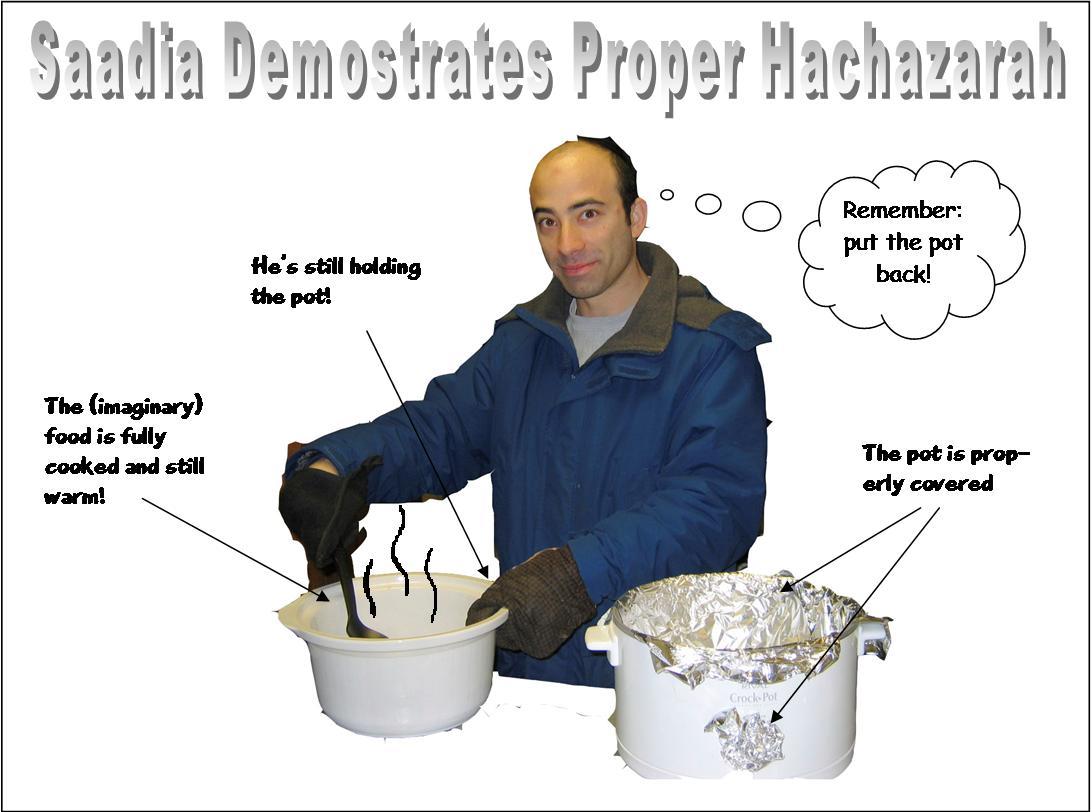
It’s a long, cold Friday night. Following the rabbi’s advice, I fully cooked my cholent before Shabbos, and even put the foil between the heating element and the insert and covered the knob. It’s now stewing peacefully on a low flame. About an hour after dinner, my cholent calls to me. At first it’s only a whisper, but as the night progresses, it grows progressively louder. “Taste me. Have some now! Don’t wait until tomorrow!” I feel like I’m trapped in an Edgar Allen Poe poem. I have to eat some cholent. But wait! I know that I can’t take food from a pot while it’s still on the flame. (I would inadvertently stir the food, which would enhance the cooking process. Bad.) But, if I take the cholent off the flame now, I’ll be left with cold cholent for tomorrow. Really bad. Can I somehow take some cholent on Friday night, and still enjoy a hot cholent on Shabbos afternoon?

The simple answer is yes. The rabbis permitted החזרה – returning food to a flame, as long as you follow all of the following conditions.

1. The flame must be properly covered. Check.

2. The food must be fully cooked. Mine is.

3. When I remove it from the fire, I must have in mind to return it to the fire immediately. (You don’t have to say it – you just have to think it.)

4. It must remain in my hand the entire time that it’s not on the fire. I can put it down on the counter, but I can’t let go with both hands. That makes this a two-man job: one person holds the pot, while the other person doles out the cholent. (I’ve seen talented people do this alone, but beware: this does take practice.)

The cholent must still be hot when I return it to its nest, um, crock pot insert – for safekeeping. If I’ve kept it out so long -- even holding onto it -- that it has cooled off, then I’m out of luck, and I’m stuck with a cold lunch tomorrow.

Quick Recap:

1. I can leave any fully-cooked foods (for liquids, that means that they’re still hot) on an uncovered fire from before Shabbos. This means that you can heat up your soup on the stove, and then put the soup in the oven to serve on Friday night. (We do this at home. This way, the stove – which can be a fire hazard – stays off, and we put the oven on a timer so that it turns itself off late Friday night.)

2. I can never return food to an oven. Once you take it out, leave it out.

3. It’s always a good idea to use a blech, in case the food isn’t fully cooked (or the soup isn’t yet warm when Shabbos begins), or in case I might want to take food off the fire and return it immediately.

4. I can only put food that was taken off of the blech back onto it on Shabbos. I can never put any other food directly onto the blech on Shabbos!

Want to know more? (And, there’s always more to know!) Great – you’ve got a bunch of options: for men, just come to our Hands-On Halachah class on Monday evenings at 8pm, during YIOP’s highly acclaimed, award-winning Beit Midrash program. Okay, we didn’t win any awards. Yet. Or you can listen to classes on the web. (No, the shameless plugs never do end.) For women, you can either (a) come to the Monday night class (b) download the classes from the web. Or, if classes aren’t your thing, there are a number of great English books that cover this material. Personally, I recommend Rabbi Dovid Ribiat’s four volume set The 39 Melachos. It’s a wonderful work. Two thumbs up -- as long as you’re not holding a hot pot of cholent!

Extremely Moderate

I love Trader Joes. I love the store, and the displays, and I’ve never had an unpleasant exchange with a Trader Joes employee. Today was a good example.

At the checkout, I asked the checkout guy about the cocoa content of one of the chocolate bars they put right next to the register, explaining that on my crazy diet (Sugar Busters!), I can only eat chocolate with a cocoa content of 60% or higher.

“You know,” he said, “Chocolate is really good for you. It helps calm your moods, and I hear that it can even be good for circulation. Of course, you’re only supposed to eat an ounce or two every few days.”

“Sure,” I said. “Anything is good for you, taken in moderation.”

At this point, the checkout guy at the register next to us apparently couldn’t help himself, as he chimed in, “Even moderation is good only in moderation.” True enough.

Taking his comment to its logical conclusion, if moderation is good only in moderation, then extremism must also have its place. Which seems somewhat contradictory: if I’m supposed to be a moderate, then how can I advocate infrequent extremism? Should I be an extreme moderate? A moderate extremist? Is that even possible?

I have been pondering this tension between moderation and extremism for the better part of a week now, as this issue has affected me in quite a personal way.

Several weeks ago, I gave a Drashah in shul on Shabbos morning sharply criticizing the recent decision of the United Torah Judaism political party in Israel to join Prime Minister Ariel Sharon’s unity government. While I did not specifically criticize any particular individual, my comments did leave the impression that I was personally critical of Rabbi Yosef Shalom Elyashiv, and his decision to allow the UTJ to join the coalition in the first place. As many of you already know, my comments in shul on that snowy January morning sparked a storm of controversy. One shul member approached me during the week, to discuss not so much the content of my talk, but its tone. “After all is said and done,” he told me, “no matter how much you disagree with his decision, he’s still Rav Elyashiv. He’s still a gadol batorah (a great Torah sage).” It bothered him greatly that I would speak about someone of that stature in the way that I did.

Looking back, I agreed with him, so the next week I spoke about the need for reverence and respect for Torah scholars, and how, while I still questioned Rav Elyashiv’s decision, I would have questioned that decision with a sense of reverence and respect for his position and the Torah that he represents. Yet, during the week between the two speeches, a sign appeared in the Kollel on Lincoln and Greenfield that, to me, seems to represent a growing and troubling trend in the Jewish world today.

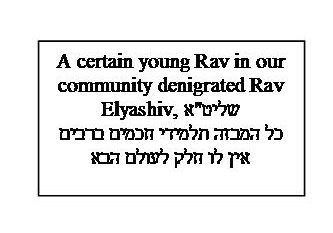
The sign – which I never personally saw, read as follows:
(Translation of the bottom section: “Anyone who denigrates Torah scholars in public has no portion in the world to come.”)

First and foremost, from a publicity standpoint, the “sign-man” did me a huge favor. Truth be told, it was pretty cold that first Shabbos, as snow fell outside throughout the morning. While we had a nice crowd for three inches of snow, our shul was by no means full. Sure, people would talk about my speech. But posting a sign condemning my Drashah only helped to ensure that every member of the community would want to know what I said. The very best publicity for anything – from a speech to a book to a movie, is a public condemnation. Just ask Mel Gibson.

Back to the sign: Hung anonymously, this sign in the Kollel bothered me for a number of personal and not-so-personal reasons. Truth be told, it’s never fun to be “called out” in public. But, when you speak publicly and take positions on sensitive issues, you have to be ready for criticism. Controversial statements often invite dissent, so criticism becomes part of the territory, as it should be. On the face of it, I understand that people have the right and even the obligation to legitimately disagree with me, often publicly. But it seems somewhat cowardly to me to hide behind an anonymous sign about a “certain rabbi” hung over the washing station in the kollel. If someone wants to take me to task for my speech in public, he should at least have the courage to name that “young Rav,” attach his name to his sign and take responsibility for hanging it. Still, his cowardice only bothers me a little -- it’s a minor point that relates only to the individual who hung the sign.

What bothers me more, and carries greater significance, is the sign’s tone.

Just for informational purposes, the quote in Hebrew is a paraphrase of the Mishnah and Gemara in Sanhedrin 99b. The Mishnah states that every Jew has a portion in the world to come. Unfortunately, a number of categories of people forfeit their portion through their actions and beliefs in this world. One person who God deprives of his portion in the next world is the apikores – the non-believing heretic. The Gemara only has one problem: what’s a heretic? What type of behavior of belief does Judaism consider so far out of bounds that it would brand its perpetrator as an apikores? The Gemara presents two opinions. Rebbe and Rabbi Chanina define a heretic as one who denigrates scholars in public. Rabbi Yochanan and Rabbi Yehoshua ben Levi argue that a heretic is one who denigrates not a Torah scholar, but his friend in front of a Torah scholar. Interestingly, Rambam accepts both opinions, writing that whether you denigrate Torah scholars in public or just denigrate your friend in public, you forfeit your portion in the world to come.

So, apparently basing himself on the words of the Gemara and Rambam and working with second-hand information, (I find it hard to believe that he actually heard my Drashah in shul Shabbos morning first-hand) our anonymous sign-poster decided that I must fit the category of one who “denigrates Torah scholars in public.” He must, therefore, brand me as a heretic, and rightfully deny me any no portion in the world to come. Basically, I don’t even get to go to hell.

The prophet Hoshea, in the very last verse of his recorded prophecy tells us,

“Whoever is wise, let him understand these things; whoever is prudent let him know them: for the ways of the Lord are right, and the just do walk in them; but the transgressors shall stumble in them.”

The Gemara in Nazir (23a) tries to understand the deeper meaning behind an ambiguous verse. The Gemara asks one simple question: what in the world is he talking about? While Hoshea’s message sounds nice, it’s also quite vague. Who are the “just” who walk God’s path, and what sin would label a person a “transgressor” in the eyes of the prophet? Before coming to a final conclusion, the Gemara presents the following suggestion:

Said Rabbah bar Bar Channah in the name of Rabbi Yochanan: It can be compared to the following parable: Two people roasted their Korban Pesach (on Pesach eve). One ate for the sake of fulfilling the commandment, and the other ate (and ate) for the purpose of stuffing himself. “The just do walk in them” refers to the one who ate for the mitzvah, while “the transgressors shall stumble in them” refers to the one who ate only to satisfy his ravenous hunger. Reish Lakish said to him: You call this [second man] evil?! Sure, he did not fulfill the commandment in the ideal manner. Yet, he still did perform the mitzvah of Pesach!

Rabbi Yochanan’s perspective appeals to many people in our generation. The Torah commands us to eat the Paschal Lamb to remember the Exodus from Egypt . So, if you ignore that commandment but wolf down the lamb on Pesach eve because you happen to like lamb chops, you’re spitting in the face of the Torah. According to his view, you can either follow the Torah, or not, but let’s not call overeating a mitzvah because you happen to be eating the right thing on the right evening at the right time.

Reish Lakish disagrees. Sure, stuffing your face with lamb chops on Pesach night doesn’t fulfill the spirit of the mitzvah. It’s not ideal. But the fact that someone doesn’t perform a commandment in the ideal manner in no way means that we should then label him as a “sinner.” To Reish Lakinsh there must be a middle ground; a place where we can disapprove of a person’s behavior without labeling him as evil and misguided.

Reish Lakish’s response to Rabbi Yochanan remains equally strong and especially relevant today. While we might disagree with many of the attitudes, actions and activities we encounter, and while they might not be ideal, a wide gulf exists between “righteous” and “evil.”

That’s where my problem with the sign-poster begins. Sure, disagree with me. If you want to condemn me, fine. State publicly and unequivocally that you think my comments were inappropriate and ill-advised. That I was wrong. That I don’t know what I’m talking about. But the author takes it not one, but many steps further. In the words of the sign, ein lo chelek l'olam haba – I have no portion in the world to come. Why go to such an extreme? But why do you have to call me a heretic in the process? Can’t I just be wrong, without being an apikores? Can’t there be some middle ground between “absolutely correct” and “worse than hell?”

In today’s day and age, the answer seems to be “no.”

We live in an era of extremism, one in which disagreeing with and refuting our opponents does not suffice. It’s not enough to argue and disprove. Rather, today we pulverize and delegitimize those who disagree with us, whether politically, personally or religiously. In an era of trash-talk, smash-mouth, in-your-face radio, whether you’re Rush Limbaugh, Sean Hannity or Michael Savage on the right (or very, very far right), or Radio America and Al Franken on the left, we have lost the art of discourse, debate and disagreement. We have lost the ability to argue respectfully and civilly disagree. And, in the din of noise that passes for debate nowadays, we diminish ourselves and the issues important to us. We’re left with “ Red States ” and “ Blue States ,” that cannot understand one-another. Israelis become “settlers” or “peaceniks,” unwilling to listen to the other. The members of the Orthodox community become “chareidi” or “Modern,” forgetting that we all still begin Shabbos at the same time, and agree about the vast majority of issues.

Rambam, in his fourteen-book work on halachah, includes a section entitled, hilchos deos – “The Laws of Temperaments.” (Actually, deos can also be “positions” or “attitudes.”) In the first chapter Rambam writes,

There are many temperaments, all of which are different and each of which is distinct, and which are possessed by different people. There are people of angry disposition, who are always annoyed, and there are those who are even-tempered and are never angry, and if they do get angry, it is only slightly and rarely. There are people who are excessively haughty, and there are people who are excessively meek. There are those with many desires who are never satisfied with what they receive, and there are those with a very pure heart and do not desire even the simplest things that the body needs…

Between the extremes of each temperament are the intermediate temperaments, each of which is also distinct. Of the temperaments, there are those which one has from the moment of one's creation [and] according to the one's nature, and there are those temperaments which direct one's nature and which one will quickly acquire in magnitudes greater than that of the other temperaments. Then there are those temperaments which one does not have from the moment of one's creation but which one learns from others, or which release themselves upon one depending upon one's thoughts, or which one heard is a good temperament to have and which is fitting to follow and accustom oneself to until it becomes fixed in one's behavior…

The way of the upright is [to adopt] the intermediate characteristic of each and every temperament that people have. This is the characteristic that is equidistant from the two extremes of the temperament of which it is a characteristic, and is not closer to either of the extremes. Therefore, the first Sages commanded that one's temperaments should always be such, and that one should postulate on them and direct them along the middle way…

If, as individuals, we are supposed to strive for the “middle ground,” moderating our attitudes away from the extremes, then as a community we must also see moderation as a goal as well. And if, as a community, we’ve learned to become extremists, then we must, as a community, actively move ourselves in the other direction, to counter the extremism that surrounds us today. We must strive to stop seeing issues as “us vs. them,” and begin to try and see the other point of view before we disagree – especially within our own Jewish community. And, if we decide that we must disagree – even publicly, then we must learn to voice our opinion with respect and civility, never stooping to the level of personal attack or derision to deligitimize our opponent.

Finally, if even moderation itself is good only in moderation, and we must be extreme at least in some way, then the only extremism I feel comfortable advocating is extreme moderation. To my mind, in the political and social climate in which we live today, the only acceptable and productive form of extremism is moderation itself.