Friday, July 29, 2011

Should Rabbis be on Facebook - Part 1

This week, I spent a day (plus) at an international rabbinic conference sponsored by Tzohar, a rabbinic group in Israel trying to create an alternative rabbinic presence other than the Israeli chief rabbinate. Tzohar became known for its registry of rabbis willing to perform weddings free of charge. It seems that for many secular Israelis, one of their only interactions with rabbis was at their wedding, and that many rabbis charged exorbitant amounts of money to perform the wedding, leaving a very bad taste, to say the least, of religious people and religion in general. To date, rabbis affiliated with Tzohar have performed tens of thousands of weddings across Israel.
At the conference, one of the more heated discussions surrounded the burning question whether rabbis should have Facebook pages or not. (Interestingly, I only found out that the press was at the conference halfway through the discussion, and it was implied that there was, “nothing to worry about.” If “nothing to worry about” means that, “You’ll be quoted directly by name in the press,” then I guess I didn’t have anything to worry about. I wasn’t quoted inaccurately, but having press representatives at a supposedly closed rabbinic conference isn’t a great way to engender open and honest dialogue.) In any case, this particular discussion made the Hebrew press here and here, and was then translated into English here, and finally blogged about here. I was quoted (pretty accurately) as saying that I didn’t think that a rabbi should have a Facebook page. Here’s the relevant passage:
Rabbi Reuven Spolter of the Israeli community of Yad Binyamin believes that, in general, "a rabbi must be a rabbi and not a friend." He does not rule out rabbinical activity on Facebook, but says it must be supervised.
"All the nonsense of the community members must be ignored," he says. "It would be better if they didn't have to see all their statuses and thoughts."
His practical suggestion is interesting: The rabbi's wife will be on Facebook and relay the spirit and messages from the community members, as expressed only there.
I once wrote a rather emphatic post about the fact that I don’t have a Facebook page. While at the time the post was accurate, today it’s less so, as I recently joined the Facebook phenomenon. (OK, I’m late to the party. But I did get an early invite to Google Plus.) I joined Facebook primarily because I need to use it at work in the context of student recruitment at Orot. You can see my Orot page here. (Please “like” us – I’m trying to build the page…) I opened two personal pages – one in Hebrew and one in English, and became “friends” with a number of acquaintances – mostly people who “friended” me.

At the discussion, I ended up sitting next to Israel’s Minister of Science and Technology, Rabbi Professor Daniel Hershkovitz. He’s a shul rabbi, math professor, and now a politician, and a generally all-around brilliant man. During the discussion, he said a number of times that it’s silly for rabbis to shy away from using Facebook, repeating to me and then to the group at large, “Facebook is a tool. Tools are not good or bad. They’re tools, and we must choose not whether to use them or not, but how to use them properly.”
In general, I agree with him. Tools aren’t good or bad. You can use a saw to cut lumber to build a home. And you can use that same saw to cut your dining room table in half. (Not recommended). But some tools are generally useful (like my screwdriver), and others primarily destructive. We measure whether to bring tools into our home by their design and their intended purpose, and whether their benefits outweigh the costs. So, my toolbox is brimming with screwdrivers. Sure, someone could use one as a weapon – but not likely. On the other hand, while there might be some benefits to keeping a firearm in my home, in my home right now the dangers outweigh them. While in some homes a firearm at the ready is a critically important, my home isn’t one of them. Let’s give another example a little closer to home: Television. One could legitimately argue that TV is a tool that can be either good or bad. After all, television can be informative, convey critical information, and even help me relax. On the other hand, do those benefits outweigh the costs? To me they don’t, because while I certainly miss watching football, I don’t miss the amazing amount of time that I’d waste watching TV. And I don’t miss the values on most television programs, nor the sexuality, violence and depravity that we don’t even notice anymore. So I don’t have a TV. It’s a tool, but not one that I choose to utilize.
What about Facebook? What kind of tool is Facebook? Are its uses valuable and positive? What are the benefits of Facebook, and do those benefits outweigh the costs? In order to answer those questions, you’ve got to (a) use Facebook, and (b) understand how it works.
Using Facebook:
Truth be told, there’s less action than I thought there would be. It’s nice to get pictures of people’s kids (very cute usually), and every now and then someone shares a thoughtful link to an article I hadn’t seen. But mostly, I haven’t found myself moved by peoples’ status updates, and I often find myself not posting for lack of what to post. This is not because I don’t have what to say. I say a lot – and if you’re reading this blog, you know what I mean.
A couple of weeks ago, I was invited by a marketing group to take part in a Facebook seminar, aimed at helping us market educational programs to potential students. The seminar spent a lot of time highlighting Facebook’s hierarchy which determines what posts are visible in someone’s feeds. This means that while you might post a status update, that doesn’t really mean that all your friends are going to see it. It depends on whether your post is “sticky” – and that stickiness follows an algorithm designed by Facebook. They like pictures and videos, and back and forth conversations. They don’t like updates that people don’t respond to. In other words, Facebook is built to get feedback. It’s not really designed for long form articles like this one. It’s really built to share the pictures, videos, short status updates that generate a quick “like”. And if your status update doesn’t get a like or a comment, it falls off the page amazingly fast. So, the trick of the Facebook status update is all about getting people to response.
That means that I’ve got to say something clever, or ask a silly question, or make a sarcastic quip, or share a family picture. It is not good for making serious comments or having an involved discussion, at least on its main pages. (Sure, you can have a private conversation with someone on Facebook, but you can also do that over email.) Facebook isn’t really about actual people. It’s more about the people they’d like others to see them as: clever, witty, outgoing – looking to get a reaction from others. Because there’s nothing worse on Facebook than sending out a status update and having it be ignored. All those friends, and no one cares about what you have to say…embarrassing.
So Facebook is built for chitchat, and not for deep, extended conversations. It’s built around superficial acquaintances, and not substantial friendships. It’s built to keep people in touch, but not to foster deeper connections.
Finally, many people share private and oftentimes inappropriate information (that has at times made me uncomfortable). That’s stuff that I really don’t want to know, and perhaps my friends also don’t want me to know, but forgot (or don’t care) that they’ve “friended” me.
Just as an aside, it’s also important for users to realize that Facebook is a marketers dream. Instead of “them” having to find you, all they have to do is entice you to “like” their page once. You “like” CocaCola? Sure you do. It tastes good. But if you “like” Coke on Facebook, they can now send you an endless stream of advertisements and promotions. Because that’s exactly what you asked them to do when you “liked” them. Why do you think advertisers spend so much energy and money asking you to “like” them? It’s a dark side of Facebook that many users don’t realize or prefer to ignore.
On the other hand, Facebook is not without benefits, and can even be surprisingly powerful. First of all, because pretty much the whole world is now on Facebook, it has reconnected people that lost touch years ago, allowing them to reestablish contact. You might not want to be best friends with your old high school classmate, but you would like to stay in touch and see how he’s doing.
Facebook also allows groups of people to coalesce around a common cause or purpose. My cottage cheese here in Israel costs me less money because of Facebook. It’s possible that the Arab Spring would never have happened were it not for Facebook. The tool allows individuals to share information with groups of interested people in unprecedented ways, with incredible ease. It’s not just about cottage cheese though. It’s used to promote Torah classes and community events as well.
There’s an even more powerful that has deep, powerful ramifications. A former member of our shul recently entered the hospital, and needed to return to the hospital following surgery a number of times due to complications. She spent hours in bed, alone, depressed. Her status updates – understandably gloomy – brought a flurry of responses, offering help, support and encouragement. People helped her – calling her, sending her messages, even visiting in person because they were aware that she was stuck in the hospital due to Facebook.
So, with all this in mind, this leads to my question: Should your rabbi be on Facebook? Do you want him as a friend, or would it be better for him and you if he stuck to email?

Thursday, July 28, 2011

Audio Shiur: Parshat Masei - Oh, the Places You Will Go

Audio Shiur:
Parshat Masei - Oh, the Places You Will Go

The laundry list of places appearing at the beginning of Masel begs one critical question: who cares? The answers to this question, from Rashi, the Midrash and others, lead us to a deeper understanding of the times in which we live.

Click here to download the shiur, or here to navigate to the shiur on YUTorah.org.


Now you can subscribe to this shiur as a podcast, directly from iTunes! To subscribe, click here.

Monday, July 25, 2011

The Slowly Changing Face of Chareidi Society

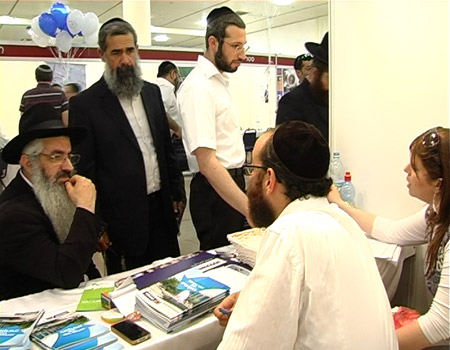
Chareidim at a recent job fair in Yerushalayim
Chareidim in Israel find themselves victims of derision, if not outright hatred by the secular public. They are seen as parasites of society, who collect taxes and social benefits, while refusing to work or serve in the armed forces.
But people often fail to consider just how challenging Chareidi life can really be. You're expected to learn full-time for years on end. It sounds easy, but try it. What if you're either not good at it, or you just don't like learning full time? You also can't really get a secular education, because society - that you love - has rejected it as treif. And, because you didn't serve in the army, you can't really work either.
In addition, Chareidim have large families, and while Chareidim truly live very frugal lives, groceries in Israel cost a lot of money. Moreover, Chareidim often buy meat, produce and other products that have only the best hechsherim, which are always the most expensive. (The chicken I buy is regularly 10 shekel per kilo for a whole chicken - I learned to cut up whole chickens very soon after we arrived in Israel; A chicken with a chareidi hechsher would easily cost double that amount. Easily.) Chareidim are expected to buy their children apartments when they marry, and many - probably even a majority, live from month to month by juggling small loans and large debts, paying when they can and borrowing to pay off other loans. And, when things get so large and out of control that there's no way out? That's when you go collecting.
Now, you might not have much sympathy for someone who actively chooses this type of lifestyle. After all, it is a choice. Go out and get a job? Personally, I agree. But it's not that simple. If you're born into this lifestyle, not only is it all that you know, but many, many thousands of Jews find themselves drawn to the insularity, sincerity and religious passion of Chareidi life. It's not as easy to reject your cultural upbringing as we may think.
But things do seem to be changing, ever so slowly. The Nachal Chareidi - the Chareidi brigade of the Israel Defense Forces, while extremely small right now (representing a tiny fraction of Israeli society), is growing and expanding at a surprising rate. Moreover, a recent Hebrew article on Yediot Achronot's website, tells of a recent job fair for Chareidim that attracted 4,000 participants, far outstripping the expectations of the people who organized the fair.
And, as work in the Chareidi world becomes more widespread, it will only continue to grow. After all, until now, even if a Chareidi wanted to work, he might refrain from doing so for fear of ostricization on the part of his community. But, as more Chareidim find gainful employment and remain integral parts of their communities, their friends and neighbors will begin to wonder, "Why am I killing myself mired in thousands of shekel of debt, while my friend and neighbor is able to support his family and remains an honored and respected member of my community?" Good question.
This is not, by any means, a suggestion that the Chareidi lifestyle is going anywhere. Far from it. I actually think that Chareidim working will strengthen their community, making a Chareidi lifestyle a viable, livable option for the next generation. But, as more Chareidim enter the workforce, they will begin to not only integrate into society in small and large ways, but also influece the people that they work with, bringing us all a little closer to the Torah that they hold so dear.

Sunday, July 24, 2011

Aliyah and a Free Jewish Education

YNet recently ran a story about people who it says are making aliyah in order to save money on Jewish education. The subhead reads, "With Jewish school tuition fees per child reaching $20,000 a year, many families prefer to make aliyah and get free education. We met some of them onboard Nefesh B'Nefesh flight carrying 250 new olim to Israel."
I'm not sure that the headline is totally accurate. When you actually read the piece, you see that people didn't really make aliyah just to save money on day school tuition, which is smart, as I will explain. Rather, they say that it's one of many factors which push them to finally make the decision to come on aliyah. I notice this phenomenon a lot in the press - headlines that are designed to draw attention, which turn out to be less than accurate. I get the feeling that they're getting tired of writing the same "Nefesh B'nefesh Brings Jews to Israel" article five times a summer, and just needed a new angle. But I digress...
I often think about committed Orthodox American Jews who really struggle to meet the suffocating demands of day school tuition. I wonder how they do it. Just in my own family, my sister and brother-in-law both have great jobs, work hard, make decent salaries, and literally live hand to mouth. True, they have over the years built a nice home. But they certainly don't live high off the hog. They're paying for day school, seminary, yeshivot, and also trying to save for (God willing) weddings as well. It just seems crazy that they work as hard as they do, and have so little savings to show for it.
From this vantage point, aliyah seems like a sensible alternative. After all, isn't public school education in Israel free?
Let's set the record straight: It's not free, at least not for us. And while the prices would seem like a joke to Americans paying U.S. tuition prices, they're not as simple as they seem.
Basic public school in Israel really is free. It's public school, and I get a certain degree of pleasure just knowing that my children learn chumash, tefillah, dinim, and all the other regular, normal Jewish subject in public school. But...
1. There are fees for trips, books and other things that are not included, for which we pay.
2. The school in Yad Binyamin is what's called a ממלכתי דתי תורני - or for short, a ממ"ד תורני - "Mamad Torani" - a Torah-oriented public school. Our children have several more hours in Torah than regular public school kids, and someone's got to pay for those hours. The local Moatzah pays some (because our mayor feels that it's in the municipality's interest to have an "upgraded" school - to which I agree), but we pay the rest. It comes out to about 1,500 shekel for a grade-school age child per year. Yes, I know it's not a lot. That's the good part.
3. Once your child hits seventh grade, the hours in school shoot way, way up. Someone's got to pay for those hours, and that someone is basically you. Tuition for my son going into seventh grade is about 7,000 shekel for the year, not including the lunch program.
4. In high school, it goes even higher. We kept our oldest son local, but the yeshiva insists that all students dorm twice a week and stay in the yeshiva for Shabbat once a month. Total cost, about 11,000 shekel per year, and 14,000 at least if you don't live in the Moatzah. If you live in the States, I know what you're thinking: 11 thousand divided by 3.5 shekel per dollar comes to...about $3,000 dollars for high school tuition per YEAR? That's nothing! True, it might be if we were earning an American salary. But we're not. We earn Israeli salaries.
That's not to say that it's undoable. Thank God, I'm pretty sure that we're OK for next year. The schools also help people out if they can't meet the tuition needs, and I don't think that the scholarship process is nearly as draconian as it is in the States now. But it's not free. (Health care, on the other hand, which is really quite good here, is actually next to free. But that's a totally different post.)
Let me be clear. I'm very much in favor of aliyah. I even did it myself. Contrary to what many people said (and perhaps think and hear) about the education system in Israel, while it has problems, I think that our kids' education thus far has been excellent. Truly.
But there are far better reasons to move to Israel than to save money on day school tuition. Like the fact that God wants all the Jews to live here. Like the fact that it's really a Jewish country, which caters to the unique way of life that the Torah demands. Like the fact that there are many, many more kosher restaurants here than even in Teaneck (although Teaneck does indeed have some good ones). Did I mention that God wants the Jews to live in Israel?
But I wouldn't make aliyah to do better financially. It's not simple here, and people really do struggle to make ends meet.
In the end, though, if you're going to struggle to make ends meet and keep your kids in Jewish Day school - which it seems like most Orthodox Jews in Amerca do, isn't it better to do struggle in the Land of Israel?

Friday, July 22, 2011

Eim Habanim Semeichah Shiur 28 - The Munkatcher's Mistake

Audio Shiur:
Eim Habanim Semeichah Shiur 28 - The Munkatcher's Mistake
(This shiur studies the classic work of Rav Yissachar Teichtal on the importance of settling the Land of Israel, following the Hebrew text with English translation.)

Rav Teichtal finds himself in a huge bind. As a devout Munkatcher Chasid, he himself considers every word of his rebbe as holy and binding. But the rebbe was against supporting building the Land of Israel. How does he deal with this difficult cognitive dissonance?

Click here to download the shiur, or here to navigate to the shiur on YUTorah.org.


New! Now you can subscribe to this shiur as a podcast, directly from iTunes! To subscribe, click here.

Eim Habanim Semeichah Shiur 27 - The Benefits of Nationhood

Audio Shiur:
Eim Habanim Semeichah Shiur 27 - The Gradual Process of Redemption
(This shiur studies the classic work of Rav Yissachar Teichtal on the importance of settling the Land of Israel, following the Hebrew text with English translation.)

Nu? What's taking so long? A better question is, does the redemption we think that we're experiencing match the redemption that we expected? If not, what did we really expect? And was that a realistic expectation?

Click here to download the shiur, or here to navigate to the shiur on YUTorah.org.


New! Now you can subscribe to this shiur as a podcast, directly from iTunes! To subscribe, click here.

Audio Shiur: Parshat Matot - My Needs, or Our Needs

Audio Shiur:
Parshat Matot - My Needs, or Our Needs

The issue of selflessness vs. selfishness arises several times over the course of Parashat Matot. It's also a great subject to discuss at the beginning of the three weeks, as we look for ways to improve during this difficult period for the Jewish people.

Click here to download the shiur, or here to navigate to the shiur on YUTorah.org.


Now you can subscribe to this shiur as a podcast, directly from iTunes! To subscribe, click here.

Thursday, July 21, 2011

Happy Aliyahversary To Us!

No, it's not our wedding anniversary. Rather, this is the day that we celebrate our three year Aliyahversary. That's right, three years ago, a bleary-eyed Spolter family arrived in boiling hot Yad Binyamin with a bunch of luggage, and a dream...to get some sleep. Last night, the family celebrated with a steak dinner (I think it's the first time that I bought steak here), and we spoke about the things that we love about living in Israel.

So, how's it going? All in all, terrific. Note that I did not say easy. It's certainly not easy, and not nearly as easy as it would have been staying the course in the USA. But we have a great deal to be thankful for:

Financially, we're doing OK, (thank God!) having been fortunate to find work that we enjoy. But that has come with a willingness to change, adapt, and do things that we didn't ever think we'd be doing. This is not to say that we don't miss our old jobs. It's hard to give up what you loved doing and what you think you were really good at. But we made a choice to move to something new, and change is never easy, and comes with a price. Even after three years.
The Kids, excited for the flight, three years ago
Socially, we've found some level of acclimation in Yad Binyamin, which is a really great place. We've met great people, both Israeli and Anglo. But, truth be told, I feel somewhat betwixt and between: on the one hand, we've gotten to know a bunch of wonderful Israeli families. At the same time, we're just different. We're Anglos, and nothing we can do will ever change that. We're Olim, and always will be, and it can be challenging to know that as successful as you'll be (and we feel that we are successful), you'll never be a native. It's just a fact of life that we didn't understand as fully as we do now, but accept so that our children won't have this struggle. Some choose to live in very Anglo areas like Ra'anana or Beit Shemesh, and they never really feel like outsiders, as they're not trying to enter into Israeli society. We've chosen a different path, which entails a greater sense of alienation. One is not better than the other; both have costs and benefits, and each oleh must find his or her place here in Israel.

Same kids (+1), last Yom Kippur
Kids-wise: The kids are really doing great. Most acclimated to Israel almost immediately, but for some the second year was light-years different than the first. They're fully integrated into the Israeli school system, and while it's of course not perfect, we're really, reallly happy with our childrens' education thus-far. We also added a beautiful daughter (our only Sabra) who needs no integration.

The Gemara tells us that it takes three years to make a Chazakah on a place. Truth be told, I don't miss the United States per se. I listen to American talk-radio (mostly sports) online. I miss the people: our family, the close friends we made in Michigan, and I also miss the reasonably-priced vacations during the summer. I also miss watching NFL football - not that I watched it that much back home. (I'm just too cheap to pay for an online subscription.) But I cannot remember a time that I wished I was back in the States.
I feel truly blessed to be raising my family in Eretz Yisrael; I feel blessed to have acclimated as much as we have. I feel blessed to have the opportunities that I've had over the past three years, and often see the hand of God guiding us on this crazy journey. And I pray that He will give me the wisdom and serenity to continue to handle the inevitable struggles that will come unexpectedly, and to always see the great blessings that I have.

Happy Aliyahversary!

Tuesday, July 19, 2011

Judaism and Liberalism: Never the Twain Shall Meet?

In Israel, the inherent clash of values that the Jewish State grapples with manifests itself on an almost daily basis. This question of religion vs nationality and democracy vs faith goes to the core of so many of the ongoing debates in Israeli society. But, as more and more American Jews grow increasing culturally assimilated in Western modes of thought, it seems clear that many Jews now grapple with this issue on an internal level as well.
Writing in the Forward, a JTS student named Benjamin Resnick writes about the larger meaning of the alienation of liberal Jews from Israel. He says,
The fact is, liberal commitments and traditional Jewish commitments are in many ways incompatible. They conceptualize political freedom differently, civic responsibility differently, personhood differently and nationhood differently. The American political tradition, emerging from thinkers like John Rawls and Isaiah Berlin, generally construes political freedom as freedom from our fellow citizens (that is, as long as we don’t hurt anyone, we can more or less do as we please). But Jewish tradition, with its robust emphasis on norms of tzedakah and communal obligation, takes a more communitarian approach.
So, Judaism and American liberalism inherently clash in terms of their underlying values. He's right about this: Judaism doesn't promote the same level of personal freedom as does Western society. The Torah demands that the courts system punish people who sin publicly against God, without harming a fellow human being. Most of the sins for which a violator recieves the death penalty are מצוות בין אדם למקום - commandments between man and God, including violating Shabbat and worshipping idolatry. Can we even imagine the reaction of the Western world (and most of American Jewry) if a Beit Din even tried to enforce the halachah as passed down through the Gemara? Resnick continues,
And whereas American political life pushes us to construct our civic identities around such phrases as “I am” or “I want,” the Zionist tradition pushes us to construct those same identities around phrases like, “We need.” Good fences may indeed make good neighbors, but they make it a lot harder to construct an eruv.
(Just as an aside, if you've ever been involved in eruv construction, he's totally off the mark. Good fences make great eruvim. Bad or no fences make it a lot harder to construct an eruv. But I digress.) This point I find truly troubling. If I understand him correctly, he's saying that liberal thinkers struggle to identify with Judaism because it demands that they think of the klal before they think of themselves. This might be true, but is it a good thing? Wouldn't a liberal Jewish person reject this tenet of liberalism instead of advocating a "me-first" attitude?
Jews have, with good reason, been fierce proponents of liberal democratic states throughout history. But from the perspective of American civic participation, the communitarian, tribe-centered approach of both the religious Jew and the committed Zionist is a very radical notion. The ritually observant Jew commits herself to a life that separates socially, visually and physically from the surrounding world. And the liberal-minded Zionist, who is deeply, genuinely concerned about the welfare of the Palestinians and the fundamental “fellowship of man,” nonetheless affirms that the Jewish democratic state must maintain a Jewish majority and a “Jewish character.”
And for my liberal-minded rabbinic colleagues — most of whom hold full participation in both ritual Jewish life and American civic life as high, religious values — this tension is particularly poignant.
Basically, liberally educated Jews have been so infused with their sense of liberalism that the underlying values of Judaism - separatism, tribalism (i.e. peoplehood), and care for each-other first - now seem foreign to them. In essence, their rabbinic training contradicts the American values that they lived for the first twenty years of their lives. Then, they get to seminary and learn that rather than being all-inclusive, Judaism advocates that we be a nation that "Dwells alone." They get to Israel and find a country which strives to maintain both a Jewish character and a Jewish demographic majority, which is an insult to the American values they hold so dear.
I agree with Resnick and find his article well-written but alarming. If the rabbis of the next generation are themselves alienated from the underlying values of traditional Judaism, what about their parishiners? Of even greater concern is the fact that rather than change their core ideals to match traditional Jewish values, they will simply redefine Judaism. They will create a religion of ritual devoid of a notion of peoplehood or separateness. (see early Reform Judaism). They will insist that Judaism need not distinguish itself from other religions. They will insist that the rights of Palestinians supercedes the need to maintain a Jewish State. And, rather than bringing their flock closer to God, they will only be driving them farther away from God and His Chosen people.
Tragically, this will only hasten the almost total complete assimilation of American (non-Orthodox) Jewry that seems to have already snowballed out of control.

Friday, July 15, 2011

The Techelet Controversy 2 - An Email, and My Response

Continued from this post.

I received the following email from a very close acquaintance, who wrote,
A few points to ponder:
1. The title Godol is not one bestowed upon "little" people (no pun intended). a "Godol" is a "Godol B'Torah" and they are called that because they no more Torah and have greater insight into the Torah than the rest of us. If all of the Gedolim do or don't do something that IS reason enough for us to do or not do that thing - end of discussion. If there was merit to the opposing view then at least ONE of the Gedolim would do it. Since there is plenty of machlokes in the Torah world and many opposing views within Halacha (note how long the Gemmoroh is - without opposing views Artscroll woudl be out of business). IF a Godol felt strongly about something he WOULD do it. The fact that none of them wear techeiles IS enough of a reason not to do it. I won't go into all the Torah sources for mimiking the behaviour of the Gedolim - nor will I invade the privacy of their bedroom, but it IS in our best interest to follow their lead.
2. You wrote that it's ok to have the color of the tzitzis match the color of the beged and therefore it's ok to have techeiles. I saw your talis and it's not blue, nor are all of your tzitzios...
3. There is a price to pay for going against the accepted "tide". It has become fashionable to do that and that helps destroy the fabric (again, no pun intended) of the community. Bnai Yisroel were lauded for very few things when they were in Mitzrayim - not changing their clothing to follow some new "trend" be it Egyptian or "new age" was one of the them. We are who we are and we are that way because we steadfastly cling to what is handed down to us. Minhag Avosaynu B'yadeinu is not limited to holding an extra day of Chag in CHU"L. Remember the adage - change your Minhag and you're gong to Gehenam - both words may have the same letters but very different outcomes.
I responded to him (and you, as follows)
Dear (Very close Acquaintance),
First and foremost, thanks for your thoughtful response. As you can see, I'm pretty passionate about this issue, and I can see that you are too. All the better.
I'd like to post your response to me - and my answers to you on the blog. If you give me permission, I'll do it with your name, and if not, I'll do it anonymously.
I'll respond to your points one by one:
1. Of course we look to Gedolim for guidance and leadership. But I think that today this has gotten out of hand, to the point that we won't even try and perform a mitzvah unless the gedolim do it. Sometimes gedolim, as great as they are, make mistakes. (see Eim Habanim Semeichah on the position of the Gedolim that advised, and even forbade Jews from moving to Israel. He has very harsh things to say.) But more to the point, I don't think that Judaism was ever meant to be a religion where we only do things that gedolim do. I'm not talking about issur; moreover, gedolim don't say (generally) not to wear techelet; they don't do it themselves. When did the fact that great rabbanim don't do something make it assur?
Secondly, you should know that Rav Tal, Simcha's Rosh Yeshiva, as well as Rav Hershel Schachter of YU do wear techelet. Rav Tal is not my Rav, and I don't ask him questions, but Rav Schachter is certainly someone I consider a rav of mine, and I have and do ask him shailot. Are they "great" enough to rely on?
2. Regarding the color of the beged: the mishnah berurah says that it's a hiddur of zeh keili v'anveihu to have the tzitzis be either white, or the color of the beged. but al pi din, they can really be any color you want. Am I willing to give up the hiddur of all white for the chance to fulfill a d'orayta. You betcha.
3. Regarding לא שינו את מלבושם - this is really a ridiculous argument. Is it really "trendy" now to want to fulfill דאורייתות? For years and year, people wore תפילין דקות. Why? Because they didn't have the technology to properly make גסות. When someone finally figured out how to do it well, why didn't the whole world say, "you know what, we've got a minhag that we don't want to give up"? Because גסות are better. They're a hiddur. Go check your father or grandfather's tefillin. They didn't have גסות. But you do. And I do. Isn't that the abandonment of a minhag that will lead us all to gehenim? Of course not! It's an attempt to fulfill a mitzvah in a more special and appropriate manner.
And to suggest that putting techelet on our clothing is some trend, and that we're abandoning the principle of שלא שינו את מלבושם represents nothing less than a complete bastardization of the midrash. I can tell you one thing: this morning, when you said ונתנו על ציצית הכנף פתיל תכלת, you knew with absolute certainty that despite the fact that you're saying the words, and you know God wants you put that blue string on - you're still not doing it. When I say the very same words, I think, "You know, there's a chance that I'm actually doing what הקב"ה wants in this one area." And instead of thinking about bucking trends and changing minhagim, I feel lucky - fortunate about the fact that I live in a time when we've been given the gift of being able to fulfill this mitzvah once again.
And I feel pretty good about that.